
Ancient Nutra Wellness Team · 2 August 2026 · 5 min read
How to build a 30-day evening ritual around one herb
- Thirty consistent evenings beat ninety scattered ones, because a herb taken at random hours gives the body no pattern to respond to.
- The ritual is six steps and about four minutes of hands-on time, tied to something that already happens every night.
- Thirty days tests whether the habit survives. The published ashwagandha trials run 60 days at 600 mg daily, so day 30 is a checkpoint, not a verdict.
- One skip rule matters more than any step: on a bad night, take the capsule and drop the rest.
Most herb routines fall apart in week two. Not because the herb stopped working, but because nothing in the evening ever changed enough for the herb to slot into. A capsule swallowed at a random hour, remembered some nights and forgotten on others, is not a routine. It is a series of unrelated events. A ritual fixes that by tying the herb to a fixed time, a fixed room, and a physical action that already happens every night. What follows is the thirty-day version: six steps, roughly four minutes of hands-on time, one herb, and a clear rule for the nights it collapses.
The ritual, step by step
- Pick one end-of-day marker and never change it. Locking the front door, rinsing the last plate, switching off the kitchen light. It has to be something that already happens every single night without effort, because the marker, not motivation, is what carries the ritual through week three.
- Move the bottle to where the marker happens. If the marker is the kitchen light, the bottle lives on the kitchen counter, not in a bedroom drawer. Distance is the single most common reason a nightly capsule quietly stops being nightly.
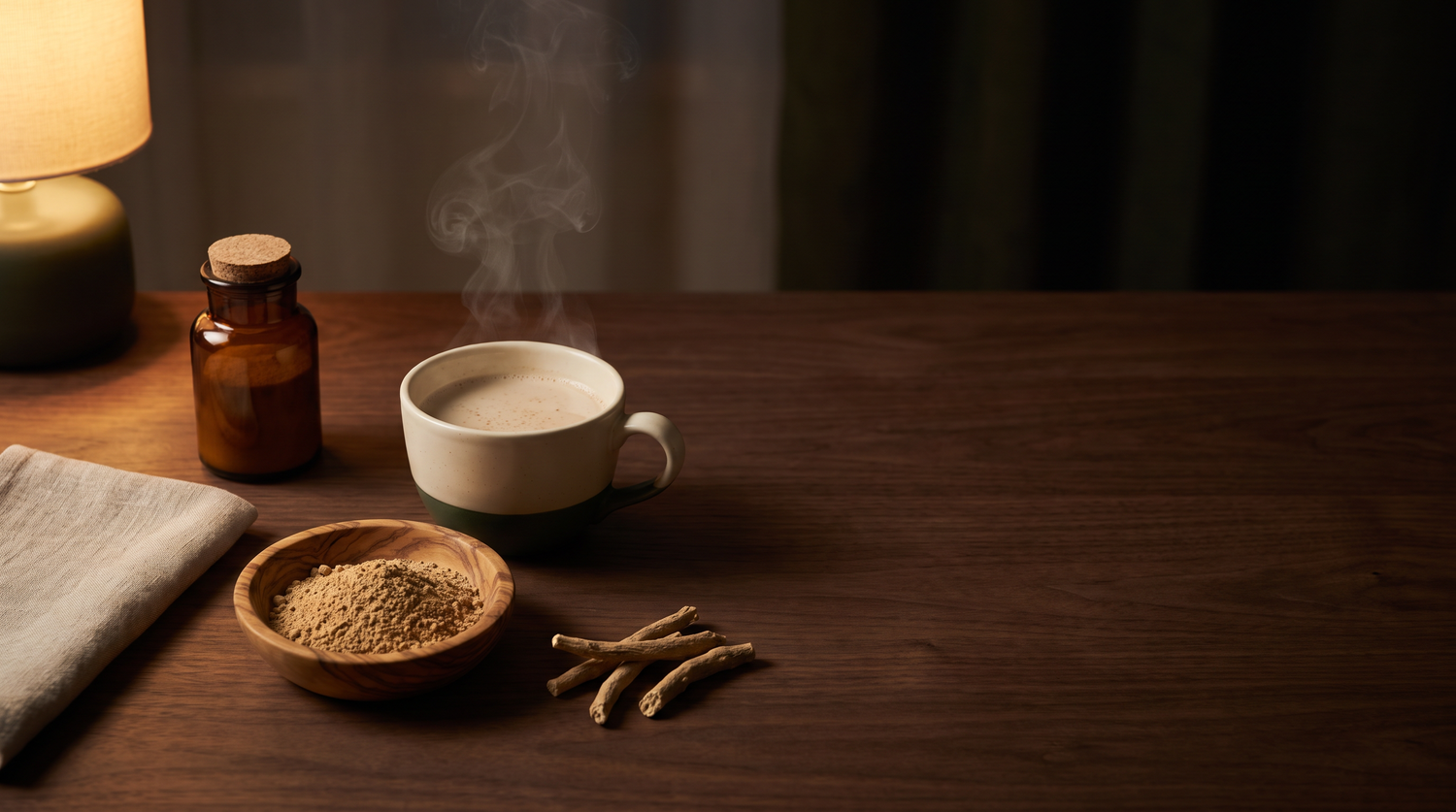
- Take the daily serving of Ancient Nutra's Ashwagandha with a warm drink. Warm milk, warm water, or a plain herbal tea. The warm drink is not decoration. It slows the next ninety seconds down, which is what turns swallowing a capsule into a marked moment.
- Drop the main lights immediately after. Overhead lights off, one lamp on. This step costs nothing and does more for the evening than the previous two combined, because bright overhead light late at night keeps the body in daytime mode.
- Give the next forty minutes to something with no screen in it. Stretching, tidying one surface, a shower, a paperback, a conversation. Forty minutes is long enough to matter and short enough to survive a normal week.
- Mark the day on paper. A tick on a wall calendar or a page in a notebook. Not an app. Seeing an unbroken row of thirty ticks is the mechanism that gets most people past day 12, which is where these things usually die.
The actual hands-on time is around four minutes. Everything after step four is time already being spent, just spent differently.
Why thirty days is the honest number
Thirty days is not where ashwagandha finishes its work. It is where the habit proves it can survive contact with a real life. The distinction matters, because most people quit an adaptogen for reasons that have nothing to do with the adaptogen.
The research is fairly clear on the timeline. In a randomised, double-blind, placebo-controlled trial of 64 adults under chronic stress, 300 mg of full-spectrum ashwagandha root extract taken twice daily for 60 days reduced serum cortisol by 27.9 percent, against 7.9 percent in the placebo group (Chandrasekhar et al., Indian Journal of Psychological Medicine, 2012). A later systematic review pooling five randomised trials and 400 participants found the effect on sleep was clearest at doses of 600 mg per day or more, taken for eight weeks or longer (Cheah et al., PLoS One, 2021).
Read those two numbers together and the thirty-day frame makes sense. Sixty days is where the herb is being tested. Thirty days is where the ritual is being tested. If the ticks on the calendar are unbroken at day 30, the second month is close to automatic and the herb finally gets the run it needs. If the row is full of gaps, the honest conclusion is not that ashwagandha failed. It is that the ritual was built around the wrong marker, and the fix is step one, not a different bottle.
Treat the second month as a run, not a permanent habit. A sensible pattern is eight to twelve weeks, then a break, and longer stretches only under a doctor's oversight. The NIH LiverTox database (Withania somnifera, likelihood score B) documents liver injury with onset between two and twelve weeks of use, usually a cholestatic or mixed pattern with jaundice and itching (NIH LiverTox).
Check with a doctor first if you are pregnant or breastfeeding, or take thyroid medication, sedatives, or immunosuppressants. Stop and seek medical attention if you notice yellowing of the eyes or skin, itching, dark urine, persistent nausea, or unusual tiredness.
When to run it, and when to skip
Aim for 60 to 90 minutes before the intended bedtime, at roughly the same clock time each night. Within half an hour either side is close enough. Ashwagandha is not a sedative and does not need to be timed to the minute, but the ritual around it does need a predictable slot to occupy.
The skip rule matters more than perfect timing. On the night the flight lands late, the dinner runs long, or a child is unwell, take the capsule with a glass of water and drop the other five steps entirely. A shortened ritual keeps the streak alive. An abandoned one restarts the count, and restarting is what most people never recover from. Run it every night including weekends, because the weekend nights are precisely the ones that break an otherwise solid weekday habit.
Look for
For a nightly routine, look for whole-root ashwagandha in a plain capsule, with the botanical name (Withania somnifera), the plant part, and the serving size stated on the label. Ancient Nutra's Ashwagandha is a 60-capsule pack, which is two full thirty-day runs from one bottle and removes the mid-month reorder that quietly ends most streaks.
When there is no ashwagandha in the house yet
Start the ritual anyway. The six steps have independent value, and beginning them on the night the idea arrives is worth more than beginning them perfectly next week.
For the herb itself, the other format works fine. Half a teaspoon of Ancient Nutra's Ashwagandha powder stirred into the warm milk in step three does the same job, with a bitter, slightly malty taste that milk and a pinch of cinnamon handle well. The capsule is more elegant on a weeknight and easier to keep consistent, but the underlying compound does not care which one it arrives in. The trade-offs between the two formats are set out in this comparison of ashwagandha powder and capsules.
The bottom line
A thirty-day evening ritual does one thing: it gives a herb a fixed slot in a life that otherwise has none, and it does that in about four minutes a night. Commit to the thirty ticks before judging anything, keep the skip rule handy for the nights that go wrong, and treat day 30 as the point where the habit is proven and the second month, the one the research actually studied, can begin. Most of the common early mistakes are covered in this guide to starting a daily supplement routine, and they are worth reading before night one rather than after night twelve.

Ashwagandha, 60 capsules
Whole-root ashwagandha in a plain daily capsule, sized for two full thirty-day runs.
Shop AshwagandhaSources and further reading
- Chandrasekhar K, Kapoor J, Anishetty S. A prospective, randomized double-blind, placebo-controlled study of safety and efficacy of a high-concentration full-spectrum extract of ashwagandha root in reducing stress and anxiety in adults. Indian Journal of Psychological Medicine, 2012.
- Cheah KL, Norhayati MN, Husniati Yaacob L, Abdul Rahman R. Effect of Ashwagandha (Withania somnifera) extract on sleep: a systematic review and meta-analysis. PLoS One, 2021.
Written by the Ancient Nutra Wellness Team. The team researches, sources, and tests every ingredient before it earns a place in an Ancient Nutra blend. Questions? Email info@ancientnutra.com or message Ancient Nutra on Instagram.
Medical disclaimer: This article is for educational purposes only and is not medical advice. Statements have not been evaluated by the FDA. Ancient Nutra products are not intended to diagnose, treat, cure, or prevent any disease. Speak with a qualified healthcare provider before starting any new supplement, especially if you take prescription medication or have a medical condition.