
By the Ancient Nutra Editorial Team · Published 11 September 2026 · 6 min read
- September is the last month of Sri Lanka's southwest monsoon, and wet evenings are where small habits add up: dry feet, no standing water, a room that can breathe.
- In one small trial, 13 of 90 people whose feet were chilled reported a cold within five days, against 5 of 90 who were not, so getting out of wet shoes first is a cheap habit worth keeping.
- The Shield Shot and a warm Ceylon cinnamon cup are the comfort end of the routine, not armour: one shot a day at most, on a bounded course with a break.
The rain usually arrives right when everyone is heading home. You walk in with wet shoes, a damp bag and an umbrella dripping on the floor, and the evening starts from there. What you do in the next hour is not dramatic. It is a handful of small moves that keep your feet dry, your house dry and your routine steady through the wet weeks. Here is the version the team at Ancient Nutra would hand a friend: six steps, about 20 minutes of hands-on time, built around one shot and one warm cup.
Know what the wet weeks change
Sri Lanka's southwest monsoon runs from May to September, so this month is the tail of it. The second inter-monsoon rains follow in October and November. Researchers studying dengue in Sri Lanka note that the country's two yearly dengue peaks line up with the two monsoon seasons, May to September and December to February.
At home, the wet weeks change three things. You come in soaked more often. Water collects in anything left outside, and the mosquitoes that spread dengue breed in exactly that kind of water. And the house stays damp, because clothes dry slowly and windows stay shut against the rain.
The daytime basics, such as sleep, handwashing and what zinc can and cannot do, are covered in the team's guide to monsoon habits that lower your odds of getting sick. This piece picks up where that one stops: at the front door, in the evening.
Run the wet evening in six steps
- Get out of wet shoes and socks first. Before the kettle, before the phone. Dry your feet properly, between the toes too, and change out of damp clothes. The evidence here is small but interesting: in a UK trial of 180 healthy adults, 13 of 90 people given a foot chill reported a cold over the next four to five days, against 5 of 90 who were not chilled (Family Practice, 2005). It was one study with self-reported symptoms, so treat it as a nudge, not proof. Dry socks cost nothing.
- Walk round the outside of the house before dark. Tip out anything holding rainwater: buckets, plant saucers, old tyres, coconut shells, a blocked gutter. The mosquitoes that spread dengue are active during the day and breed in standing water, and the World Health Organization advises emptying and cleaning water containers every week. The evening, while you are home and it is still light, is the easy time to do it.
- Let the house breathe. Hang wet clothes, towels and umbrellas where air moves, on a verandah or near an open window with a fan running, not folded into a closed bedroom. Wipe condensation off the window sills and check behind wardrobes for the first grey spots. The World Health Organization's review of damp homes found that people living in damp or mouldy buildings are at higher risk of respiratory symptoms, respiratory infections and worsening asthma (WHO, 2009).
- Take one Shield Shot, if it is your shot for the day. Shake it, open it, and drink the 30 mL straight. Ancient Nutra's Shield Shot is a ready-to-drink turmeric and ginger shot at 3.3 kcal, and the serving is one a day. If you already take it in the morning, as in the team's morning Shield Shot ritual, skip it here rather than doubling up. Be clear about its job: it is a steady cue in the routine. No turmeric or ginger drink has been shown in people to stop you catching a cold.
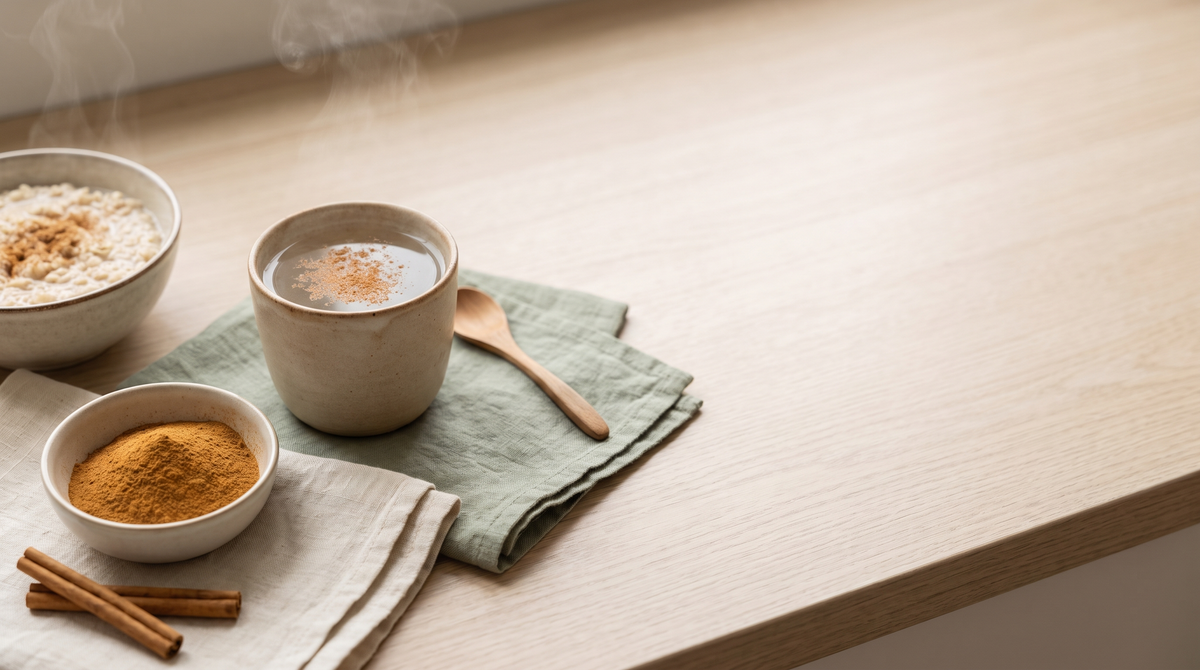
- Make one warm cinnamon cup. Warm a cup of milk or coconut milk on low heat, whisk in a level teaspoon of Ceylon cinnamon powder, add two crushed cardamom pods if you like, and strain. It has no caffeine, so it will not fight your sleep the way a late cup of tea can. The full method is in the team's evening cinnamon milk recipe, and Ancient Nutra's Cinnamon Powder works well in it. For a spicier cup, try the coconut milk dahl-spice latte instead. A teaspoon in a drink is a kitchen amount, not a supplement dose.
- Put the lights down and keep a bedtime. Close the curtains, dim the room, and aim for the same bedtime each night. Sleep carries more weight in cold season than anything in a cup, and the monsoon habits guide explains why. The routine works best when it ends in bed, not on a screen.
Hands-on time is about 20 minutes, and most of it is the walk round the house and the pot on the stove.
Look for
For the shot, a ready-to-drink serving with the ingredients and the pace printed plainly. Ancient Nutra's Shield Shot lists turmeric and ginger, one 30 mL shot a day, best as an eight to twelve week course with a break. For the cup, look for Ceylon cinnamon (Cinnamomum verum) rather than cassia, which carries far more coumarin.
Keep the wet-evening habits your house already has
Many of the best rainy-season habits in Sri Lankan homes were never written down as health advice. They are simply how a house copes with the rain, and they map neatly onto the first three steps above.
Walk into most Sri Lankan homes on a wet evening and the rhythm is familiar. Umbrellas stand open on the verandah to dry, slippers wait by the door, and damp work clothes are swapped for a dry sarong or house dress before anyone sits down to tea. Nobody calls it a routine. It is the same idea as this one: get dry first, then get warm.
Know when to start, and when to stop
Run the household steps whenever the rain is steady: the tail of the southwest monsoon now, and again when the second inter-monsoon rains arrive in October and November. Standing water and damp rooms do not follow the calendar, so keep those habits going for as long as the wet weather lasts.
The shot runs on its own clock, not the weather's. Its main ingredient, turmeric, is rated by the US National Institutes of Health's LiverTox database as a well-documented cause of liver injury, with most reported cases linked to turmeric supplements (NIH LiverTox). So keep it to a bounded course. It is recommended to take a 1-week break after every 8 to 12 weeks of continuous use. Stop and see a doctor if you notice yellowing of the skin or eyes, dark urine, persistent nausea or unusual tiredness. Skip it if you have a liver condition, are pregnant or breastfeeding, or take regular medication, unless your doctor agrees. The same goes for cinnamon capsules: a teaspoon in a cup is a different exposure from a daily supplement, and capsules deserve a defined run and a break too.
One rainy-season rule matters more than any drink. A sudden high fever during these months can be dengue, and that needs a doctor, not a home routine.
The bottom line
Wet evenings reward small, unglamorous moves: dry feet, no standing water, a room that can breathe and an early night. The Shield Shot and the cinnamon cup are the pleasant part in the middle, one shot and one warm cup, not a shield against the season. Try all six steps for five wet evenings and keep the ones that stick. The Shield Shot 5-pack is sized for exactly that first week.

Five ready-to-drink 30 mL turmeric and ginger shots, one a day. Read the safety note on the product page and keep to a bounded course.
Shop Shield ShotSources and further reading
- Johnson C, Eccles R. Acute cooling of the feet and the onset of common cold symptoms, Family Practice, 2005.
- WHO guidelines for indoor air quality: dampness and mould, executive summary, World Health Organization, 2009.
- Dengue and severe dengue, fact sheet, World Health Organization.
- Faruk MO, Jannat SN, Rahman MS. Impact of environmental factors on the spread of dengue fever in Sri Lanka (includes Sri Lanka's four monsoon seasons), International Journal of Environmental Science and Technology, 2022.
- Turmeric, NIH LiverTox.
- Cinnamon, NIH LiverTox.
Written by the Ancient Nutra Editorial Team. The team researches, sources, and tests every ingredient before it earns a place in an Ancient Nutra blend. Questions? Email info@ancientnutra.com or message Ancient Nutra on Instagram.
Medical disclaimer: This article is for educational purposes only and is not medical advice. Statements have not been evaluated by the FDA. Ancient Nutra products are not intended to diagnose, treat, cure, or prevent any disease. Speak with a qualified healthcare provider before starting any new supplement, especially if you take prescription medication or have a medical condition.