2 September 2026 · 6 min read
Venivel: What the Yellow Vine Is, and What We Actually Know
By the Ancient Nutra Editorial Team
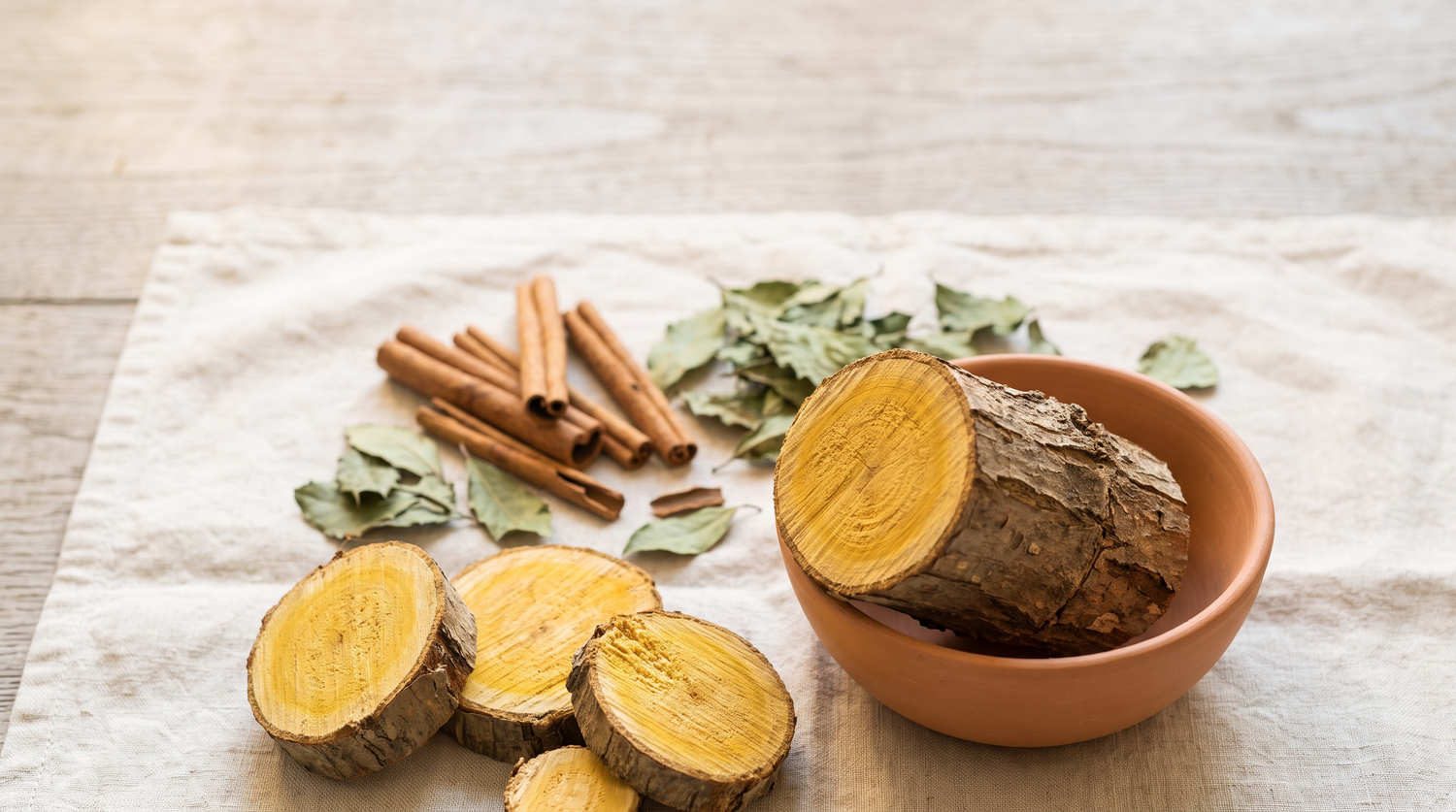
- Venivel (Coscinium fenestratum) is the third herb in Ancient Nutra's Sugar Balance System, alongside Gurmar and Ceylon cinnamon. It is a woody forest liana, and the bright yellow wood is the visible signature of its alkaloids.
- PubMed holds 49 papers on the plant and, filtered for clinical trials, returns zero. There is no published human trial of venivel for blood sugar or for anything else, so this article makes no efficacy claim for it.
- The vine takes about 15 years to reach reproductive maturity, has lost more than 80 percent of its population across India and Sri Lanka, and India banned its export in 1994. Sourcing it responsibly is the harder problem, not marketing it.
Three herbs sit in the Sugar Balance System box, and two of them are easy to write about. Gurmar has a clean controlled trial behind it. Ceylon cinnamon has a whole shelf of them. The third one, venivel, has almost nothing, and the honest thing to do is say so rather than borrow someone else's evidence and hope nobody checks. This is what venivel actually is, what the research base looks like when you count it, and why the most interesting story about this plant is not a health claim at all.
Meet the third herb in the box
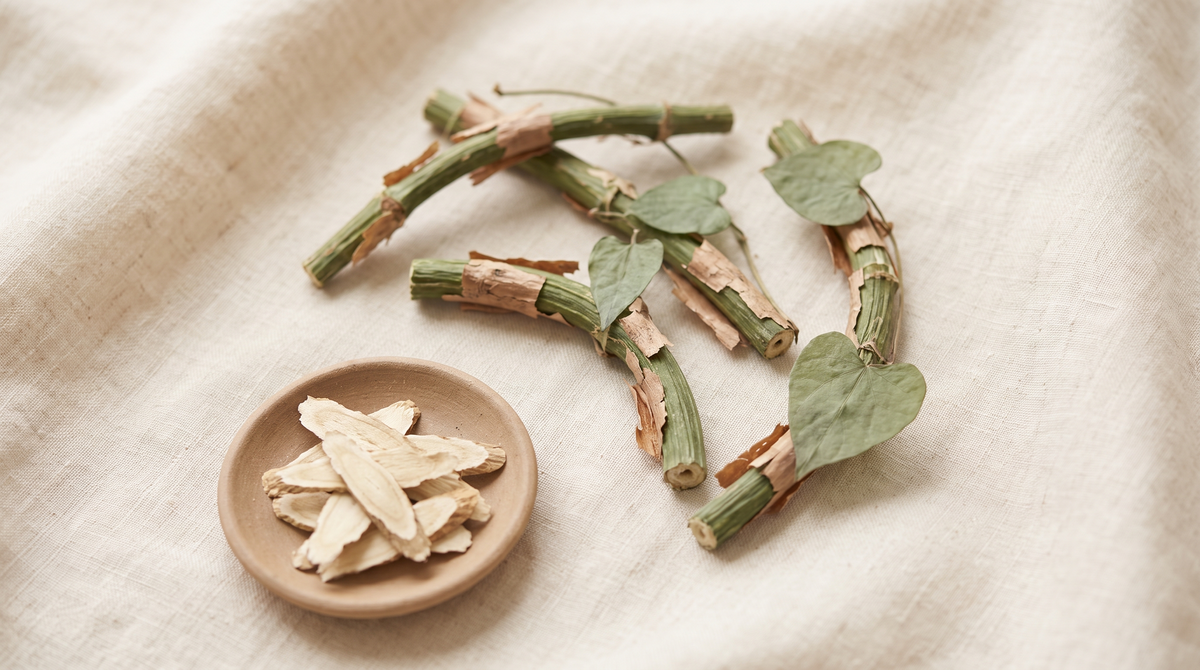
Venivel, also written weniwelgeta, is Coscinium fenestratum, a member of the moonseed family. It is a large woody climbing vine that grows up into forest canopy, and the part used is the dried stem. Cut a section and the inside is a startling saffron yellow, which is where the English names yellow vine and tree turmeric come from.
It is a South and Southeast Asian plant rather than a Sri Lankan exclusive. Recorded occurrences span Malaysia, Indonesia, Sri Lanka, India, Vietnam, Cambodia, Singapore, Laos and Thailand, with the Western Ghats of southern India and Sri Lanka usually described as the two centres of its native range. Calling it purely Sri Lankan would be flattering and wrong.
Sri Lanka does have a long domestic relationship with it. A stem decoction combined with coriander seed is a well established household remedy here for colds and early inflammation, and a 2020 study in Evidence-Based Complementary and Alternative Medicine set out to test that combination. Worth reading carefully: that study was done in rats.
Trace where the yellow colour comes from
The colour is chemistry you can see. The dominant alkaloid in the stem is berberine, with palmatine and jatrorrhizine alongside it. When researchers quantified the two main ones from stem extract, berberine came out roughly thirteen times higher than palmatine. Those quaternary alkaloids are the pigment.
This is exactly where herbal writing usually goes wrong, so it is worth being blunt. Berberine as an isolated compound has a substantial research literature of its own. That literature is not transferable to this plant. The NIH LiverTox monograph on berberine names its source plants specifically, listing goldenseal, Coptis chinensis and three Berberis species, and Coscinium does not appear in it anywhere. A shared molecule is not shared evidence. Whole plant extracts carry different compounds at different ratios, and the studies that exist were run on the isolate, not on venivel stem.
Read the evidence honestly
Here is the count, and anyone can repeat it in about thirty seconds. A PubMed search for Coscinium fenestratum returns 49 records. Apply the clinical trial and randomised controlled trial filters to the whole genus and the result is zero. The case report filter also returns zero. NCBI Bookshelf, which hosts the NIH LiverTox database, has no entry for the plant at all.
What does exist is preclinical. Two 2005 papers in Journal of Ethnopharmacology and Evidence-Based Complementary and Alternative Medicine reported effects of an alcoholic stem extract on glucose handling in streptozotocin induced diabetic rats. There is also a Sri Lankan cross-sectional survey from 2015 recording which household ingredients people with diabetes believe help them, which measures belief and usage rather than outcomes. That is the blood sugar evidence base for venivel in full: rodent work and a survey.
The toxicology is thin and, awkwardly, inconsistent. A 2006 paper in Food and Chemical Toxicology reported reduced neuron density in rat brain regions after 14 days of oral extract, and its authors described the available safety data on the plant as very limited. A 2007 study found no mortality at a single very large oral dose and no major adverse effects over 90 days in rats, while explicitly calling for chronic toxicity testing. A 2004 rat study on liver injury found the extract protective rather than harmful. Those three do not add up to a settled picture in either direction. Thin and contradictory is the accurate summary, and it is neither a warning nor a reassurance.
None of this makes venivel worthless. It makes venivel untested. Those are different words and Ancient Nutra is not going to use the second one as if it were the first.
Count the years it takes to grow one
The strongest documented story about venivel is not clinical. It is agricultural, and it is uncomfortable.
The plant is dioecious, meaning male and female flowers grow on separate individuals, and a 2024 paper in Molecular Biology Reports notes it takes roughly 15 years to reach reproductive maturity. A slow growing forest liana that needs both sexes present and a decade and a half before it can reproduce is close to a worst case profile for wild harvesting, because the harvest is the stem.
The consequences are on record. The 2015 global IUCN assessment lists the species as Data Deficient, which means the fieldwork to categorise it properly has not been done rather than that it is safe. Regional assessments are far less ambiguous. A population decline exceeding 80 percent across India and Sri Lanka is attributed to unregulated harvesting and habitat loss, a 2008 review in the Journal of Plant Sciences records the species as Critically Endangered in Karnataka, Kerala and Tamil Nadu and Vulnerable in Vietnam, and India formally banned its export by trade notification in 1994.
For anyone selling a herbal product, that is the part that should govern behaviour. Cultivated and traceable stem material matters here more than it does for a fast growing leaf crop, and demand created faster than propagation can answer it is a real cost to a real forest.
Know what is actually in the box
Worth stating plainly, because it is frequently described wrongly: Ancient Nutra's Sugar Balance System contains Gurmar, Ceylon cinnamon and Venivel, three full size bottles, plus three bonus Shield Shots. It does not contain bitter melon and it does not contain fenugreek.
Of the three, the trial evidence sits with the other two. Gurmar has a randomised double blind placebo controlled trial at 600 mg per day running 12 weeks. Ceylon cinnamon has considerably more, and the pooled reviews report effects clustering at durations of about two months or less. Venivel has no human trial to bound at all, which is precisely why no duration or benefit is claimed for it here. For how the three are actually taken across a day, Ancient Nutra's guide to running the Sugar Balance System walks through the schedule, and four blood sugar herbs ranked by evidence compares the strength of the research behind the common ones.
Take what the label says and no more. Anyone taking metformin, insulin or any other blood sugar medication should speak to their doctor before starting, because Gurmar and cinnamon can add to the effect of those medicines. This matters locally: the Sri Lanka Health and Ageing Study, a nationally representative survey of 6,661 adults published in 2023, found 23.0 percent of Sri Lankan adults living with diabetes and a further 30.5 percent with pre-diabetes, and only 14.3 percent had been diagnosed before the study tested them. A great many people here are managing this alongside prescribed treatment, or without knowing yet that they need to.
Look for
With venivel specifically, look for the species named in full and the plant part stated as stem, since the yellow colour alone is shared with several unrelated plants sold under similar names. More broadly, judge a blood sugar routine by the herbs in it that have actual trials behind them, and treat the traditional ones as tradition. Ancient Nutra's Sugar Balance System lists all three herbs and its serving schedule openly on the product page.
The bottom line
Venivel is a genuinely interesting plant with a genuinely thin evidence file. It has centuries of documented traditional use across South and Southeast Asia, a striking chemistry you can see in the wood, no human trials whatsoever, and a conservation position serious enough that one of its range countries stopped its export three decades ago. Ancient Nutra includes it in the Sugar Balance System as a traditional component and describes it that way, while the measurable expectations for that box rest on Gurmar and Ceylon cinnamon. If that sounds less exciting than the usual herbal copy, it is also the version that survives being checked.

Sugar Balance System
Gurmar, Ceylon Cinnamon and Venivel capsules with three bonus Shield Shots, one month of the routine per box.
Shop Sugar Balance SystemSources and further reading
- Rannan-Eliya RP, et al. Prevalence of diabetes and pre-diabetes in Sri Lanka: SLHAS, 6,661 adults, BMJ Open Diabetes Research and Care, 2023.
- Berberine monograph (source plants and likelihood score), NIH LiverTox, NBK564659.
- Alkaloid profile of Coscinium fenestratum stem, Natural Product Research, 2023.
- Coriander and Coscinium fenestratum decoction, rat study, Evidence-Based Complementary and Alternative Medicine, 2020.
- Antidiabetic activity of stem extract in diabetic rats, Journal of Ethnopharmacology, 2005.
- Subchronic toxicity evaluation in rats, Journal of Ethnopharmacology, 2007, and neuron density findings, Food and Chemical Toxicology, 2006.
- Reproductive maturity and propagation constraints, Molecular Biology Reports, 2024.
- Regional conservation status and the 1994 Indian export notification, Tushar et al., Journal of Plant Sciences, 2008. Global category Data Deficient, IUCN assessment T50126585A50131325 (2015).
Written by the Ancient Nutra Wellness Team. The team researches, sources, and tests every ingredient before it earns a place in an Ancient Nutra blend. Questions? Email info@ancientnutra.com or message Ancient Nutra on Instagram.
Medical disclaimer: This article is for educational purposes only and is not medical advice. Statements have not been evaluated by the FDA. Ancient Nutra products are not intended to diagnose, treat, cure, or prevent any disease. Speak with a qualified healthcare provider before starting any new supplement, especially if you take prescription medication or have a medical condition.