Ancient Nutra Wellness Team · 20 September 2026 · 6 min read
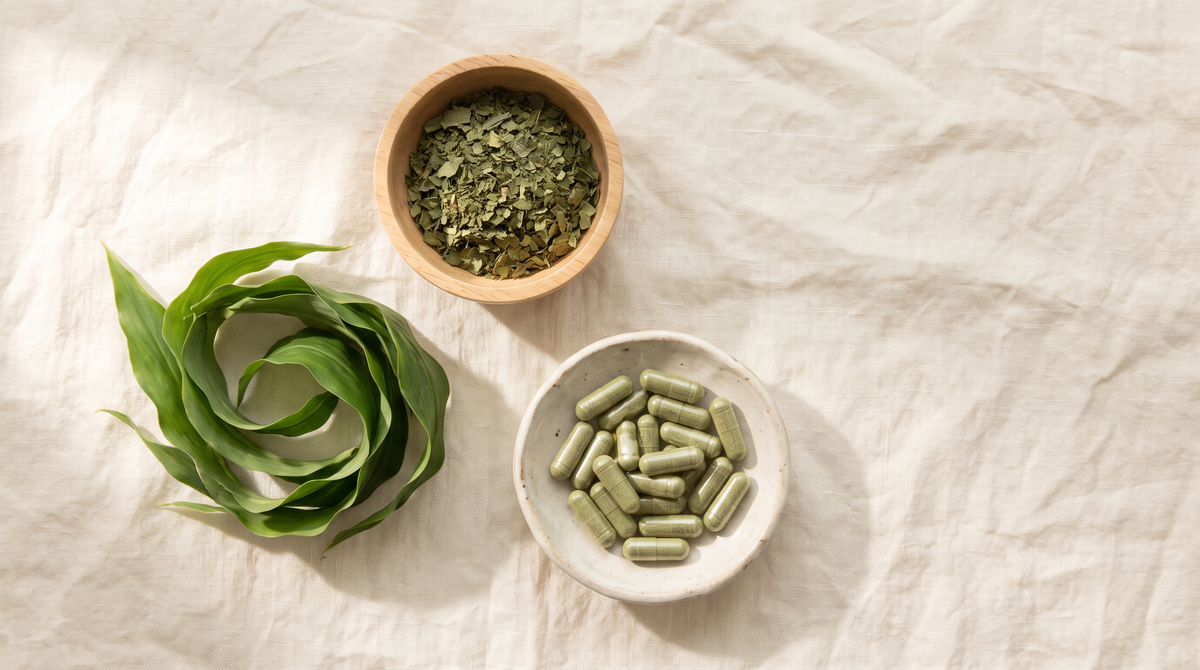
Why a fresh Thebu leaf and a Thebu capsule are not the same dose
By the Ancient Nutra Editorial Team
Key takeaways
- A fresh Thebu leaf is mostly water, so the amount of actual plant material in one leaf changes with its size, its age, and the weather it grew in.
- Drying removes that water. The World Health Organization suggests dried herbal material should generally sit below 12 percent moisture, which is what makes a repeatable measure possible.
- A measured form fixes how much you take. It does not change what the plant has been shown to do, and Thebu has not been tested in a human trial for blood sugar.
In a lot of Sri Lankan kitchens, Thebu is not a supplement. It is a plant at the edge of the garden, and somebody picks a leaf from it in the morning. That habit is older than any label, and nothing here is arguing against it. But it does raise a question worth answering plainly, because it is the question people actually ask when they see the same plant sold in a capsule: if the leaf is free and growing outside, what is the capsule for? The honest answer has almost nothing to do with potency, and almost everything to do with water.
Start with what Thebu is
Thebu is the Sri Lankan name for Costus speciosus, a spiral-stemmed plant in the Costaceae family, now also catalogued under the name Hellenia speciosa. It grows across the wet tropics from India and Sri Lanka through southern China and into Southeast Asia, and it is the leaf, rather than the rhizome, that Sri Lankan households usually reach for. What the plant has and has not been shown to do is covered separately, in Ancient Nutra's deep dive on Thebu and blood sugar. This piece stays on one narrower question: why the form you take it in changes the amount you get.
Follow the water out of the leaf
Picture two leaves off the same plant on the same morning. One is a young leaf near the top of the stem. The other is broad, older, and lower down. Weigh them and they are different. Dry them both and the gap changes again, because they were not holding the same amount of water to begin with.
That is the whole mechanism, and it is not complicated. Living leaf tissue is largely water. The compounds anyone is actually interested in are a small fraction of what you are holding. So when a recipe says "one leaf", it is describing a gesture rather than a quantity. The same gesture in January and in July, on a plant that has just had three weeks of rain versus one that has been dry, hands you meaningfully different amounts of plant material.
Drying is what turns a gesture into a measurement. Once the water is driven off, what is left is the part that does not change much from morning to morning, and it can be weighed. The World Health Organization's guidance on quality control for herbal materials sets this out as standard practice: producers run a loss on drying test, which captures both water and volatile matter, and dried herbal material is generally expected to sit below 12 percent moisture, with specific limits set per plant.
This is also why a dried and measured form is not automatically "stronger" than a leaf. It is more consistent. Those are different claims, and the second one is the only one the process actually supports.
Know why consistency matters here in particular
Thebu is not a niche herb in Sri Lanka. A 2025 study in BMC Complementary Medicine and Therapies surveyed 280 patients with type 2 diabetes at a Sri Lankan tertiary hospital and found that 68.6 percent used some form of complementary or alternative medicine, with orally taken herbal remedies the single most common category. Canereed leaves, which is Thebu, were named among the most commonly used herbs alongside bitter gourd and fenugreek seed.
The number in that paper worth sitting with, though, is a different one. Just over half the people surveyed, 52.1 percent, did not have the specific knowledge needed to ask about safety, effectiveness, or possible interactions with the medication they were already taking. That is the real gap, and it is not one a capsule closes by itself.
Consistency matters most exactly where it overlaps with something else. If a person is taking a prescribed medicine for blood sugar and also taking a plant whose amount varies day to day, then the variable is sitting inside a situation where their doctor is trying to hold things steady. A measured form at least removes one moving part from that picture. It does not remove the need to tell the doctor.
Be clear about what a measured form does not fix
A capsule solves dosing. It does not manufacture evidence, and it would be dishonest to imply otherwise.
Here is the actual state of the record for Thebu. Laboratory work from the University of Peradeniya, published in 2016, found that Costus speciosus leaf extracts inhibited alpha glucosidase and reduced glycation markers in the dish. That is a result in a controlled laboratory setting, and it is a reasonable reason to keep studying the plant. Beyond that, there are animal studies. What there is not, as of this writing, is a published human clinical trial testing Thebu for blood sugar control in people. Traditional use is long and well documented. Human trial evidence is absent.
So the useful framing is narrow and, we think, more respectable than the alternative: Thebu is a traditional Sri Lankan food plant with a long household history and promising early laboratory work behind it, and a measured form is a way to take a known quantity of it rather than a variable one.
Look for
A stated plant part and a stated quantity per serving, not just a plant name on the front. Ancient Nutra's Thebu (Canereed) is made from the leaf and comes as 60 capsules with a one capsule daily serving, made in Sri Lanka under BRCGS, GMP, HACCP, FSSC 22000, and ISO 22000.
Talk to your doctor before the habit starts
This is the part that matters more than the dosing question. If you take metformin, insulin, or any other prescribed medicine for blood sugar, speak with your doctor before adding Thebu in any form, leaf or capsule. Blood sugar herbs can add to the effect of that medication, and the person adjusting your treatment needs to know what else is in the picture.
The same applies in reverse. If you have been eating the leaf for years and have now started on medication, that is worth mentioning at the appointment, even though it feels like food rather than a supplement. Nothing on this page is medical advice, and no supplement is a substitute for prescribed treatment.
The bottom line
A leaf and a capsule of the same plant are not interchangeable quantities, because a fresh leaf is mostly water and a dried, measured serving is not. Three things follow from that:
- A measured form buys consistency, which matters most when something else in your routine is being kept steady.
- Consistency is not the same as potency, and neither is the same as proven effect.
- Thebu has traditional use and early laboratory work behind it, and no human trial for blood sugar. For how that compares with other herbs, see Ancient Nutra's evidence ranking of blood sugar herbs.
If a known quantity is what you are after, Ancient Nutra's Thebu (Canereed) is the measured version of a leaf that has been in Sri Lankan gardens a very long time.

Thebu (Canereed) 60 capsules
The Sri Lankan leaf in a measured daily serving, made under BRCGS and FSSC 22000.
Shop Thebu (Canereed)Sources and further reading
- Thilakarathna M, Appuhami K, Darshana N, Perera J. Complementary and alternative medicine use among patients with type-2 diabetes mellitus attending a suburban tertiary healthcare centre in Sri Lanka. BMC Complementary Medicine and Therapies, 2025;25(1):363, PubMed. Retrieved 20 September 2026.
- World Health Organization. Quality control methods for herbal materials, 2011, WHO IRIS. Retrieved 20 September 2026.
- Perera HK, Premadasa WK, Poongunran J. Alpha glucosidase and glycation inhibitory effects of Costus speciosus leaves. BMC Complementary and Alternative Medicine, 2016;16:2, PubMed. Retrieved 20 September 2026.
- Singh P, Khosa RL, Srivastava S, et al. Pharmacognostical study and establishment of quality parameters of aerial parts of Costus speciosus. Asian Pacific Journal of Tropical Biomedicine, 2014;4(6):486-91, PubMed. Retrieved 20 September 2026.
Written by the Ancient Nutra Wellness Team. The team researches, sources, and tests every ingredient before it earns a place in an Ancient Nutra blend. Questions? Email info@ancientnutra.com or message Ancient Nutra on Instagram.
Medical disclaimer: This article is for educational purposes only and is not medical advice. Statements have not been evaluated by the FDA. Ancient Nutra products are not intended to diagnose, treat, cure, or prevent any disease. Speak with a qualified healthcare provider before starting any new supplement, especially if you take prescription medication or have a medical condition.