Ancient Nutra Wellness Team · 31 May 2026 · 6 min read
St. John's Wort Extract: the European mood herb worth knowing
Key takeaways
- St. John's Wort is a traditional European herb used for centuries for low mood and emotional balance.
- A Cochrane review of 29 trials found it worked about as well as standard antidepressants for mild to moderate low mood, with fewer side effects.
- It interacts with many prescription medicines, including birth control and antidepressants, so it is not for everyone. Check with a doctor first.
Walk down most Ancient Nutra shelves and the story is Sri Lankan and Ayurvedic: Iramusu, Beli, Ashwagandha, Triphala. St. John's Wort is the outsider. It grew up in the meadows of Europe, not the gardens of South Asia. But when the conversation turns to low mood, the flat, grey kind that can sit on an otherwise fine week, this small yellow flower has more human research behind it than almost any herb on the shelf. That is worth knowing.
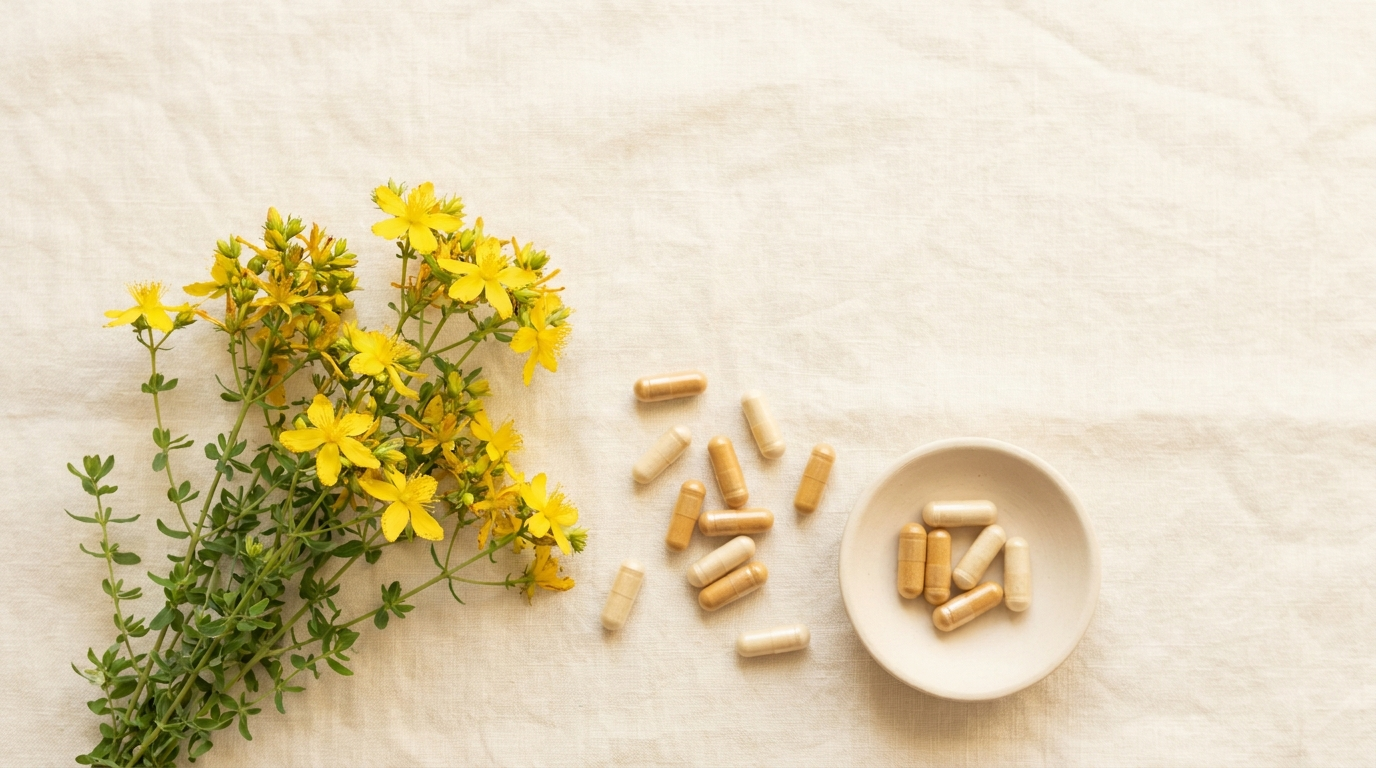
St. John's Wort is a wiry, yellow-flowered plant that grows wild across Europe and western Asia. The flowers bloom around midsummer, which is where the name comes from: they open near St. John's Day in late June. For hundreds of years, European households dried the flowering tops and steeped them for low spirits, restless sleep, and the general heaviness that settles in during darker months. Modern extracts concentrate the same flowering tops into a capsule.
What St. John's Wort actually does
Most of the herb's effect traces back to two compounds: hypericin and hyperforin. Hyperforin is the one researchers care about most. It appears to slow the reuptake of serotonin, dopamine, and noradrenaline, the same messengers that shape mood and motivation. In plain terms, it helps keep more of your feel-good chemistry in circulation for a little longer.
That mechanism is not just theory. A large Cochrane review of 29 clinical trials found St. John's Wort was better than a placebo for mild to moderate low mood, worked about as well as standard prescription antidepressants, and caused fewer side effects (Cochrane). For a plant, that is an unusually strong evidence base.
It is worth being clear about the ceiling. The research is strongest for mild to moderate low mood. It does not claim to treat severe depression, and it is not a substitute for professional care. If your mood is persistently low, talk to a doctor first. For the everyday flatness that rides on stress, St. John's Wort sits alongside the herbs that calm the stress response itself, like Ancient Nutra's Ashwagandha Extract.
Who should consider St. John's Wort
St. John's Wort is not a herb for everyone, and the honest list of who should skip it matters as much as the list of who might benefit.
It may help:
- Adults with mild, situational low mood, the flat kind tied to stress, season, or a rough stretch.
- People sensitive to the side effects of conventional options who want a gentler starting point, under guidance.
- Those in darker months who notice their mood dips with the light.
It is not for you if:
- You take prescription medication of almost any kind. St. John's Wort speeds up how the liver clears many drugs, which can quietly weaken them.
- You are on birth control. It can reduce how well oral contraceptives work.
- You take an antidepressant. Combining the two can push serotonin too high, which is dangerous (Mayo Clinic).
- You are pregnant, breastfeeding, or managing a diagnosed mood disorder without medical support.
If any of those apply, this is a talk-to-your-doctor herb, not a self-serve one.
How to actually take it
Clinical trials that showed a benefit generally used extracts standardised to around 0.3 percent hypericin, at roughly 300mg taken three times a day with meals. Most people take it with food to keep the stomach comfortable.
Give it consistency rather than intensity. St. John's Wort is a daily herb, not an as-needed one. Take it at the same times each day and let it build. One practical note: it can make skin more sensitive to sunlight in some people, so ease into strong sun while your body adjusts.
And the rule that matters most: because of the drug interactions above, clear it with a pharmacist or doctor before your first capsule if you take anything else at all.
Look for
An extract standardised to about 0.3 percent hypericin, taken as directed with food. Ancient Nutra's St. John's Wort Extract uses a concentrated, standardised extract of the flowering tops.
Where St. John's Wort comes from
St. John's Wort is one of the few herbs on the Ancient Nutra shelf with European rather than Sri Lankan roots. Its use runs back to ancient Greece, where physicians reached for it for wounds and low spirits, and it stayed a fixture of European folk medicine through the centuries that followed. The name is seasonal: the yellow flowers reach their peak around St. John's Day at midsummer, and tradition held that tops gathered then were the most potent. The plant travelled with settlers and now grows across much of the temperate world.
What to stack it with
St. John's Wort works on mood. It does not do much for the racing, wired feeling that often rides alongside it. That is where a calming herb earns its place.
For the evening wind-down, Ancient Nutra's Chamomilla Extract is the gentle classic, useful when a busy mind makes it hard to settle. For the daytime stress load, the cortisol side of the equation, Ashwagandha is the steadier partner. A simple pairing is St. John's Wort by day for mood and Chamomilla in the evening for calm.
One caveat, and it is the same one as always: if you take any prescription, especially anything that touches mood, do not build a stack without a doctor's sign-off.
How long until you feel something
St. John's Wort is a slow burn. Most trials ran for four to six weeks before differences showed clearly, and many people do not notice much in the first fortnight. Sleep and a slightly lighter baseline mood tend to shift first; the fuller effect, if it comes, builds over a couple of months. Give it a fair six-week run at a consistent dose before deciding it does or does not work for you. Herbs reward patience, and this one more than most.
The bottom line
St. John's Wort is the rare herb with real human evidence behind a real benefit: steadier mood for the mild, everyday kind of low. It is also the rare herb that demands a check-in with your doctor before you start, because of how freely it interacts with medication. Respect both halves of that, and it is a quietly effective addition to a calm-focused routine. Ancient Nutra's St. John's Wort Extract puts the standardised flowering-top extract in a simple daily capsule. Stack the flowers yourself if you prefer; the evidence does not care which capsule they come in.

St. John's Wort Extract
A standardised extract of the flowering tops, for mild everyday low mood and emotional balance.
Shop St. John's Wort ExtractSources and further reading
- St. John's wort for treating depression, Cochrane.
- St. John's wort drug interactions and cautions, Mayo Clinic.
- St. John's Wort and Depression: In Depth, NCCIH (NIH).
Written by the Ancient Nutra Wellness Team. The team researches, sources, and tests every ingredient before it earns a place in an Ancient Nutra blend. Questions? Email info@ancientnutra.com or message Ancient Nutra on Instagram.
Medical disclaimer: This article is for educational purposes only and is not medical advice. Statements have not been evaluated by the FDA. Ancient Nutra products are not intended to diagnose, treat, cure, or prevent any disease. Speak with a qualified healthcare provider before starting any new supplement, especially if you take prescription medication or have a medical condition.