
Ancient Nutra Wellness Team · 18 September 2026 · 5 min read
A letter about the word natural, and what it cannot promise
By the Ancient Nutra Editorial Team
- Natural describes where an ingredient came from. It says nothing about the dose, the form, how long to take it, or who should avoid it.
- NIH's LiverTox database rates turmeric category A and ashwagandha category B as causes of clinically apparent liver injury. Both are plants. Both are sold everywhere.
- The questions worth asking on a label are the form, the dose, the length of the course, and the list of people it is not for.
The word natural sits on the front of a great many things, including this brand's own category. It is a useful word. It is also a word that has quietly been asked to carry more weight than it can hold. Somewhere along the way it stopped meaning "this came from a plant" and started being read as "this is gentle, this is safe, this cannot be overdone." Those are different statements, and only the first one is true by definition. This letter is about the gap between them, and about what the team here does with that gap when it writes a label or an article.
Natural is a fact about origin, not a rating
Strip the marketing away and the word makes one claim: the material started as a plant, a mineral, or something else that grew rather than something assembled in a reactor. That is genuinely worth knowing. It is not a safety rating, a strength rating, or a quality rating, and it was never designed to be one.
Consider what it leaves out. It does not tell you whether you are holding a culinary pinch or a twenty-fold concentrated extract. It does not tell you the dose, or how that dose compares with the amount used in any study. It does not tell you how long the plant has been taken safely, or whether anyone has checked. It does not tell you who should not take it at all. Every one of those omissions matters more than the word itself.
The honest test is the herbal shelf itself
The clearest way to show that natural is not a synonym for harmless is to look at the most popular plants in the category, using the same public database the team checks before writing anything.
The United States National Institutes of Health maintains LiverTox, a reference on drug and supplement related liver injury. It grades ingredients by how well established the link is. Turmeric carries a likelihood score of A, described as a recently established and well documented cause of clinically apparent liver injury, with onset typically between one and four months of use. Ashwagandha carries a score of B, a likely cause. Concentrated green tea extract also carries an A. These are three of the best selling botanicals in the world, and all three are natural in every sense the word allows.
None of that makes them unusable. It makes them ingredients with a shape: a form, a dose, a sensible course length, and a group of people who should skip them. Ancient Nutra wrote about exactly that problem this morning, in a piece on why turmeric extract suits a short course rather than a daily habit. The honest admission is that the label on the front of a turmeric bottle will say natural, and the label is right, and the label is also not the information that matters most.
Form and dose change the answer completely
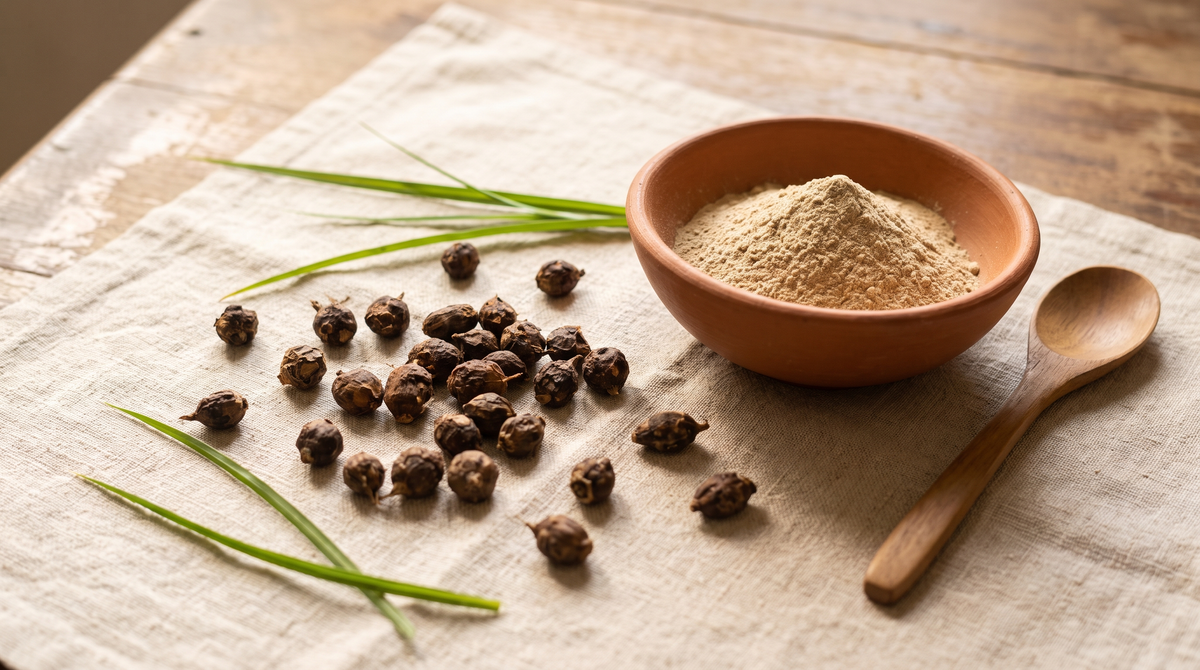
The same plant can be two very different exposures. Karavila, the bitter gourd known botanically as Momordica charantia, is a good example precisely because it is ordinary. Across the tropics, with India and China as the largest producers, the fruit is a vegetable. It goes into curries and stir fries, it is eaten by the plateful, and nobody calls it a supplement.
Concentrate that same fruit, add the seed powder, and put sixty capsules in a bottle, and the exposure is no longer a vegetable. That is not a criticism of the format, which is how Ancient Nutra's Karavila (Bitter Melon) capsules are made, and the composition is stated plainly on the product page. It is the point. The word natural applies identically to the curry and to the capsule, while the dose, the plant parts included, and the relevant cautions are not identical at all.
Bitter melon is one of the few common botanicals with a reassuring liver record: LiverTox scores it E, an unlikely cause of clinically apparent liver injury. It also carries a caution that has nothing to do with the liver. The same NIH monograph states that bitter melon is a potential abortifacient and should not be used in pregnancy, or by women of childbearing age who are not using effective contraception. That caution is not folk advice and it is not something the word natural would ever have warned anyone about.
Look for
Four things the front label rarely shows: which part of the plant is inside (fruit, root, leaf, seed), the actual dose per serving, a stated course length rather than an open ended one, and a plain list of who should not take it. Anyone who is pregnant, trying to conceive, or taking prescription medicine should confirm with a doctor before starting any botanical, including bitter melon.
The claims this brand will not make
Candour cuts both ways, so here is the limitation rather than the selling point. Bitter melon has been studied for blood sugar for decades and the result is still unsettled. A Cochrane review concluded there was insufficient evidence to recommend it. The National Center for Complementary and Integrative Health says plainly that research on herbal supplements for diabetes has been limited in number, size, and quality, and has not proven any of them effective. A 2025 pooled analysis did find a measurable effect, and graded its own certainty as low to very low.
So Ancient Nutra does not say that karavila lowers blood sugar, and it does not say that any capsule treats or prevents a disease. What can honestly be said is that it is a traditional ingredient with a long culinary history, a clean liver record, a clear pregnancy caution, and an evidence base that has not settled. That is less exciting than the alternative. It is also the only version that survives being checked. The same discipline produced an earlier letter on the blood sugar claims this brand will not make, and the decision to retire a favourite phrase about ninety days once it turned out the evidence never supported it.
The bottom line
Natural is worth keeping as a word. It is just a weak one, and it should be asked to do less work, not more. Treat it as the first line of a description rather than the conclusion, then go looking for the plant part, the dose, the course length, and the list of people the ingredient is not meant for. A brand that cannot answer those four questions about its own product has not earned the front of its label. That standard is uncomfortable to hold, and it is the reason this letter exists.

Karavila (Bitter Melon) - 60 capsules
The familiar Sri Lankan kitchen gourd in capsule form, blending the fruit with karavila seed powder. Not for use in pregnancy.
Shop KaravilaSources and further reading
- Bitter Melon, LiverTox, National Institute of Diabetes and Digestive and Kidney Diseases.
- Turmeric, LiverTox, NIDDK.
- Ashwagandha, LiverTox, NIDDK.
- Green Tea, LiverTox, NIDDK.
- Diabetes and Dietary Supplements, National Center for Complementary and Integrative Health.
- Ooi CP et al., Momordica charantia for type 2 diabetes mellitus, Cochrane Database of Systematic Reviews, 2012.
Written by the Ancient Nutra Wellness Team. The team researches, sources, and tests every ingredient before it earns a place in an Ancient Nutra blend. Questions? Email info@ancientnutra.com or message Ancient Nutra on Instagram.
Medical disclaimer: This article is for educational purposes only and is not medical advice. Statements have not been evaluated by the FDA. Ancient Nutra products are not intended to diagnose, treat, cure, or prevent any disease. Speak with a qualified healthcare provider before starting any new supplement, especially if you take prescription medication or have a medical condition.