Ancient Nutra Wellness Team · 3 August 2026 · 6 min read
A grown-up pantry snack: dip, breadsticks, and portion control
- Snacking is not a fringe habit. On any given day, 95% of US adults eat at least one snack, and snack occasions account for roughly 23% of total daily energy intake.
- Package size changes how much people eat. A Cochrane review of 58 studies found that larger portions, packages, and tableware led people to consume more food, a small to moderate effect across 6,603 participants.
- A five serving dip and breadstick pack does the portioning before the craving arrives, which is the part most adults get wrong at 4pm.
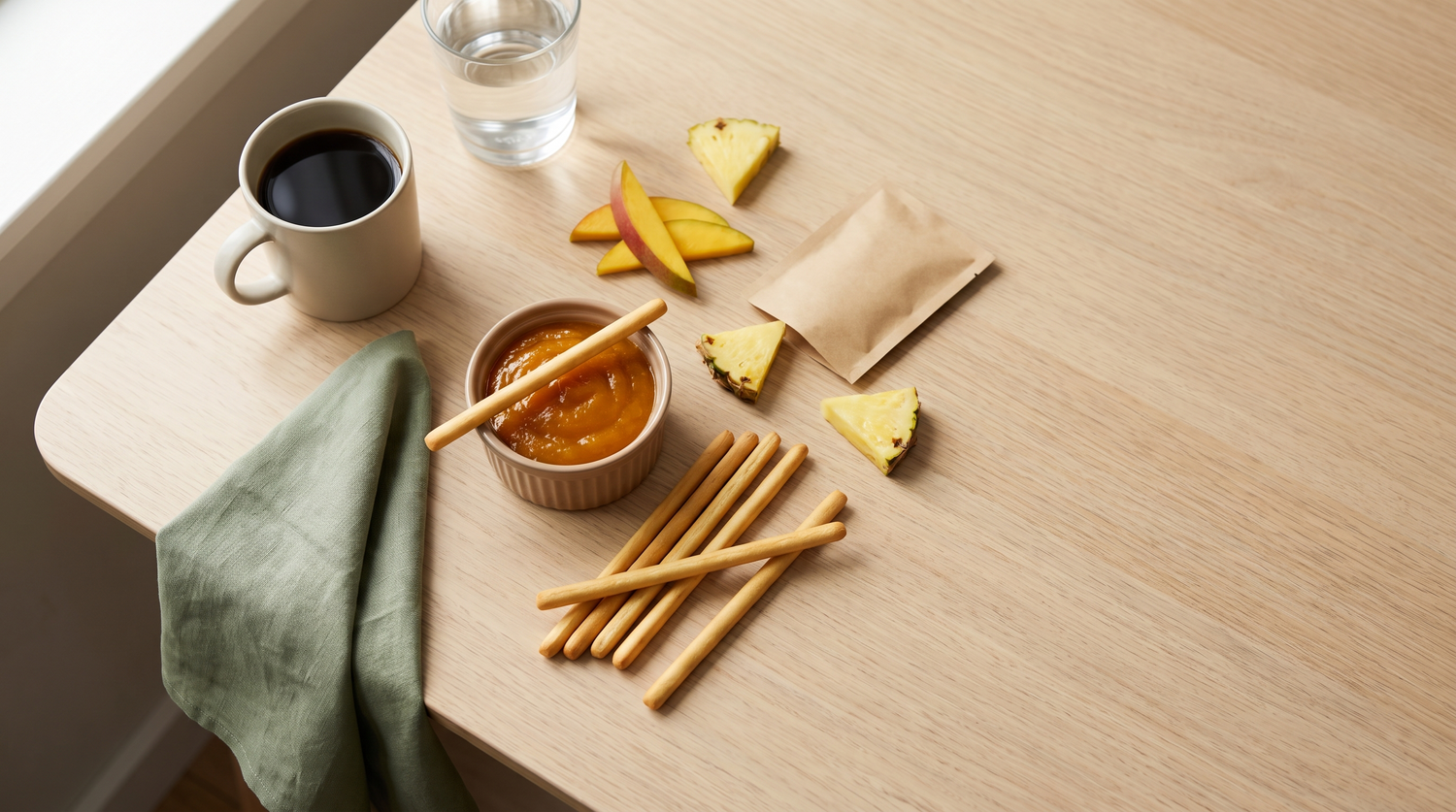
Most adults do not snack badly because they lack discipline. They snack badly because the food in front of them has no natural stopping point. A large bag has one stopping point, and it is the bottom. That is a packaging problem before it is a willpower problem, and it is worth solving with something better than guilt. Ancient Nutra's Tropical Dip & Breadstick pack is a small, deliberate answer to it: five separate servings of crunchy breadsticks with a tropical fruit dip, sitting in the pantry, already measured out.
Start with how much snacking actually matters
It is easy to treat snacks as noise around the edges of a diet. The numbers say otherwise. In the most recent USDA analysis of national dietary survey data, 95% of American adults ate at least one snack on a given day and 78% ate two or more. Foods and drinks eaten at snack occasions supplied about 23% of total daily energy intake (USDA Agricultural Research Service, 2024).
Close to a quarter of what an adult eats in a day arrives outside of meals. That is not a rounding error to be ignored, and it is not a moral failing to be scolded out of existence either. It is simply a large, recurring slice of the day that most people never plan, while they plan breakfast, lunch, and dinner carefully.
The practical conclusion is unglamorous. If a quarter of daily intake is unplanned, the highest leverage move is not eating less. It is deciding, once, what is in the drawer, so that the 4pm version of a person does not have to make a good decision under pressure.
Let the packaging do the portioning
There is decent evidence that the container, not the person, sets the serving. A Cochrane systematic review pooled 86 comparisons across 58 studies and 6,603 participants and found that people given larger portions, packages, or tableware consumed more food than people given smaller versions. The effect was small to moderate (standardised mean difference 0.38) and the evidence was graded moderate quality (Hollands et al., Cochrane Database of Systematic Reviews, 2015).
The reviewers went further and estimated that if smaller portions and packages were sustained across a whole diet, average daily energy intake from food could fall by roughly 144 to 228 calories, around 8.5% to 13.5%, in UK children and adults. That is a modelled estimate rather than a measured outcome, so it is worth holding loosely. The direction, though, is consistent and it is boring in the best way: smaller unit, less eaten, no negotiation required.
This is exactly the job a five in one pack is doing. Ancient Nutra's Tropical Dip & Breadstick pack arrives as five individual servings rather than one shared tub. Opening a serving is a decision. Opening a second one is a second decision, made consciously, which is the entire point. Nobody accidentally eats four sachets the way they accidentally reach the bottom of a family bag.
Know who this suits, and who it does not
It earns its place for a few specific people. The desk worker who keeps skipping the gap between a 1pm lunch and an 8pm dinner and arrives home ravenous. The parent packing lunchboxes at 6am who needs something that survives a schoolbag without a spoon, a plate, or refrigeration. The traveller who wants a bite in a hotel room that is not a minibar biscuit. The person who has decided, sensibly, that the answer to afternoon hunger is a planned small thing rather than nothing followed by everything.
It is honestly not for everyone. Anyone eating to a specific carbohydrate or blood sugar target should check the pack against that target rather than assume a fruit dip is automatically gentle, because fruit based dips carry sugars. Anyone building a snack primarily around protein will find breadsticks and fruit dip a poor fit, and should reach for eggs, curd, or nuts instead. And it is a snack, not a meal replacement. Treating it as lunch is a good way to be hungry by three.
The pack is produced in Sri Lanka under BRCGS, FSSC 22000, and ISO 22000 certified manufacturing, which is the part of a food product that is worth checking and almost nobody does.
Pair it so it holds you longer
A carbohydrate led snack eaten alone empties quickly. The standard fix is to add fat, fibre, or protein alongside it, and the principle is well established: the more fibre or fat a food carries, the lower its glycaemic index tends to run (Harvard Health Publishing).
In practice that means a small handful of something dense next to the breadsticks. A spoon of Ancient Nutra's 4-in-1 Super Seeds Mix scattered over the dip adds fat and fibre without changing the format or requiring a kitchen. Chia seeds stirred into the dip the night before thicken it and add fibre, which is a two minute job that pays off in how long the snack actually holds.
Not everyone needs to bother. A snack eaten an hour before dinner does not need to hold anyone for four hours. Save the pairing for the long afternoons.
Look for
When buying any portioned snack, check three things: that the servings are individually sealed rather than one tub with a resealable lid, that the manufacturing standard is named on the pack, and that a single serving is a size a person would actually stop at. The five in one pack is built around the first and third of those.
Be realistic about the afternoon slump
A lot of snack marketing promises to defeat the 3pm crash. That promise oversells what food can do. The post lunch dip in alertness is a genuine phenomenon, but a review of the research notes that it can occur even in people who ate no lunch at all and who do not know the time of day, because it tracks a circadian rise in mid afternoon sleep pressure rather than the sandwich (Monk, Clinics in Sports Medicine, 2005).
So no snack overrides a body clock. What a sensibly sized snack does is avoid stacking a large blood sugar swing on top of a dip that was arriving anyway. That is a smaller claim, and it is the true one.
The bottom line
Snacking is roughly a quarter of the daily plate for most adults, and the size of the container quietly sets the size of the serving. A five serving pack of breadsticks and tropical dip does not do anything clever, and it does not need to. It moves one decision from a hungry moment to a calm one, and it does that every afternoon without being thought about again.

Tropical Dip & Breadstick (5-in-one pack)
Five individually portioned servings of breadsticks and tropical fruit dip, made in Sri Lanka under BRCGS, FSSC 22000, and ISO 22000.
Shop the 5-in-one packSources and further reading
- Sebastian RS, Hoy MK, Goldman JD, Moshfegh AJ. Snack Consumption by U.S. Adults: What We Eat in America, NHANES 2017 to March 2020. USDA Agricultural Research Service, 2024.
- Hollands GJ, Shemilt I, Marteau TM, et al. Portion, package or tableware size for changing selection and consumption of food, alcohol and tobacco. Cochrane Database of Systematic Reviews, 2015.
- Monk TH. The post-lunch dip in performance. Clinics in Sports Medicine, 2005.
- The lowdown on glycemic index and glycemic load. Harvard Health Publishing.
Written by the Ancient Nutra Wellness Team. The team researches, sources, and tests every ingredient before it earns a place in an Ancient Nutra blend. Questions? Email info@ancientnutra.com or message Ancient Nutra on Instagram.
Medical disclaimer: This article is for educational purposes only and is not medical advice. Statements have not been evaluated by the FDA. Ancient Nutra products are not intended to diagnose, treat, cure, or prevent any disease. Speak with a qualified healthcare provider before starting any new supplement, especially if you take prescription medication or have a medical condition.