Ancient Nutra Wellness Team · 5 September 2026 · 6 min read
5 Things to Check on a Fenugreek Label Before You Buy
By the Ancient Nutra Editorial Team
- "Standardised extract" is only meaningful when a number follows it, naming the marker compound and the percentage guaranteed in every capsule.
- Ground seed and standardised extract are different products at different doses. The trials behind fenugreek used anywhere from 500 mg to 10 g a day, so the form alone tells you very little.
- Fenugreek above food amounts is not considered safe in pregnancy, and large doses can push blood sugar down far enough to matter if you take diabetes medication.
Two jars of fenugreek can sit side by side at the same price and contain quite different things. One holds ground seed. The other holds a concentrated extract standardised to a fixed percentage of a marker compound. The label on the front rarely makes the difference obvious, because the words that sell a supplement are adjectives, and the words that describe it are numbers. Learning to read past the adjective takes about a minute per label, and it is the single most useful habit a supplement buyer can build.
Start with the botanical name and the plant part
A trustworthy label names the plant in Latin and says which part of it is in the capsule. For fenugreek that reads Trigonella foenum-graecum, seed. The botanical name matters because common names travel badly between languages and markets, and the plant part matters because seed, leaf, and aerial parts are not interchangeable. Almost all of the human research on fenugreek was done on the seed. A label that names only "fenugreek" with no Latin name and no plant part has told you the least it possibly could while still being legal.
Separate ground seed from a standardised extract
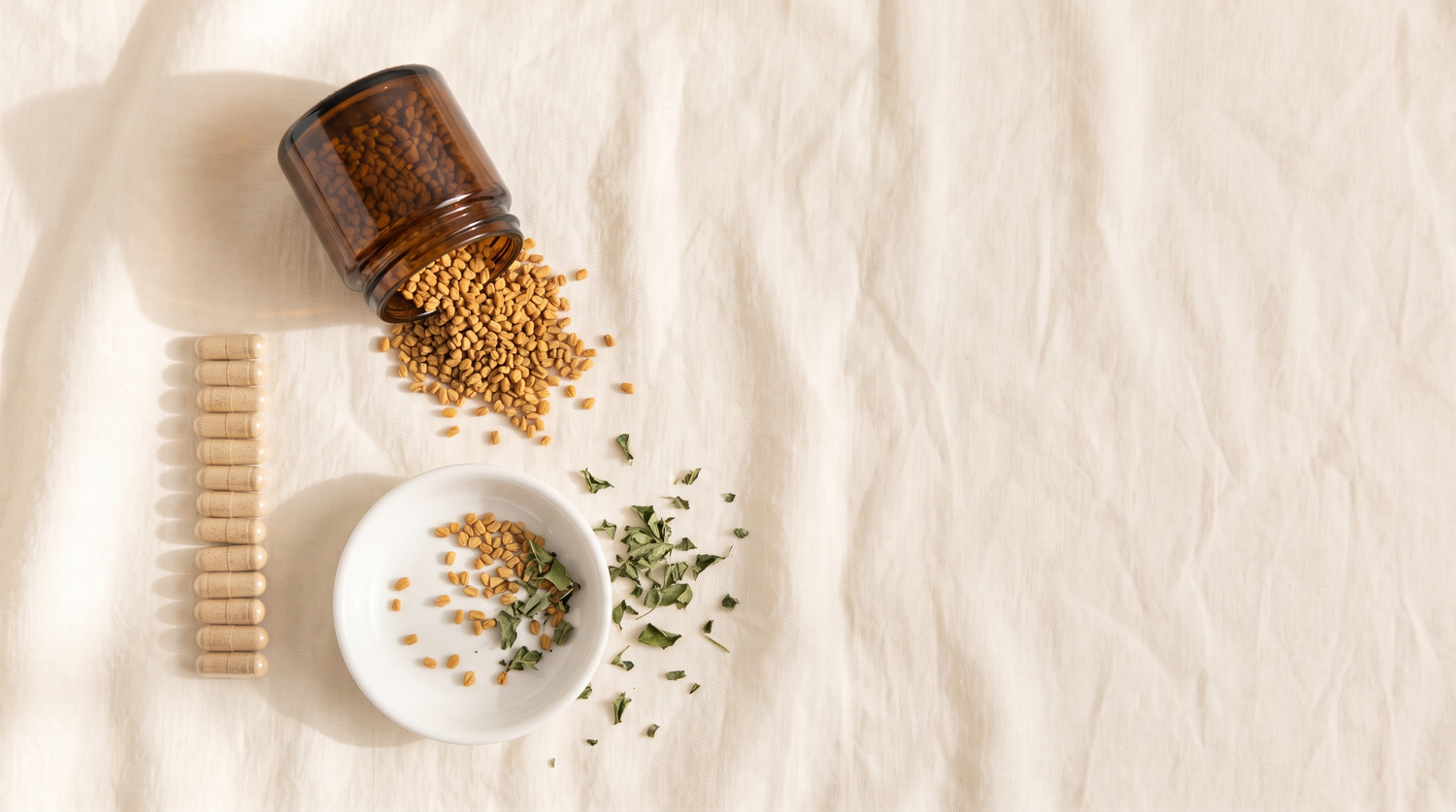
Ground seed is exactly what it sounds like: the seed, dried and milled into a powder, with nothing concentrated and nothing removed. A standardised extract is the seed processed with a solvent to concentrate particular compounds, then adjusted so that every batch delivers a fixed amount of a chosen marker. Neither one is automatically better. They are different products with different dose ranges, and a 500 mg capsule of concentrated extract is not comparable to a 500 mg capsule of ground seed. The mistake worth avoiding is assuming the two are the same thing because the number of milligrams on the front happens to match.
Look for the number behind the word standardised
This is where most labels quietly stop short. "Standardised extract" on its own is an adjective, not a specification. A complete standardisation claim names the marker compound and the percentage, in a form like "standardised to 50% saponins", and it is usually paired with an extract ratio such as 4:1, meaning four parts raw seed reduced to one part extract. If the jar says standardised and gives no compound and no percentage, there is nothing there to verify, and no batch certificate can confirm it. The number is the claim. The word on its own is decoration.
Look for
A label that gives you four things without being asked: the Latin name, the plant part, the form (seed powder or extract), and the dose per capsule. Ancient Nutra's Fenugreek Capsules are whole seed rather than a standardised extract, which is why the label names the seed and the capsule dose instead of a marker percentage.
Match the dose to the dose the research used
A 2023 systematic review and meta-analysis in the International Journal of Molecular Sciences pooled 10 randomised controlled trials covering 706 people with type 2 diabetes or prediabetes. Across those trials, fenugreek was given at doses ranging from 500 mg to 10 g a day for 8 to 16 weeks, and the pooled results showed fasting blood glucose lower by 26.66 mg/dL and HbA1c lower by 0.54 percentage points. That is a twentyfold spread in daily dose, which is the real reason a label's milligram figure needs context. It is also worth holding the counterweight in view: the National Center for Complementary and Integrative Health still states there is not enough high-quality evidence to determine whether fenugreek is useful for diabetes. For how fenugreek compares with the other herbs in this space, see our piece on 4 blood sugar herbs ranked by how strong the evidence is.
Count the capsules against your actual daily dose
The last check is arithmetic, and it is the one people skip. A bottle of 60 capsules is a two month supply at one a day and a one month supply at two. If the label's own directions call for two capsules and the research it gestures at used a dose that needs three, the bottle is telling you something about cost per day that the shelf price is not. Running the same sum across two products is often more revealing than comparing their front labels. We walked through that calculation in detail in how long a 60 capsule bottle lasts.
Two cautions that come before any label detail
Fenugreek above the amounts found in food is not considered safe during pregnancy. The National Center for Complementary and Integrative Health links its use to increased risks of birth defects in both animals and people, and no label detail changes that. Separately, large doses may cause a harmful drop in blood sugar, so anyone taking metformin, insulin, or any other blood sugar medication should speak to a doctor before starting rather than after. On the liver, the picture is reassuring: the NIH LiverTox database states plainly that fenugreek has not been implicated in causing liver injury. Keep any trial of it inside the window the research actually covers, which is 8 to 16 weeks, with about 12 weeks a sensible working figure, rather than an open ended daily habit.
The bottom line
A good fenugreek label is specific where it could have been vague: Latin name, plant part, form, dose, and a real number behind any standardisation claim. A jar that gives you all five is not necessarily the strongest product on the shelf, but it is the one you can actually evaluate, and that is the only honest starting point. Fenugreek seed has a long history in South Asian kitchens well before it reached a capsule, and it remains a food first.

Fenugreek Capsules, 60 capsules
Whole fenugreek seed in a vegetarian capsule, with the seed and the per capsule dose named on the label.
Shop Fenugreek CapsulesSources and further reading
- Nasimi Doost Azgomi R, et al. "The Effect of Fenugreek in Type 2 Diabetes and Prediabetes: A Systematic Review and Meta-Analysis of Randomized Controlled Trials", International Journal of Molecular Sciences, 2023.
- "Fenugreek: Usefulness and Safety", National Center for Complementary and Integrative Health, NIH.
- "Fenugreek", LiverTox, National Institute of Diabetes and Digestive and Kidney Diseases, NIH.
Written by the Ancient Nutra Wellness Team. The team researches, sources, and tests every ingredient before it earns a place in an Ancient Nutra blend. Questions? Email info@ancientnutra.com or message Ancient Nutra on Instagram.
Medical disclaimer: This article is for educational purposes only and is not medical advice. Statements have not been evaluated by the FDA. Ancient Nutra products are not intended to diagnose, treat, cure, or prevent any disease. Speak with a qualified healthcare provider before starting any new supplement, especially if you take prescription medication or have a medical condition.