Ancient Nutra Wellness Team · 11 July 2026 · 6 min read
A 10-minute evening calming ritual for hormonal weeks
Key takeaways
- The week or so before a period, when progesterone falls, often brings restless, broken sleep and a wired-but-tired feeling at night.
- A short, repeatable evening ritual signals the body to downshift: dim the lights, add warmth, take a calming herb, and put the screens away.
- Ancient Nutra's Hathawariya (Shatavari) and Chamomilla Extract sit naturally inside the wind-down, on top of the real basics of sleep, food, and less light.
There is a stretch most months, roughly the week before a period, when the body seems to forget how to settle at night. You are tired, but wired. The to-do list gets louder the moment the lights go off. This is a 10-minute evening ritual built for exactly those hormonal weeks. It is not a cure for a hard cycle, and it will not out-run a bad night of sleep debt. What it does is give the body a clear, repeated signal that the day is closing. Here is the sequence, why each step is there, and what to do if you do not have the calming herbs on hand yet.
The evening ritual, step by step
Run this in the last 45 minutes before bed. The actual hands-on time is around 10 minutes. The rest is just letting the room, and you, go quiet.
- Dim the lights early. About 45 minutes before bed, switch off the overhead light and leave one warm lamp on. Bright light late tells the brain it is still daytime, so dropping it is the first cue.
- Warm up, then let yourself cool. Take a warm shower or soak your feet for a few minutes. The warm-then-cool drop in body temperature that follows is one of the body's own sleep triggers.
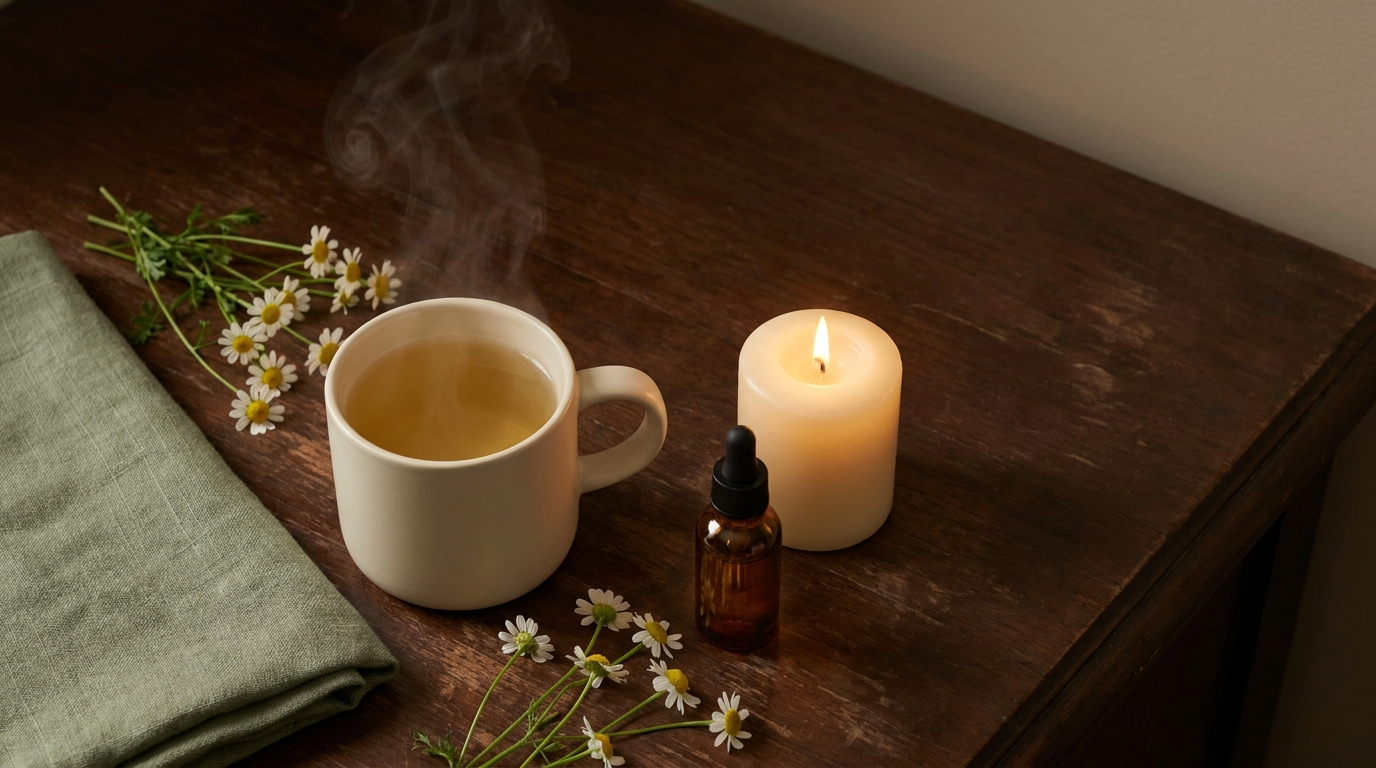
- Brew a calming tea, or take chamomile. Steep a cup of chamomile, or add a measured dose of Ancient Nutra's Chamomilla Extract to warm water. Sip it slowly. The ritual of the warm cup matters as much as the herb.
- Take Shatavari with warm water or milk. Take one capsule of Hathawariya (Shatavari) with the warm drink. In tradition it is the herb reached for during a woman's hormonal shifts, and it folds neatly into a nightly routine.
- Put the screens away. Phone face down and out of reach, ideally in another room. This is the step people skip and the one that changes the most.
- Move gently for two minutes. A few slow forward folds, or legs up against the wall while you breathe. Nothing strenuous. You are unwinding the shoulders and hips, not training.
- Breathe yourself down. In bed, breathe in for a count of four, out for a count of six, for one minute. The long exhale is what nudges the nervous system toward rest.
Seven small steps, most of them things the body already knows how to do. The herbs are one part of the sequence, not the whole of it.
Why this ritual works in the days before a period
The restlessness is not in your head. In the luteal phase, the days between ovulation and a period, progesterone climbs and then drops sharply. Sleep researchers have tracked this: sleep tends to get lighter and more broken in the second half of the cycle, and many women report the worst nights in the days right before bleeding starts (Baker and Driver, Sleep Medicine, 2007). So the goal in those weeks is not to force sleep. It is to remove every extra obstacle in front of it.
That is what each step targets. Dim light and no screens protect melatonin, the hormone that rises as the room darkens. The warm drink and warm shower use temperature, one of the oldest sleep levers there is. And the slow exhale shifts the body out of the alert, keyed-up state that hormonal weeks tend to amplify.
The chamomile earns its place here too. A review of the calming research found chamomile modestly helps sleep quality and eases mild anxiety, which is a fair description of what most people actually want on a restless night (Hieu et al., Phytotherapy Research, 2019). Shatavari plays the quieter, traditional role: a women's tonic in Ayurveda, used gently and nightly rather than in a single heroic dose.
When to run it, and when to let it go
The best window is the seven to ten days before your period is due, run nightly. That is when the payoff is largest, because that is when sleep is most likely to fray. Outside those weeks, keep whichever steps you like as a general wind-down.
And on the nights it all falls apart, when you get home late or a child is up, skip it without guilt. A ritual you resent is worse than a night off. The point is a gentle, repeatable signal, not one more thing to get right.
Look for
A single-herb Shatavari (Hathawariya) capsule, taken once in the evening as part of the wind-down. Ancient Nutra's Hathawariya/Shatavari is a straightforward daily capsule, easy to pair with a warm drink before bed.
Building the ritual without Shatavari at home
You do not need every herb on day one. The structure is what carries the ritual, so start with the light, the warmth, and the breathing tonight, and add the rest as you go.
If sleep is the main problem, a plain cup of chamomile tea covers the calming step on its own. If the harder part is stress, the mind that will not stop turning over, a gentle adaptogen fits better than a sleep herb. Ancient Nutra's Ashwagandha is the usual choice there, taken in the evening to ease a busy head. The pre-set combination is tidier, but the underlying idea, warm the body and calm the mind before the lights go out, does not care which capsule you reach for.
The bottom line
This ritual does one thing well: it removes the small obstacles between a hormonal-week evening and actual rest, using warmth, darkness, a slow breath, and two calming herbs. Give it seven nights across the week before your next period, then decide what to keep. Ancient Nutra's Hathawariya/Shatavari is built to slot into exactly that kind of quiet, nightly routine.

Hathawariya / Shatavari
A traditional women's tonic, taken as one gentle capsule in the evening wind-down.
Shop Hathawariya / ShatavariSources and further reading
- Baker FC, Driver HS. Circadian rhythms, sleep, and the menstrual cycle. Sleep Medicine, 2007.
- Hieu TH, et al. Chamomile for anxiety, sleep quality, and insomnia: a systematic review and meta-analysis. Phytotherapy Research, 2019.
- Office on Women's Health. Premenstrual syndrome (PMS). womenshealth.gov.
Written by the Ancient Nutra Wellness Team. The team researches, sources, and tests every ingredient before it earns a place in an Ancient Nutra blend. Questions? Email info@ancientnutra.com or message Ancient Nutra on Instagram.
Medical disclaimer: This article is for educational purposes only and is not medical advice. Statements have not been evaluated by the FDA. Ancient Nutra products are not intended to diagnose, treat, cure, or prevent any disease. Speak with a qualified healthcare provider before starting any new supplement, especially if you are pregnant, breastfeeding, take prescription medication, or have a medical condition.