Ancient Nutra Wellness Team · 1 August 2026 · 6 min read
Coconut milk powder: the pantry staple that beats the can
- Under the FAO and WHO Codex standard, canned coconut milk can legally be up to 87.3 percent water. Spray-dried coconut milk powder sits under 5 percent moisture, so the tin you carry home is mostly the thing you actually wanted.
- The powder lets the cook set the strength. Add less water for a curry base, more for a latte, instead of accepting whatever concentration the can was filled at.
- The same Codex standard permits emulsifiers, gums and preservatives in canned coconut milk. Permitted is not the same as present, so the label is still worth reading either way.
Most Sri Lankan kitchens have never needed a tin. Coconut milk came from a scraper, a bowl of warm water and two minutes of squeezing, and it was made fresh because there was no way to keep it. The tin solved the keeping problem and quietly created a new one: a heavy, single-strength product that starts oxidising the moment it is opened and has to be used up the same day. Coconut milk powder solves the keeping problem differently, by taking the water out instead of sealing it in. That one difference changes how the ingredient behaves on a shelf and in a pan.
What coconut milk powder actually is
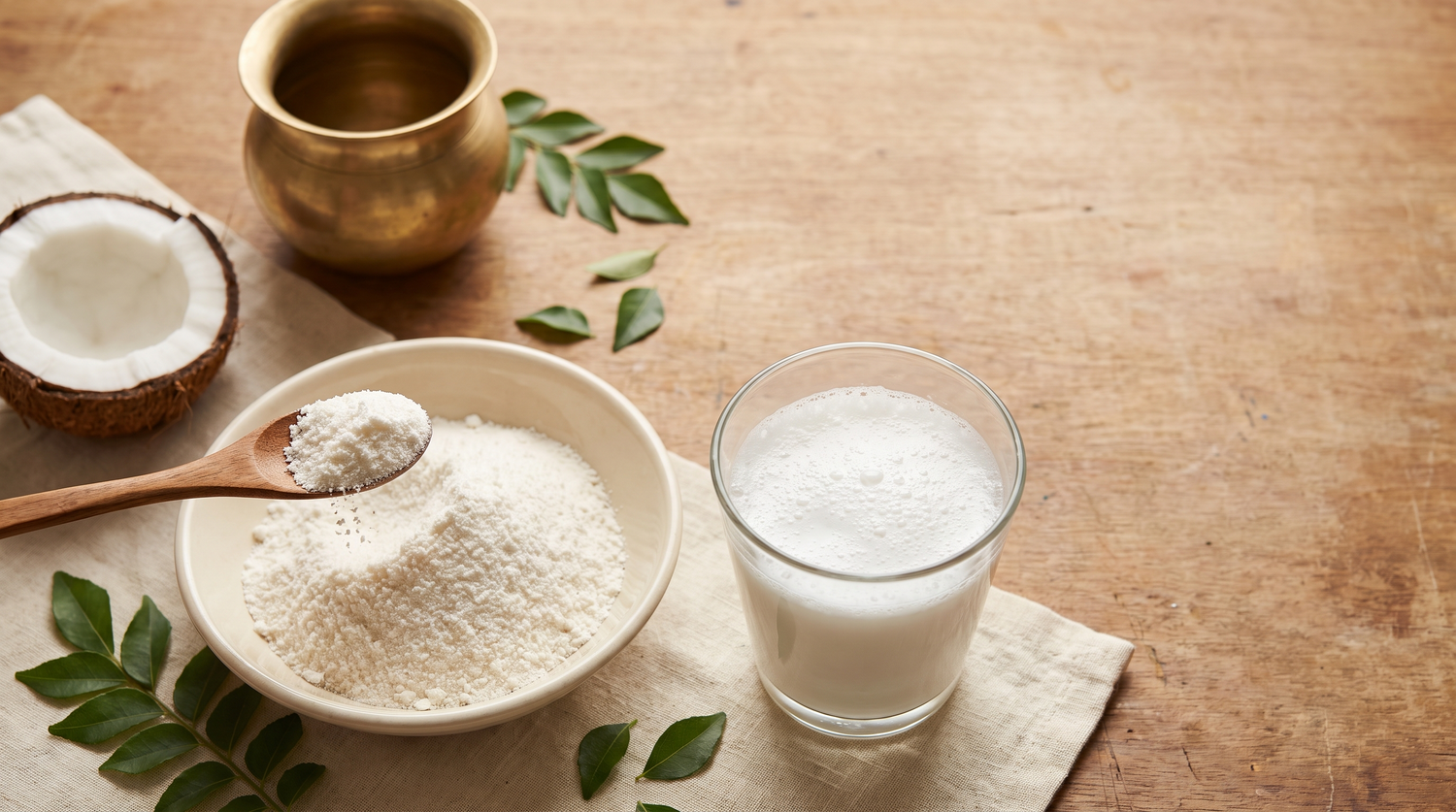
Coconut milk powder is coconut milk with the water removed by spray drying. Liquid coconut milk is atomised into a chamber of hot air, the water flashes off in seconds, and what falls out is a fine, cream-coloured powder of coconut fat and solids. It is not an imitation or a flavouring. Add water back and it becomes coconut milk again.
That is not a marketing position, it is a regulatory one. The Codex Alimentarius standard for coconut milk, written jointly by the FAO and WHO, explicitly recognises coconut milk made by reconstituting coconut cream powder with potable water as coconut milk, and only asks that the label say it was reconstituted. The powder route is a recognised way to make the product, not a shortcut around it.
Spray drying is also gentler than it sounds, within limits. In a 2020 study in the Journal of Food Science and Technology, researchers spray-dried coconut milk across a range of temperatures and got powders at 3.64 to 3.76 percent moisture, comfortably under the 5 percent mark at every setting tested. Drying too hot was the problem, not drying itself: above roughly 160 degrees Celsius the fat globules ruptured, which left more free fat on the surface and made the powder harder to dissolve cleanly.
Count the water you are paying to carry
The Codex standard sets out exactly what can be sold under each name, and the numbers are worth knowing. Coconut milk must be at least 10 percent fat and can be up to 87.3 percent moisture. Light coconut milk can be up to 93.4 percent moisture. Coconut cream must reach 20 percent fat, with moisture up to 74.6 percent. So a standard 400 ml tin is, at the legal limit, roughly three parts water to one part coconut.
That water is not a scandal. It is the point of a liquid product. But it is water that has been canned, shipped, stored, shelved and carried home, and it is water the cook usually adjusts anyway: thinning a curry, thickening a sauce, watering down a cream for a drink. Powder moves that decision to the last possible moment. A curry base wants a thick, high-fat milk. A morning drink wants something looser. From a tin, the cook gets one strength and works around it. From powder, the strength is a choice made with a spoon.
The storage arithmetic is the same story. An opened tin has to be used or refrigerated and used quickly. A sealed pouch of powder waits, and is measured out in the quantity actually needed, which is the more useful behaviour for anyone cooking for one or two people rather than a family of six.
Know what the standard allows in the tin
Coconut fat and water do not want to stay mixed. Canned coconut milk separates, so the industry stabilises it, and the Codex standard sets out what is permitted to do that job. Polysorbates, including polysorbate 60, are allowed up to 1,000 mg per kg. Guar gum, xanthan gum, gellan gum and sodium carboxymethyl cellulose are permitted at levels limited only by good manufacturing practice. Sodium benzoate is allowed up to 1,000 mg per kg in pasteurised coconut milk, and metabisulphite bleaching agents up to 30 mg per kg. Maltodextrin and sodium caseinate are permitted as ingredients.
Two honest caveats belong here. Permitted is not the same as present: plenty of canned coconut milk contains coconut, water and nothing else, and the standard describes a ceiling, not a recipe. And powders are not automatically cleaner, because maltodextrin and sodium caseinate are commonly used as spray-drying carriers, which is exactly why the ingredient list matters on a pouch too. The useful habit is not brand loyalty. It is turning the pack over.
Look for
A short ingredient list, unsweetened, with coconut high up and carriers such as maltodextrin low down or absent. A higher fat percentage means less bulking agent per spoon and a creamier result at the same dilution. If the powder is destined for drinks rather than curries, it pairs naturally with a spiced base like Ancient Nutra's Turmeric Latte Mix, which is built to be whisked into a warm coconut or dairy milk.
Use it at the strength the dish needs
The working method is to think in strengths rather than in tins. A thick, rich milk belongs in a curry base, a coconut sambol dressing, or anything that will be reduced. A medium milk suits dahl, soups and rice cooked in coconut. A thin milk is for lattes, smoothies and porridge, where the coconut should carry flavour without turning the cup heavy.
Two practical notes save most of the trouble. Whisk the powder into warm, not boiling, water and give it a moment, because coconut fat disperses better with a little heat and a little patience than with a hard boil. And add the coconut milk late in a curry rather than early, since long aggressive boiling is what splits it and leaves an oily surface, whether it came from a tin or a pouch.
What the fat is doing
Coconut fat is unusual, and it is the reason coconut milk behaves the way it does in a pan. In a 2025 analysis in Foods, lauric acid made up about 48 percent of the total fatty acids in mature coconut meat, the kernel coconut milk is pressed from, with medium-chain fatty acids accounting for around 59.5 percent overall. That is a saturated, medium-chain profile, which is what gives coconut milk its body and its high tolerance for heat. It is also why coconut milk is a genuinely rich ingredient rather than a light one, and why the sensible framing is flavour and texture, not health halo.
Pair it with what it was always cooked beside
Coconut milk rarely arrives alone in a Sri Lankan kitchen. It goes into a pan already holding curry leaves, pandan, cinnamon and a little heat, and the coconut is what carries all of it. For drinks, cinnamon is the most reliable partner: Ancient Nutra's Cinnamon Powder gives a warm, slightly sweet edge that keeps a coconut drink from tasting flat. For sweetening, coconut sugar is the natural match, since it comes from the same tree; the comparison between coconut sugar, kithul treacle and jaggery covers when each one earns its place.
For an evening version of all of this in one cup, the coconut milk dahl-spice latte is the recipe that put this idea into practice, and it is a good place to test how a powder-made milk handles at drinking strength.
The bottom line
Coconut milk powder is not a health upgrade over canned coconut milk, and anyone selling it that way is overreaching. It is a logistics upgrade and a control upgrade. It stores dry, it travels light, it is measured by the spoon, and it lets the cook decide how strong the milk should be for the dish in front of them instead of inheriting that decision from a filling line. For a kitchen that uses coconut milk twice a month, a tin is fine. For a kitchen that reaches for it several times a week, and especially for drinks, the pouch does more work.

Turmeric Latte Mix 100g
A Ceylon-spiced turmeric base built to be whisked into warm coconut milk, at whatever strength the cup calls for.
Shop Turmeric Latte MixSources and further reading
- Standard for Aqueous Coconut Products (CXS 240-2003), Codex Alimentarius, FAO and WHO.
- The effect of drying temperature and sodium caseinate concentration on the functional and physical properties of spray-dried coconut milk, Journal of Food Science and Technology, 2020.
- Comparative Study of the Fatty Acid and Phenolic Profiles of Tender and Mature Coconut for Coconut Milk Production, Foods, 2025.
Written by the Ancient Nutra Wellness Team. The team researches, sources, and tests every ingredient before it earns a place in an Ancient Nutra blend. Questions? Email info@ancientnutra.com or message Ancient Nutra on Instagram.
Medical disclaimer: This article is for educational purposes only and is not medical advice. Statements have not been evaluated by the FDA. Ancient Nutra products are not intended to diagnose, treat, cure, or prevent any disease. Speak with a qualified healthcare provider before starting any new supplement, especially if you take prescription medication or have a medical condition.