
- The wind-down stacks six small steps (close work tabs, dim lights, Reishi with warm water, a gentle stretch, box breathing, and reading on paper) in the right order before bed, not in it.
- It works by helping three things happen: cortisol drops, core temperature falls slightly, and the brain disengages from problem-solving mode. Reishi sits underneath all three and is taken about 45 minutes before sleep.
- Run it every weeknight for about three weeks. Consistency moves the needle more than any single perfect night, and you can swap in chamomile or ashwagandha if Reishi is not on hand.
There is a small sequence the body needs before it sleeps well. Most people skip it. They scroll on the couch until midnight, walk into the bedroom with their phone still warm, fall into bed, and wonder why the brain refuses to switch off. The problem is not the bed. The problem is the 90 minutes before it.
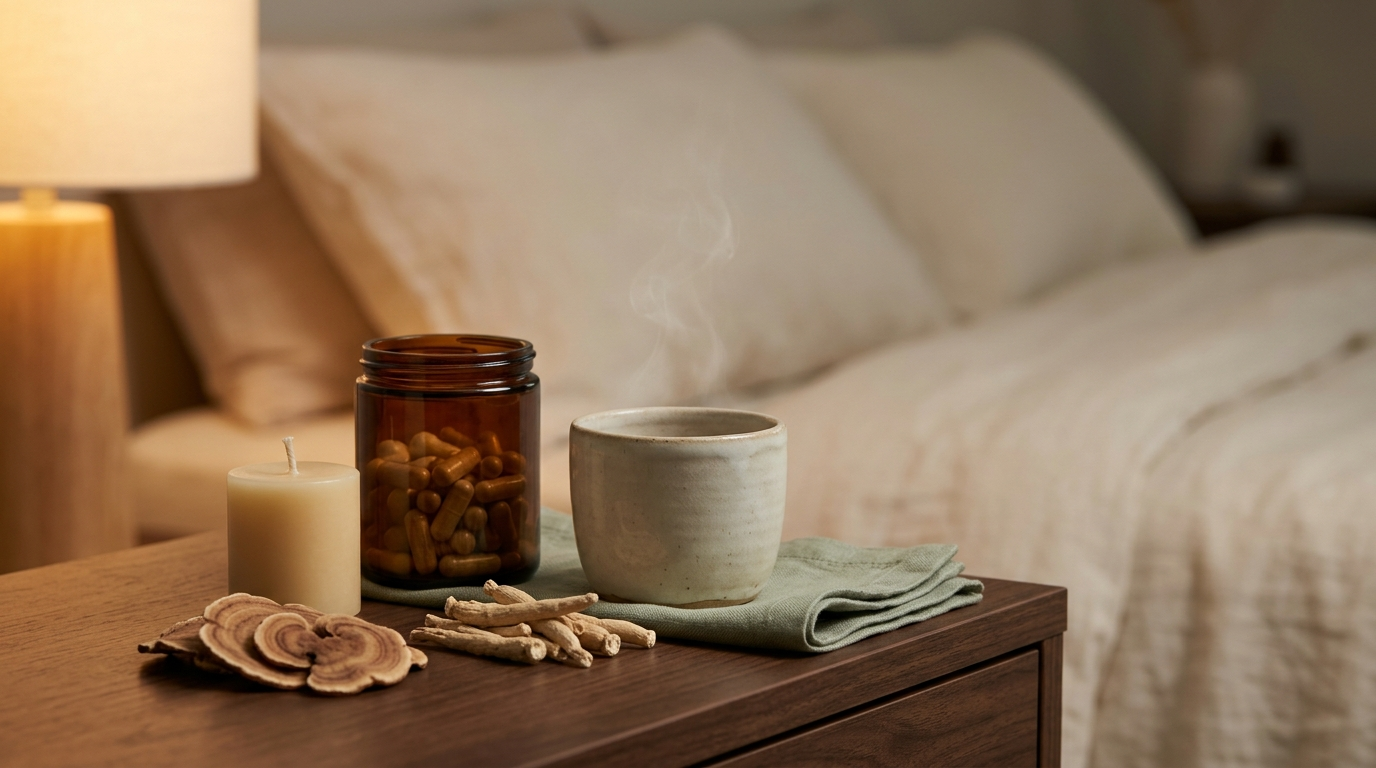
The team at Ancient Nutra runs a five-minute version of the wind-down sequence on stressful weeks. It pairs five small physical actions with one capsule of Reishi Extract about 45 minutes before bed. Nothing in it is new. Each step uses something the body already does. The point is to stack the steps in the right order, before bed instead of in it, so the nervous system has time to shift gear.
The ritual, step by step
- Close the work tabs (60 seconds). No "one more thing." Close the laptop, set the phone face-down across the room, not on the nightstand. The decision to stop is the hardest step.
- Dim the lights (30 seconds). Drop the bedroom to one warm lamp or a single candle. Bright overhead light keeps the body on daytime cortisol.
- Take one capsule of Reishi Extract with a glass of warm water (15 seconds). Roughly 45 minutes before you want to be asleep. Reishi is slow-acting, not a knock-out. The window matters.
- Stretch the hips and shoulders (90 seconds). Two minutes is enough. Standing forward fold, seated twist, slow shoulder rolls. Whatever loosens the day off the spine.
- Five rounds of box breathing (60 seconds). Inhale 4, hold 4, exhale 4, hold 4. Five rounds is enough to flip the nervous system from alert to rest.
- Read something on paper (60 seconds, then keep going). A novel, not the news. Anything backlit pulls the brain back into problem-solving mode.
The actual hands-on time is around five minutes. Steps 4 to 6 you do anyway. The ritual just stacks them in the right order, before bed, not in it.
Why this works
About 30.5 percent of US adults sleep less than seven hours on most nights, according to the most recent National Health Interview Survey (CDC NCHS, 2024). The biggest reason is not biology. It is wind-down hygiene. Three things have to happen for sleep to come easily.
Cortisol has to drop. Bright light and screen blue light keep cortisol elevated past dusk, which is the opposite of what evenings used to do naturally. Dimmed lights and slow breathing pull cortisol back down. Box breathing in particular flips the nervous system from sympathetic to parasympathetic mode in well under a minute. That switch is what most people are missing when they say they cannot turn their brain off.
Core body temperature has to fall slightly. The stretch lowers shallow muscular tension and helps the body shed a little heat through the skin. Heavy exercise late evening does the opposite, which is why the routine stays gentle.
The brain has to disengage from problem-solving mode. Phones and laptops keep the prefrontal cortex active. Paper does not. A printed page engages a slower, less rewarded loop than scrolling.
Reishi sits underneath all three. The fruiting body has been used for sleep and calm energy across East Asia for centuries. Modern lab work confirms one of the mechanisms: extracts of Ganoderma lucidum reduce sleep latency and increase total sleep time through a GABAergic pathway, the same calming brake on the nervous system that benzodiazepines act on, without the same risks (Chu et al., 2007, PubMed). Reishi is not a sedative. It quiets a noisy nervous system rather than knocking it out, which is why the 45-minute lead time matters more than the dose. The point of taking it early is not to feel sleepy. It is to soften the runway.
Two more things help, beyond the steps in the list. Stop caffeine by early afternoon, not 4 PM. Half-life is around five hours for most people, so a 2 PM espresso is still circulating at midnight. And eat the heavier meal of the day at lunch when possible. A late, heavy dinner forces digestion to compete with sleep, and digestion usually wins.
When to do it
The best window is 45 to 90 minutes before your target sleep time. Earlier than that and the body warms up again from the next activity. Later than that and the Reishi has less time to work on the GABA system before the eyes close.
Skip the ritual on nights when sleep is already arriving. If the body is already winding down on its own, do not interrupt the descent with a routine. The ritual is for the nights when the brain is wound up, not the nights when it is not.
Frequency: every weeknight, ideally. Three weeks of consistent evening structure usually moves the needle more than any single perfect night.
Look for
Dual-extract Reishi (water and alcohol), standardized for triterpenes and polysaccharides, 500 to 1,000 mg per day.
Ancient Nutra's Reishi Extract uses the standardized fruiting body, not the cheaper mycelium-on-grain you see in some Western blends.
What if you do not have Reishi Extract at home
Two substitution paths cover most evenings. If the wind-down problem is general nervous-system arousal, brew a strong cup of chamomile or holy basil tea about 45 minutes before bed. If the wind-down problem is stress-led, swap in one capsule of Ancient Nutra's Ashwagandha Extract instead. Stress and arousal feel similar at 10 PM, but they respond to different herbs. Ashwagandha is cortisol-focused. Reishi is broader and slower. Chamomile (in the form of Ancient Nutra's Chamomilla Extract, one capsule with water, or a brewed cup) is the dietary backup either way.
The pre-blended convenience is nice. The underlying mechanism does not care which delivery format you use. Pick the herb that matches the kind of wound-up you actually are tonight.
A team observation
When the team at Ancient Nutra trialled this sequence internally during a stressful production stretch in late 2024, the most consistent feedback was not "I fall asleep faster," the usual claim. It was "I stop fighting the lying-down part." That is what a wind-down does. It changes the body before bed enters the picture. People who already slept fine reported smaller changes. People who had been wound up at midnight for months reported the biggest ones, usually by the second week.
The bottom line
A five-minute evening wind-down is not a sleep aid. It is a switch the nervous system needs and most people skip. Run it for seven nights. If the evenings feel softer and the lying-down part stops being a fight, keep it. Ancient Nutra's Reishi Extract is the steady piece in the middle of the routine. The rest is structure, and structure is free.

Reishi Extract
A standardized fruiting-body mushroom extract, traditionally used to support calm and a steadier evening wind-down.
Shop Reishi ExtractSources
- CDC, NCHS Data Brief No. 559, Short Sleep Duration and Sleep Difficulties Among Adults: United States, 2024
- Chu QP et al., Extract of Ganoderma lucidum potentiates pentobarbital-induced sleep via a GABAergic mechanism, Pharmacology Biochemistry and Behavior, 2007 (PubMed 17383716)
- Yao C et al., Exploration of the anti-insomnia mechanism of Ganoderma by central-peripheral multi-level interaction network analysis, PMC8555286 (2021)
Written by the Ancient Nutra Wellness Team. The team researches, sources, and tests every ingredient before it earns a place in an Ancient Nutra blend. Questions? Email info@ancientnutra.com or message Ancient Nutra on Instagram.
Medical disclaimer: This article is for educational purposes only and is not medical advice. Statements have not been evaluated by the FDA. Ancient Nutra products are not intended to diagnose, treat, cure, or prevent any disease. Speak with a qualified healthcare provider before starting any new supplement, especially if you take prescription medication or have a medical condition.