25 August 2026 · 7 min read
What Is Actually in Fruity Glow: 6 Ingredients, Read Honestly
By the Ancient Nutra Editorial Team
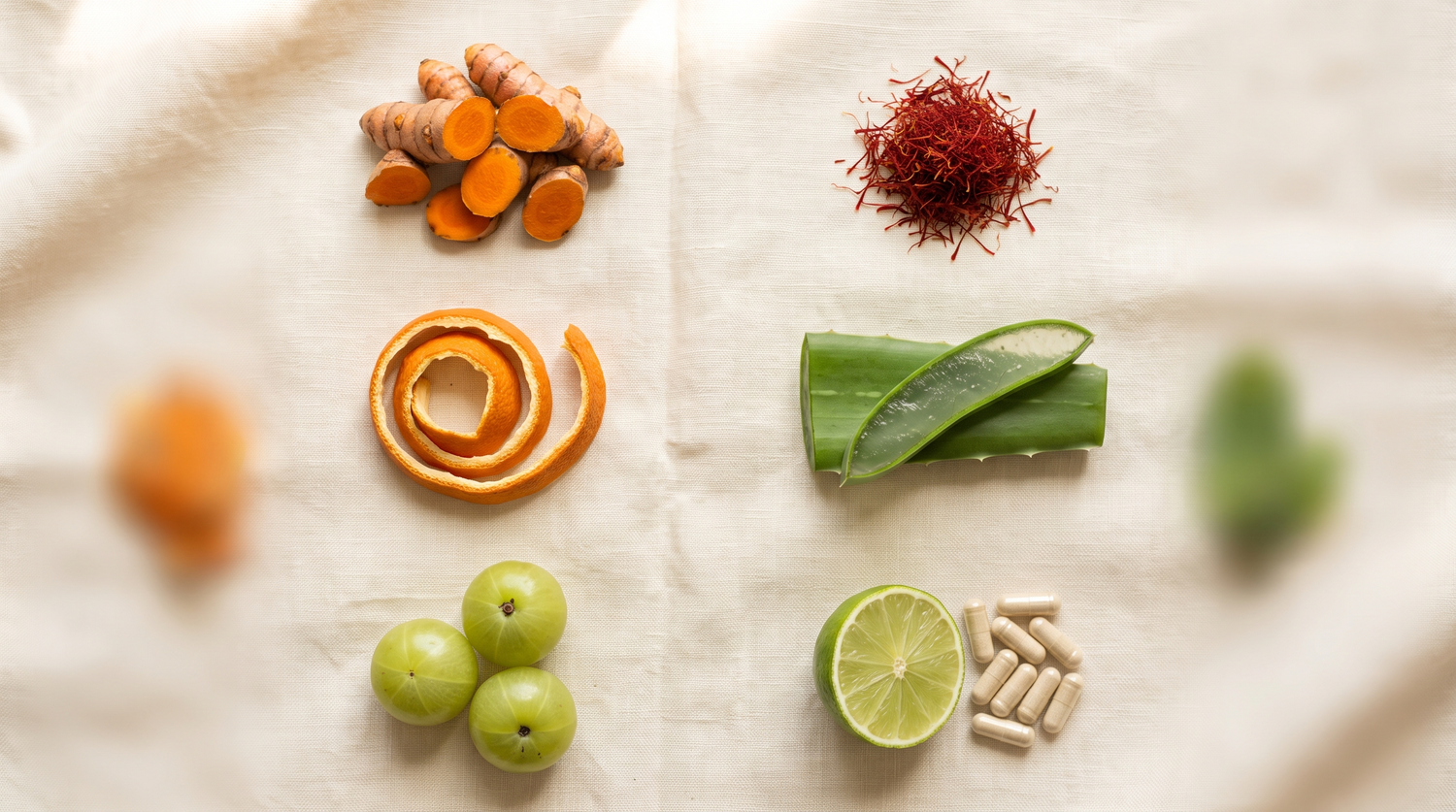
- Fruity Glow is a six-ingredient blend: Vitamin C, Turmeric, Orange Peel, Amla, Saffron Extract and Aloe Vera.
- Vitamin C is the ingredient with the clearest published basis. It is a required cofactor for collagen biosynthesis, per the NIH Office of Dietary Supplements.
- Two ingredients carry documented liver-injury signals in the NIH LiverTox database: Turmeric (likelihood score A) and Aloe Vera (score B). Both are rare and both resolve on stopping.
- The label already sets the boundary: up to 8 to 12 weeks, then a break of at least 2 weeks.
- Skin renews on roughly a 40 to 56 day cycle, so any honest timeline for a skin supplement is measured in weeks, not days.
Fruity Glow is one of the quieter products in the Ancient Nutra range. It sits on the shelf next to bigger names, it goes into the Beauty and Glow System without much fanfare, and most people who buy it could not name more than two of the things inside it. That is a reasonable place to start an honest re-read. This article opens the capsule and goes through all six ingredients one at a time: what each one is, what the published evidence genuinely supports, what it does not, and where the sensible limits sit. No new claims are made here beyond what the label states and what the cited sources say.
The short version
- Vitamin C
- Amla
- Turmeric
- Aloe Vera
- Orange Peel
- Saffron Extract
1. Vitamin C, the ingredient doing the structural work
Of the six, Vitamin C has the least ambiguous basis. The NIH Office of Dietary Supplements states plainly that vitamin C is required for the biosynthesis of collagen, acting as a cofactor for the proline and lysine hydroxylases that stabilise the collagen molecule. That is biochemistry, not marketing: without adequate vitamin C, the body cannot assemble collagen properly, which is why the classic deficiency state shows up first in skin, gums and wound healing.
What that does not mean is that more vitamin C produces more collagen indefinitely. It means the pathway needs the cofactor present. For anyone who wants the nutrient on its own rather than inside a blend, Ancient Nutra's Vitamin C 60 Capsules is the single-ingredient version.
2. Amla, the fruit that carries the vitamin C story
Amla is the fruit of Phyllanthus emblica, the Indian gooseberry, long used across Ayurvedic practice and one of the three fruits in Triphala. It is included here as a whole-fruit source of vitamin C and polyphenols rather than as a standalone active.
The honest position on amla: it has no entry in the NIH LiverTox database, which is a good sign but is not the same as having been cleared. It is best described as not evaluated rather than proven safe or proven effective. Traditional use is genuine and long. Human clinical evidence for skin outcomes specifically is thin, and this article will not pretend otherwise.
3. Turmeric, the ingredient that needs a time limit
Turmeric (Curcuma longa) is the ingredient in this blend that most deserves a careful sentence. The NIH LiverTox database gives turmeric a likelihood score of A, its highest category, meaning turmeric is a well established cause of clinically apparent liver injury. The cases are rare relative to how widely turmeric is consumed, and they typically resolve after stopping, but the rating is not a technicality.
Two things follow from that, and they are practical rather than alarming. First, this is an ingredient to take in courses, not continuously and indefinitely. Second, it is worth knowing the symptoms that mean stop and ask a doctor: unusual tiredness, nausea, dark urine, or yellowing of the skin or eyes. That is the same wording already printed on the Fruity Glow label.
4. Aloe Vera, the one with a documented onset window
Oral aloe vera carries a LiverTox likelihood score of B. The documented cases are rare and self-limiting, with no fatalities, no liver transplants and no chronic hepatitis recorded in the database. What makes aloe worth naming specifically is the timing: LiverTox describes onset typically within about 3 to 24 weeks of starting, and its illustrative case involved a woman who developed symptoms 3 to 4 weeks in.
That window overlaps almost exactly with the period most people would still consider themselves at the beginning of a supplement routine. It is another argument for the bounded course rather than the open-ended one.
5. Orange Peel, the flavonoid carrier nobody reads
Orange peel is in the blend for its flavonoid content, principally hesperidin, and for the aromatic bitters that come with the pith and zest rather than the juice. It is the ingredient most likely to be skipped over on a label, partly because it sounds like a flavouring.
It is not a headline actor and should not be sold as one. Treat it as a supporting botanical: real, food-derived, with no documented liver signal, and with no specific skin claim worth making from the current human evidence.
6. Saffron Extract, the smallest quantity and the largest evidence gap
Saffron (Crocus sativus) is the stigma of the saffron crocus, harvested by hand, which is why it appears in small quantities in almost everything that contains it. There is no LiverTox entry for it.
One clarification is worth making, because it trips people up regularly. Searches for saffron and liver safety often surface colchicine, which is described as coming from the meadow saffron or autumn crocus. That plant is Colchicum autumnale, a different and genuinely toxic species. It is not the saffron in a kitchen or in this capsule. For culinary saffron, the accurate summary is that human evidence for skin outcomes is limited and the ingredient sits closer to traditional use than to demonstrated effect.
Read the six side by side
| Ingredient | Why it is in the blend | Evidence position | LiverTox |
|---|---|---|---|
| Vitamin C | Collagen cofactor | Established biochemistry | Score E, no liver signal |
| Amla | Whole-fruit vitamin C, polyphenols | Traditional use, thin human data | Not evaluated |
| Turmeric | Antioxidant botanical | Well studied, take in courses | Score A |
| Aloe Vera | Traditional skin botanical | Rare, self-limiting cases | Score B |
| Orange Peel | Flavonoids, hesperidin | Supporting botanical | No entry |
| Saffron Extract | Traditional botanical | Limited human data | No entry |
Look for
On any multi-botanical skin capsule, look for a stated course length rather than an open invitation to take it forever. Ancient Nutra's Fruity Glow states its own boundary on the label: up to 8 to 12 weeks at a time, then a break of at least 2 weeks before resuming, and stop and consult a doctor if unusual tiredness, nausea, dark urine, or yellowing of the skin or eyes appears.
Set a realistic timeline before you start
The most common mistake with a skin supplement is judging it in a fortnight. The epidermis renews on a cycle of roughly 40 to 56 days, per the published work on epidermal turnover. A capsule taken today is therefore acting on skin that will surface over the following month and a half, not the following week.
Put that together with the label's own 8 to 12 week course and a sensible plan emerges: take it as a defined block, give it the length of one or two full turnover cycles, then stop for at least a fortnight and decide honestly whether anything changed. Do not stack it with a second turmeric-containing product at the same time, and do not run it continuously across the year.
Where it sits beside the rest of the range
Fruity Glow is one of the three capsules inside Ancient Nutra's Beauty and Glow System, alongside Collagen 60 Capsules and Carrot 60 Capsules. That division of labour is the clearest way to understand it: Collagen supplies the structural protein, Carrot supplies beta-carotene and Vitamin A, and Fruity Glow is the antioxidant and Vitamin C component of the set.
Bought on its own, it is the smallest commitment of the three. That is a fair reason to start there, and a fair reason not to expect it to do the work of all three.
The bottom line
Read honestly, Fruity Glow is one well-evidenced nutrient, two traditional botanicals with documented liver-injury ratings that argue for course-based use, and three supporting ingredients whose human evidence is limited. That is a more useful description than a glow promise, and it is enough to decide with. Anyone taking it should treat the label's 8 to 12 week course as the instruction it is, and anyone on prescription medication or managing a liver condition should speak to a doctor first.
Frequently asked questions
How long should Fruity Glow be taken?
The label states up to 8 to 12 weeks at a time, followed by a break of at least 2 weeks before resuming. Because the blend contains turmeric and aloe vera, both of which carry documented liver-injury ratings in NIH LiverTox, that course length should be treated as a boundary rather than a suggestion.
Does Fruity Glow replace a collagen supplement?
No. Vitamin C is a required cofactor for the body's own collagen biosynthesis, per the NIH Office of Dietary Supplements, but it is not collagen. Collagen 60 Capsules is a separate product, and the Beauty and Glow System includes both rather than choosing between them.
How quickly would any change show on skin?
Epidermal turnover runs on roughly a 40 to 56 day cycle, so a realistic assessment window is one to two full cycles, not one to two weeks.

Fruity Glow 60 Capsules
A six-ingredient Vitamin C and botanical blend, labelled for a bounded 8 to 12 week course.
Shop Fruity GlowSources and further reading
- Vitamin C, Health Professional Fact Sheet, NIH Office of Dietary Supplements.
- Turmeric, LiverTox, NIH National Institute of Diabetes and Digestive and Kidney Diseases.
- Aloe Vera, LiverTox, NIH National Institute of Diabetes and Digestive and Kidney Diseases.
- Koster MI, Making an epidermis, Annals of the New York Academy of Sciences, 2009, PMC2861991.
Written by the Ancient Nutra Wellness Team. The team researches, sources, and tests every ingredient before it earns a place in an Ancient Nutra blend. Questions? Email info@ancientnutra.com or message Ancient Nutra on Instagram.
Medical disclaimer: This article is for educational purposes only and is not medical advice. Statements have not been evaluated by the FDA. Ancient Nutra products are not intended to diagnose, treat, cure, or prevent any disease. Speak with a qualified healthcare provider before starting any new supplement, especially if you take prescription medication or have a medical condition.