Ancient Nutra Wellness Team · 30 September 2026 · 6 min read
5 mistakes people make with green coffee bean capsules
By the Ancient Nutra Editorial Team
- Green coffee beans are unroasted coffee, so a green coffee capsule still contains natural caffeine. Count it alongside your usual cups.
- The weight-loss evidence is thin: a review of three small trials found a modest difference versus placebo, and the reviewers rated every trial at high risk of bias.
- Take it early in the day, with food and diet changes doing the heavy lifting, and speak to a doctor first if you have high blood pressure, anxiety or a heart rhythm problem, or are pregnant.
Green coffee bean capsules sit in an odd spot. They come from the same plant as the coffee in your morning cup, yet many people treat them as a gentle herbal supplement that has nothing to do with coffee at all. That gap is where most of the mistakes happen. Some people double their caffeine without noticing. Others expect a capsule to do what only a change in eating can do, or they take it at the wrong time of day and blame it for a bad night.
None of these mistakes is hard to fix. Below are five common ones, why each one matters, and the simple correction. For the science of the bean itself, read the chlorogenic acid story.
Mistake 1. Stacking it on top of your usual coffee
The most common slip is taking a green coffee capsule with breakfast and then drinking two or three cups of coffee or strong tea on top of it, as if the capsule were caffeine-free.
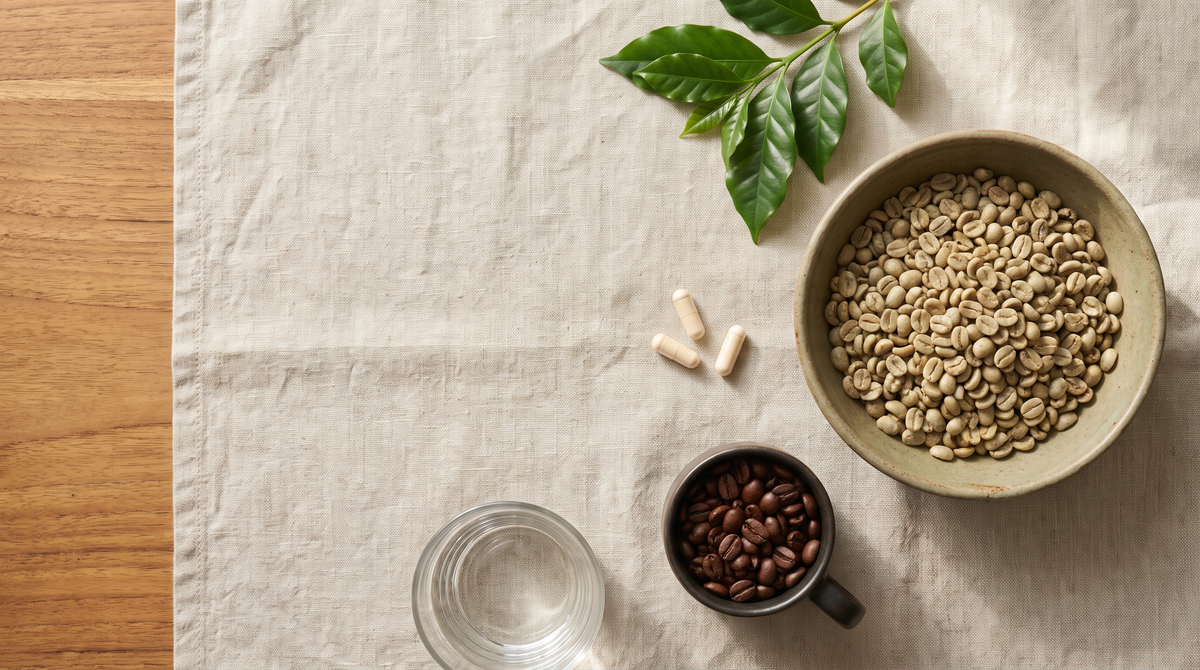
It is not. Green coffee beans are simply coffee beans that have not been roasted, and they carry natural caffeine alongside chlorogenic acid (Operation Supplement Safety). The US Food and Drug Administration cites 400 mg of caffeine a day as an amount not generally linked to negative effects in most healthy adults, and lists a racing heart, jitters, anxiety, headache and poor sleep as signs of too much (FDA). Every source counts toward that total.
The fix: treat the capsule as part of your caffeine budget. On days you take it, drop one cup of coffee or switch one to a caffeine-free drink, and notice how you feel before adding anything back.
Mistake 2. Expecting weight loss without changing what you eat
Green coffee is often sold as a weight-loss shortcut, so many people start it and change nothing else.
The evidence does not support that hope. A systematic review pooled three randomised trials with 142 people in total and found that those taking green coffee extract lost about 2.47 kg more than those on placebo. The same reviewers judged all three trials to be at high risk of bias and of poor methodological quality, and said the result could not be taken as proof (Onakpoya and colleagues, 2011). Operation Supplement Safety, run by the US military's health university, puts it plainly: there is not enough evidence to support green coffee bean for weight loss.
The fix: let food, sleep and daily movement do the real work, and see green coffee as a small, optional extra at most. If afternoon snacking is your weak point, these five craving mistakes are a better place to start than any capsule.
Mistake 3. Taking it late in the day
Because it comes in a capsule, green coffee is easy to swallow with lunch, then again with an early dinner, without thinking of it as coffee.
Caffeine lingers. In a controlled sleep study, 400 mg of caffeine taken six hours before bed still cut total sleep time by about an hour compared with placebo, and the researchers concluded that people should avoid substantial caffeine for at least six hours before bedtime (Drake and colleagues, 2013). A capsule holds far less caffeine than that test dose, but people who are sensitive to caffeine can still feel it at night.
The fix: keep green coffee to the first half of the day. Ancient Nutra's label suggests taking it 30 minutes before a meal, up to 2 capsules a day, so breakfast and lunch are the natural slots. If the 3 pm energy dip is what pushes you toward a later dose, deal with the dip instead.
Mistake 4. Ignoring blood pressure, anxiety or heart sensitivity
Some people start green coffee without asking whether caffeine suits them at all.
The FDA lists high blood pressure, a fast heartbeat, palpitations and anxiety among the effects of too much caffeine, and advises anyone concerned about a condition or a medicine, or who is pregnant, trying to conceive or breastfeeding, to ask a doctor whether they should limit caffeine. Operation Supplement Safety adds that headache and nausea have been reported with green coffee, and that the safety of long-term use is unknown.
The fix: if you have high blood pressure, an anxiety disorder, a heart rhythm problem or trouble sleeping, or you take prescription medicine, talk to your doctor before you start. If you notice a racing heart, jitters or a new headache, stop and get advice.
Mistake 5. Assuming every green coffee product matches the studies
People often read a headline about a green coffee trial and assume any green coffee capsule will do the same thing.
The trials in that 2011 review used green coffee extracts, which are concentrated for chlorogenic acid. A whole-bean powder capsule is a different product: it keeps the bean as it is, so its chlorogenic acid dose is not the same as a trial extract. Label accuracy also varies across the market; Operation Supplement Safety notes that some green coffee products tested contained less chlorogenic acid than their labels claimed.
The fix: know which kind you are buying. Ancient Nutra's Green Coffee Bean capsules use whole green coffee powder, 650 mg per capsule. Judge it as a whole-bean product taken with a sensible diet, not as a copy of any single trial.
A label that says clearly whether the capsule is whole green coffee powder or a concentrated extract, how much is in each capsule, and a daily maximum.
Ancient Nutra's Green Coffee Bean states 650 mg of whole green coffee powder per vegetarian capsule and a limit of 2 capsules a day, made under BRCGS, GMP and FSSC 22000 standards.
How to course-correct in a week
This is a one-week reset of habits, not a promise of results. The aim is to find out whether green coffee suits you at all.
- Day 1: write down every caffeine source you have in a normal day, including tea, cola and chocolate drinks.
- Day 2: on any day you take a capsule, replace one cup of coffee with water or a caffeine-free drink.
- Day 3: move every dose to before breakfast or lunch, and none after that.
- Days 4 to 7: keep a short note each evening on sleep, heart rate and jitters. If any of them get worse, stop.
By the end of the week you will know whether green coffee fits your day without costing you sleep or calm. That is the honest question to answer before you think about anything else.
Safety
Green coffee bean contains caffeine. Too much caffeine can cause a fast or irregular heartbeat, raised blood pressure, anxiety, jitters, headache, nausea and poor sleep. Do not exceed the label's 2 capsules a day, count it with your other caffeine, and avoid taking it in the evening. The safety of long-term use has not been established. Speak to your doctor before use if you are pregnant, trying to conceive or breastfeeding, have high blood pressure, a heart condition or an anxiety disorder, or take prescription medicine. Stop and seek advice if you notice palpitations, chest discomfort or a severe headache.
The bottom line
The two mistakes that matter most are forgetting that green coffee is caffeine, and expecting it to replace changes in what you eat. Count it in your daily caffeine, take it early, and keep your expectations in line with evidence that is still small and weak.
Used that way, Ancient Nutra's Green Coffee Bean can sit in a morning routine as a small extra, taken before breakfast or lunch, alongside the habits that actually move the needle.

Green Coffee Bean - 60 capsules
Whole unroasted green coffee powder, 650 mg per capsule, taken early in the day before a meal.
Shop Green Coffee BeanSources and further reading
- Onakpoya I, Terry R, Ernst E. The use of green coffee extract as a weight loss supplement: a systematic review and meta-analysis of randomised clinical trials, Gastroenterology Research and Practice, 2011. Retrieved 30 September 2026.
- Spilling the Beans: How Much Caffeine is Too Much?, US Food and Drug Administration. Retrieved 30 September 2026.
- Drake C, Roehrs T, Shambroom J, Roth T. Caffeine effects on sleep taken 0, 3, or 6 hours before going to bed, Journal of Clinical Sleep Medicine, 2013. Retrieved 30 September 2026.
- Green Coffee Bean: Dietary Supplements for Weight Loss, Operation Supplement Safety. Retrieved 30 September 2026.
Written by the Ancient Nutra Wellness Team. The team researches, sources, and tests every ingredient before it earns a place in an Ancient Nutra blend. Questions? Email info@ancientnutra.com or message Ancient Nutra on Instagram.
Medical disclaimer: This article is for educational purposes only and is not medical advice. Statements have not been evaluated by the FDA. Ancient Nutra products are not intended to diagnose, treat, cure, or prevent any disease. Speak with a qualified healthcare provider before starting any new supplement, especially if you take prescription medication or have a medical condition.