Ancient Nutra Wellness Team · 13 September 2026 · 6 min read
Why Turmeric Is Boiled Before It Ever Reaches Your Glass
By the Ancient Nutra Editorial Team
Key takeaways
- Turmeric and ginger are both rhizomes, underground stems rather than roots, and turmeric belongs to the ginger family.
- Fresh turmeric leaves the field at 70 to 80 percent moisture and has to come down to around 10 percent before it can be milled, which is why it is boiled first and not simply dried.
- The honest position on the evidence: the US National Center for Complementary and Integrative Health states plainly that we do not know enough to conclude turmeric or curcumin is beneficial for any health purpose.
Almost everything written about turmeric starts at the finished powder. The more interesting part happens months earlier, on the farm, in a metal vessel of boiling water. Before a turmeric rhizome can become anything you would drink, someone cooks it. Not for flavour, and not for safety in the way most people assume, but because raw turmeric will not dry properly otherwise. That single step is the reason turmeric powder is an even orange rather than a patchy brown, and it is worth understanding if you use the ingredient daily.
Start with the stem, not the root
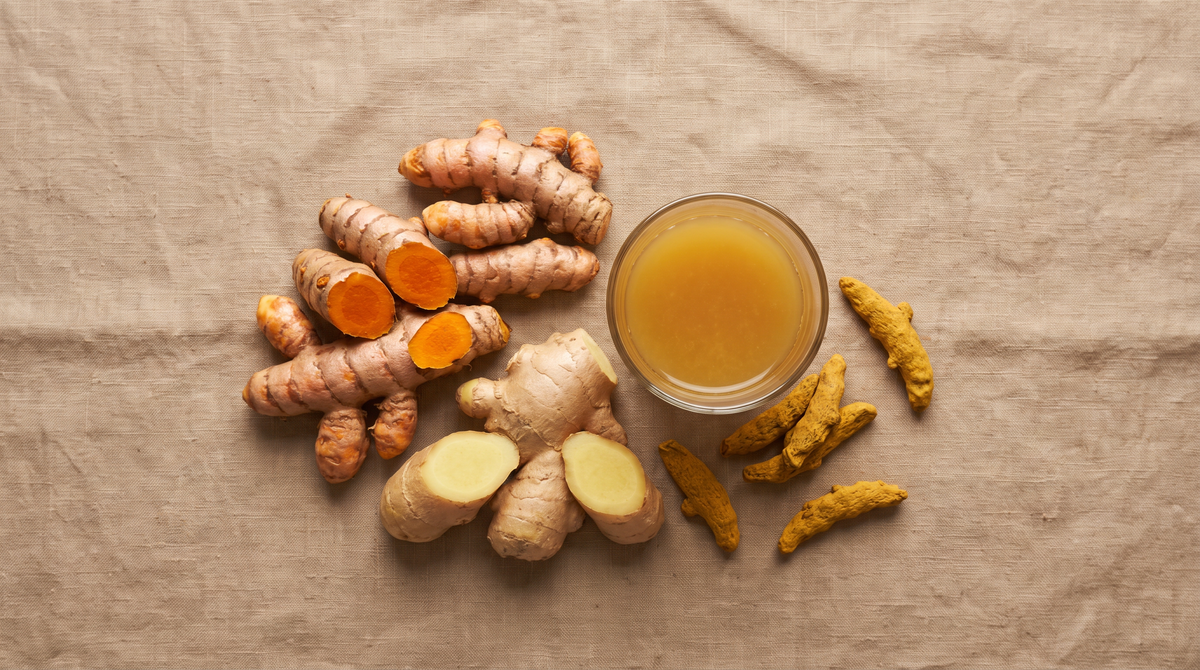
Both turmeric and ginger are commonly called roots. Neither is one. Both are rhizomes, which are horizontal underground stems that store energy for the plant and send up new shoots. The US National Center for Complementary and Integrative Health describes ginger as Zingiber officinale and names the part used as the rhizome, the underground stem. Turmeric is Curcuma longa, and it sits in the same botanical family, Zingiberaceae. Turmeric is, quite literally, a member of the ginger family.
That shared family is the reason the two behave so similarly once harvested. They store starch in the same way, they hold a similar amount of water, and they both lose their character quickly if handled badly after they come out of the ground. Ancient Nutra's Ginger capsules and the turmeric in a shot begin as the same kind of plant part, harvested the same way.
Why turmeric gets boiled on the farm it grew on
Curing, which is simply boiling the fresh rhizomes in water until they are soft, is the first post-harvest operation and it happens at farm level, usually two or three days after the crop is lifted. In the traditional method a galvanised iron vessel is used. Where volumes are larger, steam boiling replaces it.
The purpose is physical, not culinary. Boiling gelatinises the starch inside the rhizome, and gelatinised starch dries evenly. Skip the boil and the outside of the rhizome hardens before the inside has given up its water, which gives you a piece that is dry at the edge and damp at the core. Curing also destroys the vitality of the fresh rhizome so it cannot sprout, removes the raw smell, shortens the drying time, significantly reduces microbiological activity, and produces the uniform colour that turmeric is bought for.
Drying to a number, then polishing
Fresh turmeric rhizomes carry roughly 70 to 80 percent moisture at harvest. To be milled safely they need to come down to about 10 percent, and to be stored, closer to 6 percent. That is the real work of processing: removing the large majority of the weight of the crop without cooking off what gives it colour and aroma. Conventional sun drying does the job but is slow, weather dependent and tends to produce a lower grade product, which is why mechanical drying is increasingly used.
What comes out of the dryer still looks rough. Polishing is the final step, either in a mechanical drum or by hand, with the rhizomes rubbed in sacks to smooth the surface. Only then does it get ground. India accounts for roughly 80 percent of world turmeric production and about 60 percent of exports, so this sequence is, in practice, how most of the world's turmeric is made.
What the evidence supports, and what it does not
This is where most turmeric writing overreaches, so here is the plain version. The National Center for Complementary and Integrative Health states that we do not know enough to definitively conclude whether turmeric or curcumin is beneficial for any health purpose. Early evidence for osteoarthritis is described as positive but in need of higher quality studies. For ginger, the same body reports that it may help with nausea and vomiting in pregnancy, might reduce the severity of menstrual cramps, and that much of the osteoarthritis research has been of poor quality.
That is not a reason to avoid either ingredient. It is a reason to treat a daily turmeric and ginger shot as a habit you enjoy rather than a treatment you are relying on. If you want the seasonal context for that habit, the team has written separately about which Sri Lankan herbs suit the rains, and about what the daily shot ritual actually looks like.
The safety part, stated properly
Turmeric carries a documented association with liver injury. The NIH LiverTox database rates it a category A likelihood for causing clinically apparent liver injury, and that signal is almost always tied to concentrated capsule extracts rather than a 30 mL culinary shot. The distinction matters, but it is not a reason to skip the caution.
Stop and see a doctor if you notice yellowing of the eyes or skin, dark urine, persistent nausea, or unusual tiredness. On pacing, the brand's own published guidance is the one to follow: it is recommended to take a 1-week break after every 8 to 12 weeks of continuous use. That sits comfortably alongside the NCCIH position that conventionally formulated oral turmeric is likely safe in recommended amounts for up to two or three months.
Look for
A turmeric and ginger product that states its volume, its calorie count and its manufacturing standard, rather than a proprietary blend with none of the three. Ancient Nutra's Shield Shot is a 30 mL shot at 3.3 kcal per serving, made in Sri Lanka under BRCGS, FSSC 22000 and ISO 22000.
The bottom line
Turmeric is boiled before it is dried because gelatinised starch dries evenly, and even drying is what gives you uniform colour, a longer shelf life and a rhizome that mills cleanly. Knowing that will not change how a shot tastes. It should change how you read a label, and how much you trust a product that will not tell you what is in it or how it was made.

Shield Shot box, 30 pack
A month of ready to drink 30 mL turmeric and ginger shots, 3.3 kcal per serving.
Shop Shield ShotSources and further reading
- Turmeric: What You Need To Know, National Center for Complementary and Integrative Health.
- Ginger: Usefulness and Safety, National Center for Complementary and Integrative Health.
- Thul PP and Shirsat BS, Effect of curing and drying process of turmeric on its quality: A review, The Pharma Innovation Journal 2021, 10(3):1017-1024.
- Turmeric, NIH LiverTox.
Written by the Ancient Nutra Wellness Team. The team researches, sources, and tests every ingredient before it earns a place in an Ancient Nutra blend. Questions? Email info@ancientnutra.com or message Ancient Nutra on Instagram.
Medical disclaimer: This article is for educational purposes only and is not medical advice. Statements have not been evaluated by the FDA. Ancient Nutra products are not intended to diagnose, treat, cure, or prevent any disease. Speak with a qualified healthcare provider before starting any new supplement, especially if you take prescription medication or have a medical condition.