By the Ancient Nutra Wellness Team · Published June 2, 2026 · 6 min read
- Triphala is a simple blend of three dried South Asian fruits: amalaki, bibhitaki, and haritaki.
- In one open-label trial, daily Triphala raised weekly bowel frequency by about 79.5% over two weeks (Chinese Medicine, 2018).
- It works gently and slowly, so the move is one evening dose and roughly three weeks of patience, not a one-night cleanse.
Most people do not need a cleanse, a colon flush, or a cupboard full of fiber powders. They need one steady evening habit and about three weeks of patience. That is roughly where Triphala earns its reputation. It does not blast through your system, and it is not a quick fix. It works quietly, night after night, which is exactly why Ayurveda has leaned on it for so long.
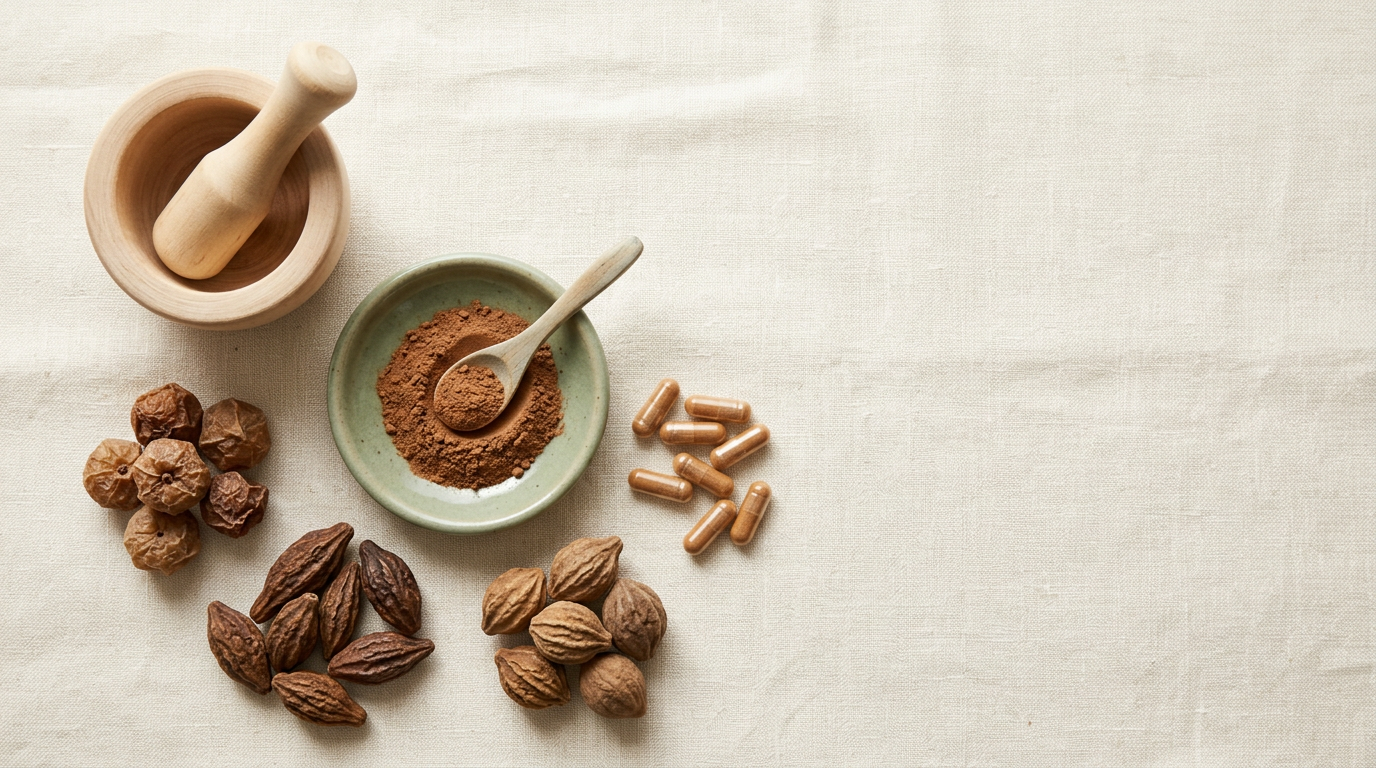
Triphala means "three fruits" in Sanskrit. It is a blend of three dried fruits that grow across South Asia: amalaki (Indian gooseberry), bibhitaki, and haritaki. Ground together in roughly equal parts, they make a tart, slightly bitter powder that has been used for digestion and gentle daily cleansing for well over a thousand years. No single exotic compound. Just three ordinary fruits doing steady work.
What Triphala actually does
Think of Triphala less as a laxative and more as a daily tune-up for the gut. The three fruits are rich in tannins and other plant polyphenols, which is why the powder tastes so astringent. Those same compounds are part of why it is one of the more studied herbal blends in traditional medicine.
A 2018 review in the journal Chinese Medicine pulled together the research on Triphala and functional digestive complaints, and the picture is consistent: it tends to support more regular bowel movements, easier transit, and a calmer gut over time rather than in a single dramatic flush (Peterson et al., Chinese Medicine, 2018). The astringent fruits seem to gently encourage the gut wall to do its own work, which is a very different feeling from a stimulant laxative.
There is an antioxidant angle too. The same polyphenols that make Triphala bitter also mop up oxidative stress, which is part of why the blend has a reputation in Ayurveda as a daily tonic and not just a digestive aid. If your main complaint is post-meal bloating or trapped gas rather than slow transit, a binder like Ancient Nutra's Activated Carbon targets that specific problem better, and the two are often used for different days rather than together.
Who Triphala is for
Triphala is a generalist, which is its strength and its limitation. It is worth considering if you are:
- Someone whose digestion has slowed down and wants a gentle daily nudge rather than a harsh stimulant.
- A person looking for one simple evening ritual instead of a stack of separate gut products.
- Anyone who eats well most of the time but still feels heavy or sluggish after dinner.
- Someone drawn to the Ayurvedic tradition who wants a foundational blend to build a routine around.
Who does not need it? If your digestion is already regular and comfortable, Triphala is not going to hand you a new superpower. And if you have sudden, severe, or painful changes in your bowel habits, that is a conversation with a doctor, not a herbal blend. Triphala is for the slow, low-grade, everyday stuff, not for acute problems.
How to actually take Triphala
The classic way is in the evening, a couple of hours after your last meal, with warm water. That timing fits the traditional idea of letting it work overnight while the body rests. In capsule form, 1 to 2 capsules (roughly 500 to 1,000mg) before bed is a sensible starting range. As loose powder, half a teaspoon to a teaspoon stirred into warm water is the traditional dose, though most people find the taste easier to live with in capsules.
Start low, take it every night, and give it time. In the first couple of weeks you may notice more regular, easier mornings. That is the change to watch for, and it is usually quiet rather than dramatic.
Look for
An equal-parts blend of all three fruits (amalaki, bibhitaki, haritaki), 500 to 1,000mg per day, taken in the evening.
Ancient Nutra's Triphala uses the traditional three-fruit ratio in a simple capsule, so the evening dose is one easy step.
Where Triphala comes from
Triphala is one of the oldest formulas in Ayurveda, and in Sri Lankan and Indian households it has long been the go-to for keeping digestion regular without drama. The three fruits were chosen to balance each other, each one tied in tradition to a different aspect of digestion. Tradition opens the door here. Modern lab work, looking at the tannins and polyphenols inside those fruits, is slowly walking through it and explaining why the blend held on for so many centuries.
How to stack Triphala
Triphala plays well with other gentle gut herbs because it is mild. A common pairing for people who struggle with a heavy, uneasy stomach is to run Triphala in the evening for regularity and reach for a soothing herb earlier in the day. Ancient Nutra's Beli, the Sri Lankan bael fruit, is a traditional choice for a calmer, settled gut and pairs naturally with a Triphala routine. This stack is for everyday digestive comfort, not a fix for a specific medical condition, and you do not need both to start. Triphala on its own is a complete first step.
How long Triphala takes to work
Give it three to four weeks before you judge it. In one open-label trial summarized in that 2018 review, a week of Triphala raised average weekly bowel frequency by about 64 percent, and two weeks pushed it to roughly 79.5 percent, with the benefit holding after the trial period (Chinese Medicine, 2018). Regularity tends to shift first. The broader, steadier feeling of a lighter, calmer gut is what people report later, once it has become a genuine nightly habit. Ninety days is a fair window to know whether it belongs in your routine.
When the team at Ancient Nutra first started recommending Triphala, the most common note back was not about any single dramatic morning. It was that people simply stopped thinking about their digestion. The heaviness after dinner faded into the background, which is usually the whole point.
For one of the simplest places to start a daily gut routine, that is what Ancient Nutra's Triphala was built for: the traditional three fruits, in an equal-parts blend, in one evening capsule. Or grind the fruits yourself the old way. The science does not care which bottle they come in.

Triphala - 60 capsules
The traditional three-fruit Ayurvedic blend for gentle, everyday digestion.
Shop TriphalaSources
- Peterson CT, et al. Triphala: current applications and new perspectives on the treatment of functional gastrointestinal disorders. Chinese Medicine, 2018.
- Open-label clinical study evaluating a Triphala-based formulation in functional constipation, PMC, 2011.
This article is for general education only and is not medical advice. Ancient Nutra supplements are not intended to diagnose, treat, cure, or prevent any disease. Speak with a qualified healthcare professional before starting any new supplement, especially if you are pregnant, nursing, taking medication, or managing a health condition.
Written by the Ancient Nutra Wellness Team. The team researches, sources, and tests every ingredient before it earns a place in an Ancient Nutra blend. Questions? Email info@ancientnutra.com or message Ancient Nutra on Instagram.