By the Ancient Nutra Editorial Team
- Ground spices do not spoil because they are old. They spoil because they got wet, and in a Sri Lankan kitchen the water arrives as steam and humid air, not as a spill.
- No mould has ever been recorded multiplying below a water activity of about 0.605, so a genuinely dry powder is safe from it. Every storage habit below exists to keep the powder on the dry side of that line.
- The southwest monsoon is finishing now. The second inter-monsoon rains arrive in October and November, which makes the next few weeks the sensible time to sort the spice shelf.
- A powder made without anti-caking agents depends entirely on how it is stored, which is a fair trade for a shorter ingredient list.
Sort the spice shelf before the October rains arrive
September is the tail of the southwest monsoon. The heavy months are ending, but the air is still thick, and the second inter-monsoon that brings Sri Lanka its October and November rain has not started yet (Faruk et al., 2022). That gap is the useful part. It is the last stretch of the year when a kitchen shelf can be reorganised calmly, before the rain makes every surface in the house feel faintly damp.
Most people notice the problem in reverse order. The jar of chilli powder that poured freely in July comes out of the cupboard in November as a solid brick. By then the fix is limited. The habits that would have prevented it cost about ten minutes to set up now.
Understand what actually ruins a powder
Ground spices have almost no free water in them, which is exactly why they keep. Microbiologists measure this as water activity, a scale from 0 to 1 that describes how much of the water in a food is available to microbes rather than locked into the food itself. A comprehensive review of growth at the dry end of that scale found no organism multiplying below a water activity of roughly 0.605, and the record holders are xerophilic fungi, the moulds that specialise in dry foods (Stevenson et al., 2015). A properly dried spice powder sits well under that figure.
So the powder in the jar is not slowly rotting. It is sitting in a stable, boring state, and it will stay there until something gives it water. In a Colombo or Kandy kitchen, that something is almost never a spilled glass. It is the steam off a pot, the humid air that rushes in every time a lid comes off, and the condensation that forms when a cold jar meets a warm room.
Clumping is the early warning. It means moisture has already entered and the particles have started bridging to each other. It is not automatically dangerous, and a lightly clumped jar of a powder that still smells right is usually fine. It is a signal that the storage is losing, and that the jar will keep getting wetter unless something changes.
Keep the jar away from the cooker
The single most common way a spice jar gets wet is being held over a simmering pan while the cook shakes some in. A pot of rice and curry throws off a continuous column of hot water vapour, and the open mouth of a jar held in it is a very efficient collector.
Measure what is needed onto a dry spoon or a small dish first, away from the stove, then add it to the pan. It feels slower for about three days and then becomes automatic. While the shelf is being reorganised, move the spice jars off the wall directly behind the cooker if that is where they live. That wall is the warmest and steamiest surface in the kitchen.
Use a dry spoon, every single time
The second route is the spoon. A spoon that has been in a curry, rinsed and shaken but not dried, carries enough water into a jar to start a clump that then spreads. So does a spoon pulled from a draining rack.
Keep one dedicated dry teaspoon on the shelf with the spices and wipe it on a cloth before it goes into a jar. It is a small discipline with an outsized effect, because it removes the only source of liquid water that regularly reaches the inside of the container.
Check the ingredient list on any ground spice before buying it. Many commercial powders include an anti-caking agent, typically silicon dioxide or a calcium salt, which keeps the powder loose in humid conditions by doing the work your storage would otherwise have to do. A powder with a single ingredient on the label has no such help. That is a reasonable thing to want, but it means the jar, the spoon and the shelf carry the whole burden.
Choose a smaller jar and fill it fuller
Air is the reservoir. A half empty one litre jar holds far more humid air above the powder than a full 200ml jar holding the same amount, and every time the lid comes off, that air is exchanged for fresh humid air from the room.
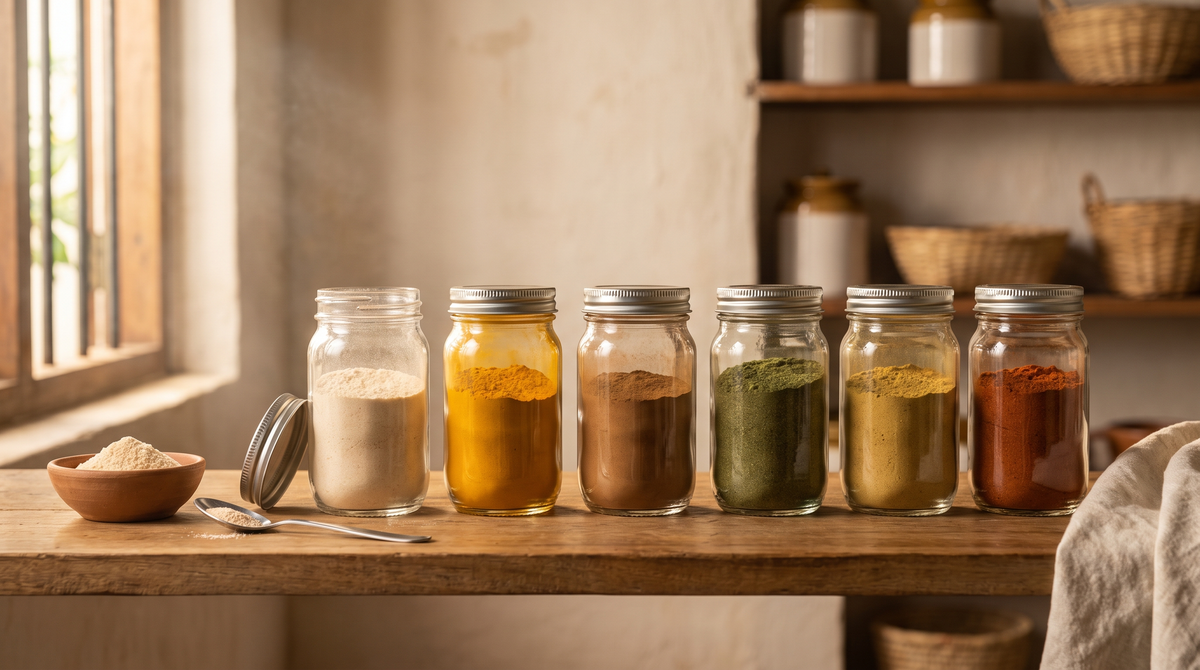
Decant into a jar the powder actually fills. Glass with a rubber gasket or a tight screw lid is better than a plastic tub with a flip top, because flip tops rarely seal. Keep the bulk of a large purchase in a sealed bag in a cool dark cupboard and refill the small jar from it every couple of weeks.
Keep powders on a shelf, not in the fridge
The fridge is a reasonable instinct and the wrong answer for dry powders. Every time a cold jar comes out into a warm kitchen, water condenses on the glass and on the powder near the surface. Repeat that twice a day for a month and the top centimetre of the jar becomes measurably damper than the rest.
A dark, dry cupboard at room temperature, away from the cooker and away from the window, beats refrigeration for anything ground and dry. Whole spices and seeds tolerate the fridge better, but they do not need it either.
Buy the size the household will actually finish
A 50g jar finished in six weeks spends six weeks being opened. A 500g tub of the same spice bought on offer spends a year being opened, through two monsoons, and every one of those openings is another exchange of humid air. The large tub is cheaper per gram and more expensive per usable gram.
This is the least glamorous habit on the list and probably the most effective one.
Judge a caked jar honestly, then act
A jar that has gone solid is not automatically ruined. Break it with a dry fork and look at what comes apart. If the colour is even, the smell is still sharp and characteristic, and the pieces crumble back into a loose powder, it has taken on moisture but nothing has grown in it. Use it soon rather than saving it.
Throw it out if any of the following is true: there is visible fuzz or a powdery bloom of a different colour, the smell has gone flat, musty or faintly sour, or the mass is damp rather than merely hard. Do not sieve out the good part and keep it. Once a jar has supported growth, the rest of the jar has been in the same air.
The honest version of this advice is that these five habits came out of losing a jar rather than reading about one. A jar of ground spice kept on the shelf above a kettle set a personal record last year for the fastest a 100g jar has ever turned into a single lump, roughly five weeks, and the lesson stuck harder than any of the storage guidance that had been read and ignored beforehand.
Start with the one you use most
There is no need to reorganise the whole shelf in one evening. Pick the spice that gets opened most often in the house, because it is the one exposed to the most humid air, and give it the small jar, the dry spoon and the spot away from the cooker. Then do the next one next week.
For a broader sort of the same cupboard, the 30-minute Sunday kitchen reset covers the rest of the shelf. Readers who want the same scepticism applied to what is printed on a pack will find it in five things to check on a label before buying, and those building a humid-weather morning habit can read the five-minute morning water ritual for humid days.
 Ancient Nutra Garlic Powder 50g
Pure ground dehydrated garlic with no preservatives, fillers, anti-caking agents or MSG, made in Sri Lanka under BRCGS, FSSC 22000 and ISO 22000. About an eighth of a teaspoon stands in for one fresh clove, and the 50g size is small enough that a household finishes it while it is still loose.
Shop Garlic PowderSources
- Stevenson A, Burkhardt J, Cockell CS, Cray JA, et al. Multiplication of microbes below 0.690 water activity: implications for terrestrial and extraterrestrial life. Environmental Microbiology. 2015;17(2):257 to 277. PMID 25142751
- Faruk MO, Jannat SN, Rahman MS. Impact of environmental factors on the spread of dengue fever in Sri Lanka. International Journal of Environmental Science and Technology. 2022;19(11):10637 to 10648. PMC8758894
This article is general information about food storage and is not medical advice. Ancient Nutra Garlic Powder is a culinary seasoning and no health benefit is claimed for it here.