Ancient Nutra Wellness Team · 14 July 2026 · 6 min read
Katupila, the Sri Lankan herb for a quieter liver and clearer skin
- Katupila, known in Ayurveda as Sarapunkha, is a Sri Lankan plant used traditionally for liver support and skin conditions.
- A 2014 Indian Journal of Pharmacology study found Tephrosia purpurea extract lowered elevated liver enzymes in arsenic exposed rats, early evidence, not a human guarantee.
- Ancient Nutra's Katupila capsules offer a standardized daily dose without needing to source or prepare the raw root.
Most people outside Sri Lanka have never heard of Katupila. Most people inside Sri Lanka have heard their grandmother mention it once, usually about a skin rash or a sluggish stomach, and then moved on without asking what it actually was. That quiet reputation is the whole story here: a plant villages have leaned on for generations, without much noise, that modern research is only now starting to catch up to.
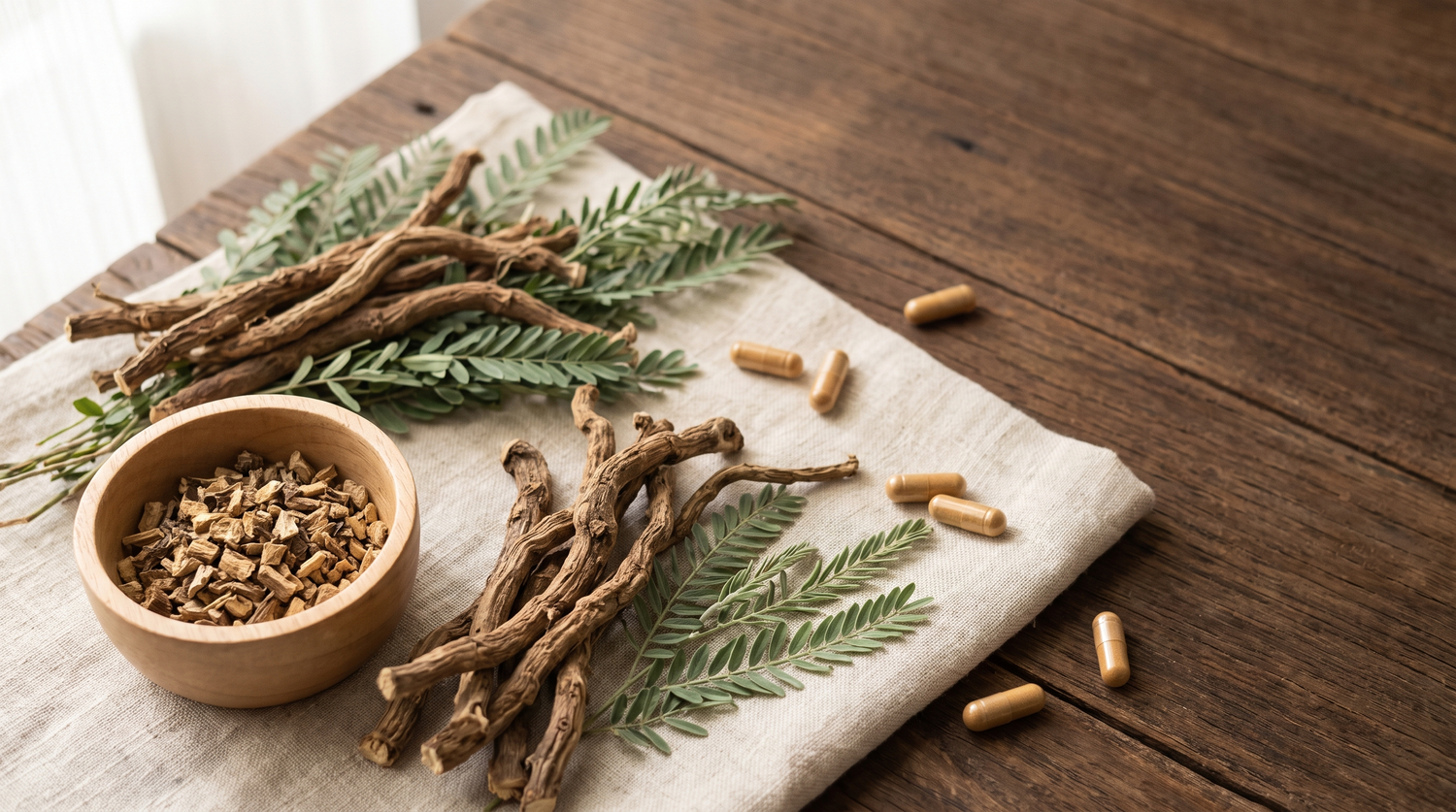
Katupila is the Sinhala name for a small, hardy shrub that grows wild across Sri Lanka's drier zones. In Ayurveda it is called Sarapunkha, and it has a long record of traditional use for liver complaints, skin conditions, and general detoxification. Its botanical name is usually given as Tephrosia purpurea (the name katupila is used in Sinhala for both Tephrosia purpurea and Flueggea leucopyrus), part of the pea family, and traditional practitioners have used its roots and leaves in decoctions for generations.
What Katupila actually does
The traditional use of Katupila centers on the liver, and that is also where the modern research has looked first. A 2014 study in the Indian Journal of Pharmacology gave Tephrosia purpurea root extract to rats exposed to arsenic, a toxin known to spike liver enzymes like ALT and ALP. The rats given the extract showed significantly lower levels of those enzymes than the ones exposed to arsenic alone, evidence the plant has a genuine protective effect on liver tissue, at least in this animal model.
That is an honest way to say it: this is preclinical, rat level evidence, not a clinical trial in humans. But it lines up with what traditional Ayurvedic and Sri Lankan village medicine have claimed for a long time, which is exactly the kind of pattern worth paying attention to. The plant also carries flavonoids like rutin and quercetin, the same broad family of plant compounds found in green tea and berries, which is part of why researchers keep circling back to it.
Who should consider Katupila
- Anyone recovering from a heavy festive season or a stretch of regular drinking. Liver support herbs work best as part of a reset, not a permanent crutch.
- People dealing with recurring minor skin issues like rashes or slow healing, where traditional use points to Katupila alongside diet and hygiene basics.
- Anyone already using a liver support routine who wants a Sri Lankan alternative to milk thistle or artichoke extract.
- People who prefer traditional, single-ingredient herbs over complex blends, and want to know exactly what they are taking.
Who probably does not need it: anyone with a diagnosed liver condition under a doctor's care, since that calls for medical treatment, not a supplement. And anyone expecting a fast, dramatic result. This is a slow, foundational herb, not a quick fix. If the goal is a one-week reset before a specific event, a longer runway or a different approach entirely makes more sense.
How to actually take it
Katupila is typically taken as a capsule once or twice a day, with food, to reduce the chance of stomach upset. Most people start with a single daily capsule for the first two weeks to see how it sits, then move to twice daily if a stronger, ongoing liver-support routine is the goal. It pairs naturally with a lower-alcohol, lower-fried-food stretch, since the herb works with the effort, not instead of it.
Morning, with breakfast, is the easiest time to remember it, though evening works just as well if that fits daily routine better. Consistency matters more than timing here. A capsule taken most days for three months does more than a perfect routine kept for two weeks and then abandoned.
Look for
A standardized Tephrosia purpurea (Sarapunkha) root capsule, not a loose or unverified powder. Ancient Nutra's Katupila capsules are sourced and tested for consistency, so the dose on the label is the dose in the capsule.
Where Katupila comes from
Katupila grows along roadsides and dry scrubland across Sri Lanka, the kind of plant most people walk past without a second look. Village practitioners have used its root as a decoction for liver complaints and skin conditions for generations, long before anyone ran a lab test on it. Ayurvedic texts call it Sarapunkha, meaning roughly "the plant with feathered leaves," and file it under herbs for detoxification and blood purification. The modern science is not proving the tradition wrong. It is mostly catching up to it, one small study at a time.
What works alongside Katupila
For a fuller liver-support routine, Katupila pairs well with Ancient Nutra's Heenbovitiya, a separate Sri Lankan herb traditionally used for fatty liver and blood sugar support. The two come from different plant families and different mechanisms, so stacking them is not redundant, it covers more ground. This combination is for someone specifically working on liver recovery, not something everyone needs to add.
For the skin side of Katupila's traditional use, some people pair it with Ancient Nutra's Neem, another herb with a long Sri Lankan record for skin and blood support. Again, this is a specific-use stack, not a default.
How long until you feel something
Liver and skin herbs are slow by nature. Most people notice nothing dramatic in the first two weeks, which is normal, not a sign it is not working. By six to eight weeks, some people report steadier digestion and calmer skin. The honest patience point is 90 days before judging whether it is doing anything for you, the same rule that applies to most traditional herbs in this category.
The bottom line
Katupila is a quiet, traditional Sri Lankan herb for liver and skin support, backed by early animal research and a long, consistent record of village use. For a standardized daily dose without the guesswork of sourcing raw root, that is what Ancient Nutra's Katupila capsules were built for. The science does not care which bottle it comes in, it cares about consistency and time.

Katupila
A standardized Sarapunkha root capsule for traditional liver and skin support.
Shop KatupilaSources and further reading
- Indian Journal of Pharmacology, 2014, Hepatoprotective activity of Tephrosia purpurea against arsenic induced toxicity in rats.
- Ask Ayurveda, Tephrosia purpurea (Sarapunkha): traditional uses and background.
Written by the Ancient Nutra Wellness Team. The team researches, sources, and tests every ingredient before it earns a place in an Ancient Nutra blend. Questions? Email info@ancientnutra.com or message Ancient Nutra on Instagram.
Medical disclaimer: This article is for educational purposes only and is not medical advice. Statements have not been evaluated by the FDA. Ancient Nutra products are not intended to diagnose, treat, cure, or prevent any disease. Speak with a qualified healthcare provider before starting any new supplement, especially if you take prescription medication or have a medical condition.