Ancient Nutra Wellness Team · 26 August 2026 · 6 min read
Katupila: What Sri Lanka's Dry-Zone Herb Actually Is
By the Ancient Nutra Editorial Team
Key takeaways
- Katupila is Flueggea leucopyrus, a thorny shrub of Sri Lanka's dry zone, used traditionally as a leaf preparation.
- The published work on it is laboratory work. There are no human trials, and that is worth saying plainly.
- Treat it as a traditional herb taken at a sensible dose, not as a treatment for anything.
Most herbs get written about backwards. The benefits list arrives first, the plant itself somewhere near the bottom, and the question of what was actually studied never arrives at all. Katupila is a good herb to do the other way round, because the interesting part is how much is genuinely known and how much is not.
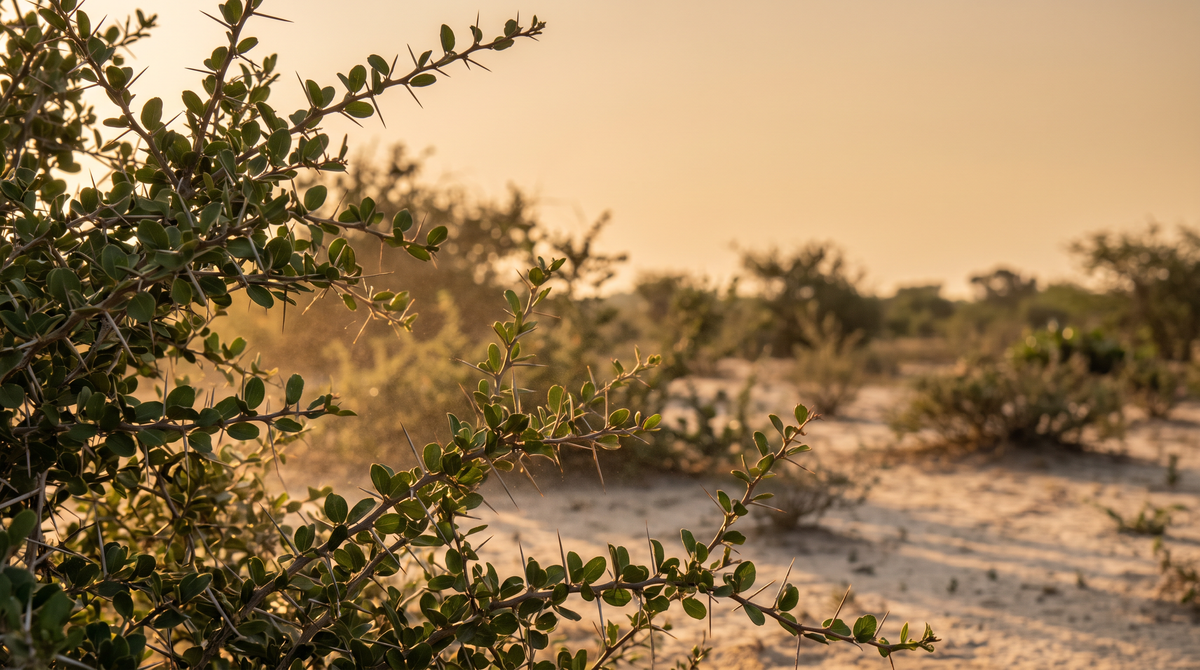
It is a thorny shrub that grows across the dry zone of Sri Lanka, unremarkable to look at, and long used in village and traditional practice. What follows is what it is, what has been tested, and where the evidence stops.
What Katupila actually is
Katupila is the Sinhala name for Flueggea leucopyrus, a shrub in the family Phyllanthaceae. It grows as a spiny, densely branched bush in the dry lowland zones of Sri Lanka and parts of India, in sandy and scrubby ground that suits very little else. The leaves are the part traditionally used.
The botanical name matters more here than it usually does. Sinhala plant names are local and practical rather than taxonomic, and the same common name can attach to more than one species depending on district and on who is speaking. A common name tells you what people call a plant. Only the binomial tells you which plant is in the jar. When comparing any Katupila product, that Latin name is the thing worth checking on the label.
What the research actually shows, and where it stops
This is the section most ingredient articles skip. The honest position on Katupila is that the published science is early and laboratory-based.
The most cited work is a 2014 study in BMC Complementary and Alternative Medicine, which prepared a freeze-dried aqueous extract of the leaves and measured its antioxidant activity, reporting a phenolic content of about 22 percent as gallic acid equivalents. Phenolics are the plant compounds behind a lot of antioxidant behaviour, so a figure in that range tells you the leaf is chemically interesting. The authors were explicit that their work was laboratory testing and did not progress to animal or human trials. Later work has taken it as far as animal models of inflammation.
What that means in practice: there is a reasonable chemical case for why traditional practice settled on this leaf, and there is no clinical evidence in people. Those two statements sit together comfortably. Anyone presenting Katupila as proven for a health outcome is going further than the published record allows, and Ancient Nutra will not do that.
Who it is for, and who does not need it
- People already using traditional Sri Lankan herbs. If Iramusu, Welpenela or Beli are familiar, Katupila belongs to the same category of plants and fits the same habit of a daily herbal capsule.
- People who want the local plant rather than the imported one. Katupila is a dry-zone endemic rather than a globally traded botanical, which is most of its appeal.
- People who prefer a capsule to a decoction. Traditional preparations are boiled leaf, which few households make now. A capsule is the practical version.
- Who does not need it: anyone looking for a supplement with human clinical evidence behind it. Katupila does not have that, and there are ingredients that do. Anyone pregnant or nursing, anyone managing a kidney or liver condition, and anyone on prescription medication should speak to a doctor before starting rather than after.
How to actually take it
Ancient Nutra's Katupila capsules are pure Katupila powder, taken as 1 to 2 capsules daily with water, ideally with a meal. Take it with food rather than on an empty stomach, which is the usual advice for any plant-powder capsule and helps with tolerance.
On duration, the honest answer is that no human trial exists to set a window, so no window can be quoted. Treat it as a traditional daily herb rather than a course of anything: take it consistently for a defined stretch, pay attention to how you feel, and stop and reassess rather than continuing indefinitely by default. Stop and speak to a healthcare professional if anything feels off, particularly persistent digestive upset.
Look for
A label that names the species, not just the Sinhala name, and states the plant part. Ancient Nutra's Katupila capsules are pure herb powder in a vegetarian capsule, made in Sri Lanka under BRCGS, GMP, HACCP, FSSC 22000 and ISO 22000.
Where Katupila comes from
Katupila is a plant of the dry zone, the drier lowland districts where scrub and thorn do better than anything green and thirsty. It is not a plantation crop and not a garden ornamental. It grows in hedgerows and waste ground, which is exactly why traditional practice reached for it: it was there, in quantity, at no cost. The leaves were used in poultices and boiled preparations, mostly applied to the skin and mostly for everyday complaints rather than serious ones.
What works alongside it
Katupila sits naturally with the other Sri Lankan endemics rather than with imported adaptogens. Ancient Nutra's Iramusu capsules are the usual companion, a cooling root with a long domestic history and a similar traditional-use profile. Welpenela is the other, used traditionally for skin and joints.
One at a time, though. Starting three unfamiliar herbs in the same week means that if something disagrees with you, there is no way to know which one it was. Add one, give it a few weeks, then decide whether the second is worth adding at all.
The bottom line
Katupila is Flueggea leucopyrus, a thorny dry-zone shrub whose leaves carry a genuinely interesting phenolic profile and a long record of traditional use in Sri Lanka. The laboratory work supports the chemistry. The clinical work has not been done.
That makes it a reasonable herb to take as part of a traditional daily routine, at 1 to 2 capsules with a meal, and an unreasonable thing to take instead of medical care for anything. If that sounds like a modest pitch, it is the one the evidence supports.

Katupila 60 Capsules
Pure Katupila leaf powder from a Sri Lankan dry-zone shrub, in a vegetarian capsule.
Shop KatupilaSources and further reading
- Evaluation of antioxidant and antiproliferative activity of Flueggea leucopyrus Willd (katupila), BMC Complementary and Alternative Medicine, 2014.
- Flueggea leucopyrus Willd. species record, Flora of Sri Lanka.
Written by the Ancient Nutra Wellness Team. The team researches, sources, and tests every ingredient before it earns a place in an Ancient Nutra blend. Questions? Email info@ancientnutra.com or message Ancient Nutra on Instagram.
Medical disclaimer: This article is for educational purposes only and is not medical advice. Statements have not been evaluated by the FDA. Ancient Nutra products are not intended to diagnose, treat, cure, or prevent any disease. Speak with a qualified healthcare provider before starting any new supplement, especially if you take prescription medication or have a medical condition.