
By the Ancient Nutra Wellness Team · 6 min read
Guduchi (Tinospora cordifolia) has been associated with liver injury in published case reports. The US National Institutes of Health LiverTox database lists it as a well-established cause of clinically apparent liver injury, with cases typically appearing between a few weeks and six months of use (NIH LiverTox, NBK608429).
Do not take Guduchi if you have liver disease, or alongside other medicines or supplements known to affect the liver, without medical advice. Stop taking it and seek medical attention if you notice yellowing of the eyes or skin, dark urine, persistent nausea, unusual tiredness, or pain in the upper right abdomen. Do not take it continuously for long periods without a doctor's supervision.
- Guduchi, called Rasakinda in Sinhala, is a climbing vine that Ayurveda has used as an immune tonic for roughly 2,000 years.
- Lab work shows it wakes up the immune system's cleanup cells, which is why it has long been the herb people reach for during fevers and after illness.
- It is a daily, slow-build habit, not a cold remedy. Most studies use around 300 to 500mg of extract, once or twice a day with food.
- Guduchi carries a documented liver-safety signal (NIH LiverTox). Read the caution above before taking it, and treat it as a cyclical herb, a few weeks on and then a break, rather than a continuous, year-round habit.
Most herbs that get called "immune boosters" do nothing of the sort. They are vitamin C in a fancier jar. Guduchi is one of the few traditional plants with a different story: a 2,000-year run in Ayurvedic medicine as the go-to herb for fevers and recovery, and a stack of modern lab studies trying to explain why. It will not stop you catching a cold this week. What it does is steadier and more interesting than that.
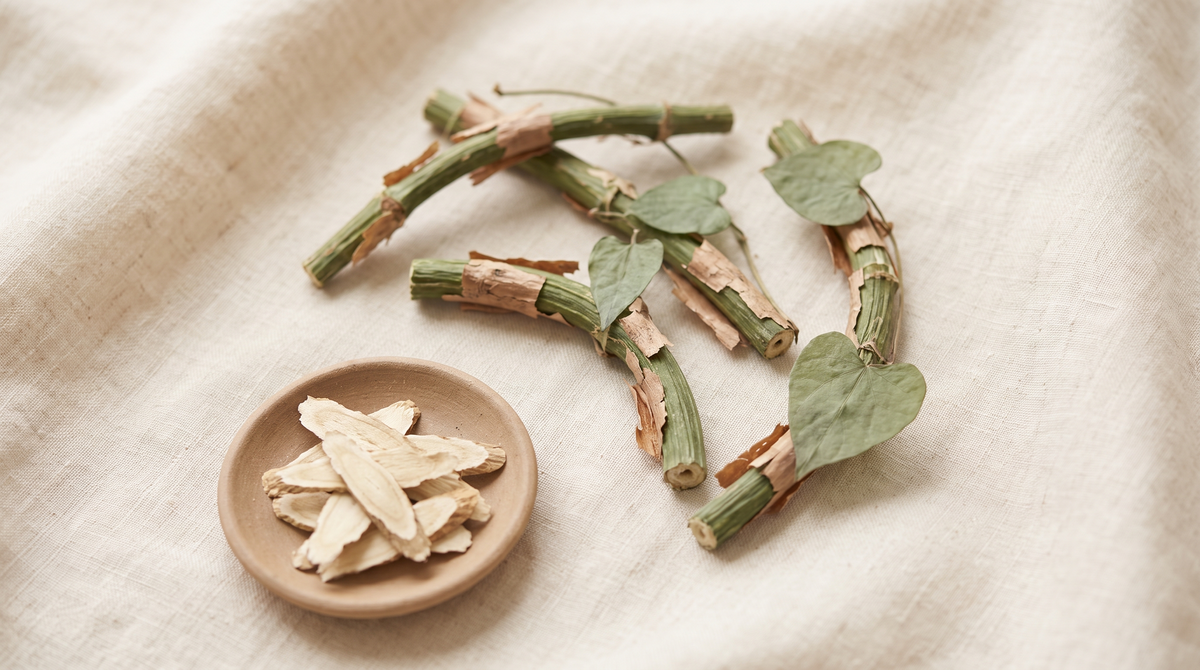
Guduchi, known in Sri Lanka as Rasakinda, is a climbing vine from the same botanical family that grows across the island and much of South Asia. The stem is the part used. In the old texts it earned the name "Amrita," the herb of immortality, which tells you how seriously it was taken. People drank it as a bitter decoction during fevers, after illness, and through the dry season when energy ran low.
What Guduchi actually does
The simplest way to think about Guduchi is that it does not push your immune system in one direction. It nudges it toward balance. That is what "immunomodulator" means, and it is the word that keeps appearing in the research.
In lab studies, Guduchi extract increases the activity of macrophages, the immune cells whose job is to find and swallow anything that does not belong, from bacteria to cellular debris (Tinospora cordifolia: one plant, many roles, NIH). A 2017 review of the herb's pharmacology pulled together the active compounds behind this, a group with long names like cordifolioside and magnoflorine, and found they consistently support the cells that do the front-line work (immunomodulatory review, PubMed).
This is the honest reason Guduchi shows up in fever and recovery formulas rather than in pain or sleep ones. Its lane is the immune system. If you want the anti-inflammatory side of the picture covered too, that is a different herb's job, and Ancient Nutra's Turmeric & Black Pepper is the usual partner there.
Who should consider Guduchi
Guduchi is a quiet, daily herb, so it suits people who want steadiness more than a quick fix. It tends to make the biggest difference for:
- People who catch everything going around. If every office cold and every change of season lands on you, a daily immune tonic is worth a fair trial.
- Anyone coming back from an illness. Guduchi's traditional home is the recovery window, the foggy, low-energy stretch after a fever has passed.
- People run down by a hard season. Long hours, broken sleep, and stress all chip away at immunity. Guduchi will not fix those, but it gives the system a little support while you do.
- Anyone wanting a non-stimulant daily herb. Unlike a lot of "wellness" products, Guduchi has no caffeine and no jolt. You will not feel it the way you feel coffee.
And the honest other side: if you are generally healthy, sleeping well, eating real food, and rarely get sick, you may not notice much. That is fine. Guduchi earns its place when the immune system is under load, not when everything is already running smoothly.
How to actually take Guduchi
The dose that does something in most modern studies sits around 300 to 500mg of Guduchi extract, taken once or twice a day. Take it with food. The traditional powder form ran higher, closer to a teaspoon brewed as a bitter tea, but a standardized extract gives you a known amount in a capsule without the bitterness.
Timing is flexible because it is not a stimulant. A common pattern is one capsule with breakfast, and a second with dinner during a season when you feel run down. In the first three to four weeks, do not expect fireworks. What people usually report first is simply getting sick less often through a stretch where they normally would have.
Where Guduchi comes from
Guduchi grows as a wild vine that climbs through hedges and trees across Sri Lanka and India. In Sinhala it is Rasakinda, and the bitter stem decoction was a standard household answer to a coming fever, made the way Yaki Narang and other village tonics were made: boiled down, strained, handed over warm. Ayurveda placed it among its most valued plants, which is how it picked up the "Amrita" name. The tradition opened the door here. The modern lab work is what walks you through why it held that place for so long.
What to stack with Guduchi
Guduchi handles the immune-balancing side. The two herbs that pair with it most naturally cover the gaps it does not.
For calm, sleep-supporting immunity, a mushroom like reishi is the classic match, and Reishi Extract is currently unavailable while we source new raw material. In the meantime, Ancient Nutra's Maca Root Extract is a related in-stock adaptogen. For the inflammation side, turmeric is the partner, especially in the run-down weeks when everything aches a little. This stack is for people whose immune system is genuinely under pressure, not a default everyone needs.
How long Guduchi takes to work
Guduchi is not a fast herb, but it is also not one to take without a break. Traditional use is cyclical: a few weeks during a run-down stretch or a season when you are catching everything going around, then a break, rather than a continuous, year-round habit. Given the liver-safety signal above, that cyclical pattern is also the more cautious one, and continuous year-round use is not something we would suggest without a doctor's supervision. What tends to shift first within a cycle is how often you get knocked down: fewer of those two-day colds that usually arrive with every weather change. Energy through a recovery window often follows.
When the team first kept Guduchi in rotation through a Colombo monsoon, running it in cycles rather than daily without a break, the feedback was not dramatic. It was a version of the same line, over and over: "I usually get the seasonal cough by now, and this year I did not." That is what a good immune herb sounds like within a sensible cycle, not an indefinite daily habit.
For a ready daily capsule of the same Rasakinda vine, Ancient Nutra's Guduchi keeps the traditional herb in a known dose, with nothing else in the bottle. Pair it with sleep, real food, and a sensible season of rest, and let the herb do the small, steady part it has done for two thousand years.

A pure stem extract of the Rasakinda vine, for steady daily immune support.
ShopSources
- Upadhyay et al. Tinospora cordifolia (Guduchi): one plant, many roles. NIH (PMC)
- Sharma et al. Immunomodulatory effects of Tinospora cordifolia. PubMed
- Therapeutic application, phytoactives and pharmacology of Tinospora cordifolia. NIH (PMC)
Written by the Ancient Nutra Wellness Team. The team researches, sources, and tests every ingredient before it earns a place in an Ancient Nutra blend. Questions? Email info@ancientnutra.com or message Ancient Nutra on Instagram.
Medical disclaimer: This article is for educational purposes only and is not medical advice. Statements have not been evaluated by the FDA. Ancient Nutra products are not intended to diagnose, treat, cure, or prevent any disease. Speak with a qualified healthcare provider before starting any new herb or supplement, especially if you are pregnant, take prescription medication, or have an autoimmune condition.