Ancient Nutra Wellness Team · 15 October 2026 · 6 min read
Guduchi in Ayurveda: what the traditional-use record actually says
- Guduchi (Tinospora cordifolia) has a long place in Ayurvedic practice, but a traditional-use record is a history of use, not a trial result.
- NIH LiverTox rates Guduchi as a well established cause of clinically apparent liver injury, and a 43-patient Indian study reported cases ranging from acute hepatitis to liver failure.
- If a person chooses to take it, the responsible frame is a bounded course (8 to 12 weeks, then a one-week break) and knowing the four stop-symptoms.
Guduchi is one of the most quoted names in modern Ayurveda writing. It turns up in immunity blends, wellness feeds and family remedies, usually with a line about 2,000 years of use. That line is worth slowing down on. Long use tells you a plant mattered to a culture. It does not tell you what the plant does, at what amount, or for whom it is safe. This article sorts those three questions apart.
What Guduchi is and where it sits in Ayurveda
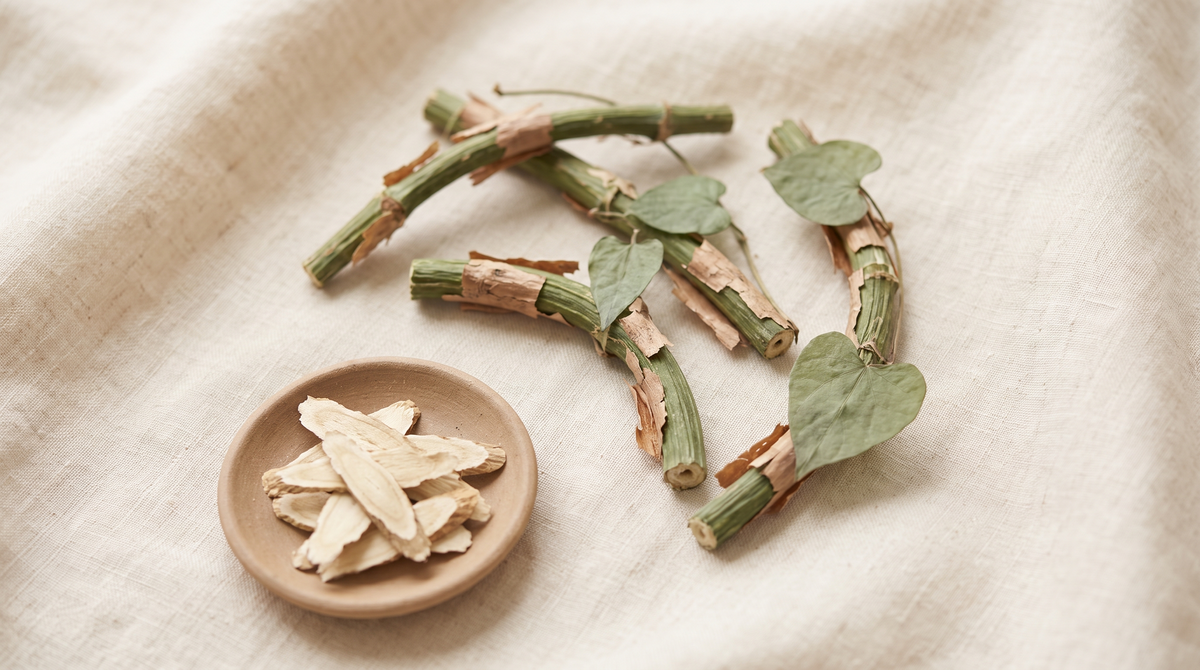
Guduchi is the Sanskrit name for Tinospora cordifolia, a climbing vine with heart-shaped leaves and a stem that thickens and develops papery bark as it ages. It is known in Hindi as giloy and in Sri Lanka as rasakinda. In Ayurvedic practice the stem is the part most often used, traditionally dried and prepared as a decoction, powder or extract.
In Ayurvedic practice Guduchi is associated with immunity, fevers and recovery after illness. That is where the record is strongest: it shows what practitioners chose to use and in what setting. It is a cultural and historical document, and the Ancient Nutra team treats it as exactly that.
What a traditional-use record can and cannot establish
A traditional-use record can establish four things with reasonable confidence:
- The plant has been used for a long time in a specific tradition.
- Which part of the plant was used and how it was usually prepared.
- The conditions or seasons it was associated with.
- That it was not known, in that tradition, to cause immediate and obvious harm at the amounts used.
It cannot establish that the herb works for a given purpose, that a modern capsule or concentrated extract behaves like a home decoction, or that rare and delayed harms are absent. Harms that appear in a small share of users, or weeks after starting, are easy to miss in an oral tradition and easy to miss in a family kitchen. That gap is not a criticism of Ayurveda. It is simply the limit of any history-based record, and it is why modern case reporting matters.
What modern case reports add to the picture
The modern record on Guduchi is mostly about safety, and it is serious. The US National Institutes of Health runs LiverTox, a public database that rates how strongly a substance is linked to liver injury. It rates Tinospora cordifolia at its highest likelihood category, "A," described there as a well established cause of clinically apparent liver injury.
A multicentre study from India, published in Hepatology Communications in 2022, looked at 43 patients across 13 centres whose liver injury followed use of Giloy during the COVID-19 period, when the herb was widely promoted as an immune booster. The median time from first use to symptoms was 46 days. Presentations ranged from acute hepatitis to worsening of existing chronic liver disease to acute liver failure, and many cases showed autoimmune features. The authors concluded that Giloy can unmask autoimmune hepatitis in people who had a silent form of it, and called for more safety and efficacy work on heavily promoted herbals.
Two points are worth stating plainly. First, this is a case series, which shows an association and cannot give a risk percentage. Second, the same study notes that the herb was being promoted for immunity without matching safety evidence. That is the pattern the Ancient Nutra team wants readers to recognise: a strong traditional story, a popular claim, and a thin safety record running in parallel.
Who should skip it, and who should ask first
Because the reported injuries include people with undiagnosed or existing liver conditions, the cautious list is long:
- Anyone with a known or suspected liver condition, including autoimmune hepatitis.
- Anyone with an autoimmune condition or taking immune-modifying medication.
- Anyone who is pregnant or breastfeeding.
- Anyone taking prescription medication, who should check with a doctor or pharmacist first.
If you are healthy and still curious, the decision is yours to make with a healthcare provider, not something this article can make for you.
If you choose to take it: a bounded course and four stop-signs
For anyone who decides, after speaking with a clinician, to take Guduchi, the Ancient Nutra team's house standard for this class of herb is a bounded course: take a 1-week break after every 8 to 12 weeks of continuous use. It should never be an unbounded, daily-forever habit. This is a precaution from the brand's own safety policy, not a figure drawn from a Guduchi trial, because no trial exists to set one.
Stop and see a doctor if you notice any of these:
- Yellowing of the skin or the whites of the eyes.
- Dark urine.
- Persistent nausea.
- Unusual tiredness.
These are the standard warning signs of liver trouble. They are easy to put down to a busy week, which is exactly why they are worth knowing in advance.
Look for
Claims that separate history from evidence. A label or article that says "used for 2,000 years" is describing tradition. A label that also names the part used, the preparation and a safety caution is giving you something to act on.
Reading the traditional-use record sensibly
None of this means Guduchi's place in Ayurveda is unimportant. It means the right way to read the record is to hold two things together: the herb has a real cultural history, and its modern safety signal is real too. The Ancient Nutra team has covered the herb before, in Guduchi Benefits: the Ayurvedic Herb for Immune Support and Guduchi: the Ayurvedic root for a steadier immune system. Read them with the liver-safety caution in this article in mind.
The bottom line
Guduchi has a long history and a documented liver-injury record. The first is a reason to be curious. The second is a reason to be careful. If you want to explore it, talk to a clinician, keep to a bounded course, and know the four stop-signs.
Sources and further reading
- Tinospora cordifolia monograph, NIH LiverTox.
- Tinospora Cordifolia (Giloy)-Induced Liver Injury During the COVID-19 Pandemic, Multicenter Nationwide Study From India, Hepatology Communications, 2022.
Written by the Ancient Nutra Wellness Team. The team researches, sources, and tests every ingredient before it earns a place in an Ancient Nutra blend. Questions? Email info@ancientnutra.com or message Ancient Nutra on Instagram.
Medical disclaimer: This article is for educational purposes only and is not medical advice. Statements have not been evaluated by the FDA. Ancient Nutra products are not intended to diagnose, treat, cure, or prevent any disease. Speak with a qualified healthcare provider before starting any new supplement, especially if you take prescription medication or have a medical condition.