Ancient Nutra Wellness Team · 18 July 2026 · 6 min read
Ashwagandha capsules: when the whole root beats the extract
Key takeaways
- A whole-root ashwagandha capsule delivers the full ground root, the same part of the plant Ayurveda has used for centuries, in a form that does not need measuring or mixing.
- A standardised extract concentrates the active withanolides into a smaller, lab-consistent dose. It is not automatically better, just built for a different job.
- Choose the whole root when you want a gentle daily adaptogen and the traditional full-spectrum form. Choose the extract when you want a specific clinically studied dose for stress or sleep.
NIH LiverTox rates ashwagandha (Withania somnifera) likelihood score B, a likely cause of clinically apparent liver injury. Onset is typically 2 to 12 weeks after starting, with a cholestatic or mixed pattern, often with jaundice and itching. About 23 documented cases have been reported since 2017. Most were self-limited, but rare fatal cases, emergency transplant, and 3 deaths from acute-on-chronic liver failure have been reported in an Indian case series. Serious outcomes are uncommon relative to how widely ashwagandha is used, but they are real, so take the herb in a bounded course, not indefinitely.
Stop and seek medical help if you notice yellowing of the eyes or skin, itching, dark urine, persistent nausea, or unusual tiredness.
Walk into any supplement aisle and the word on the front of the bottle is usually "extract." More concentrated, the label implies, therefore better. That logic holds for a lot of ingredients. Ashwagandha is one of the places it quietly falls apart. The root has been taken as a simple ground powder for a very long time, and for many people that whole-root form, packed into a capsule, is the right call. The trick is knowing which job you are hiring the herb to do.
What ashwagandha actually is
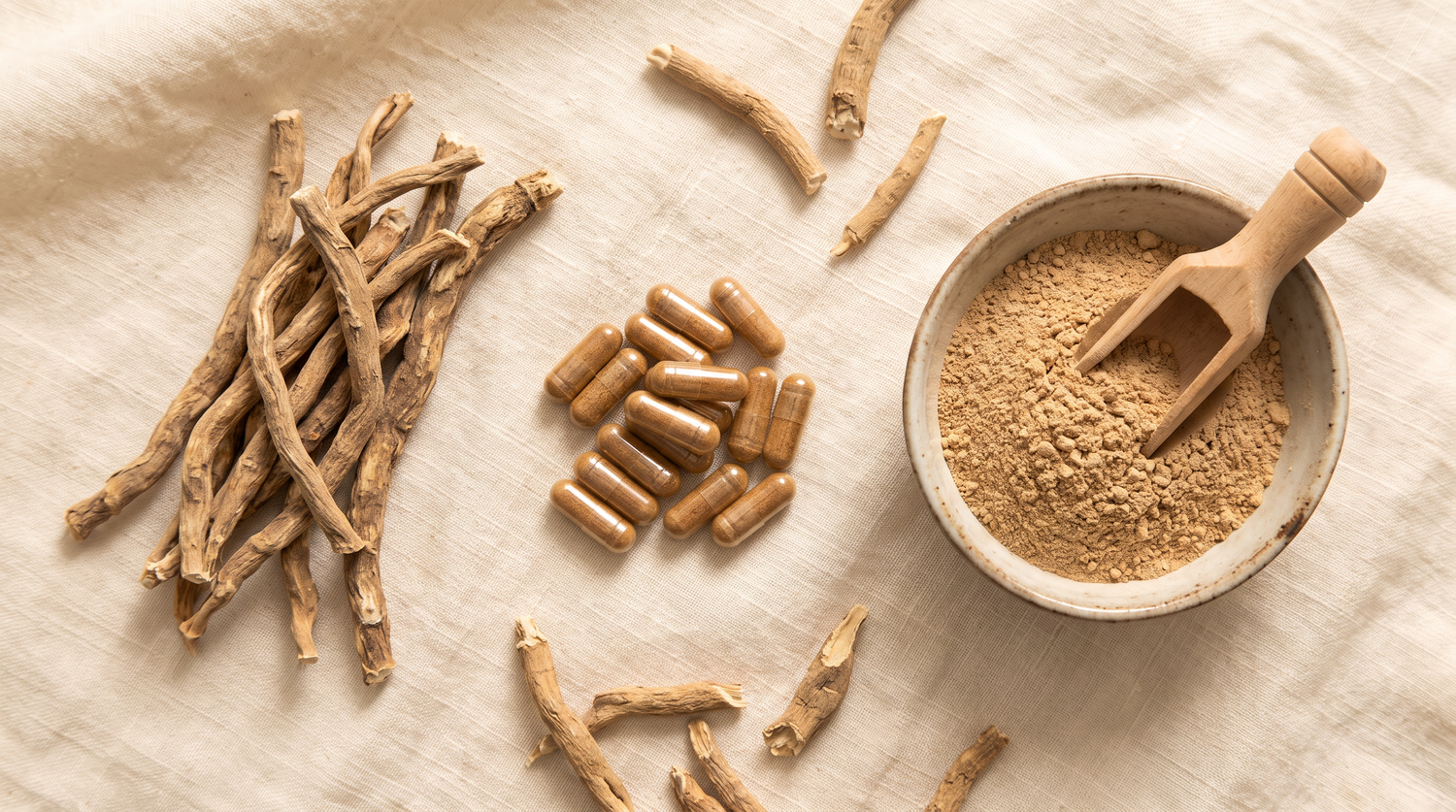
Ashwagandha is a small woody shrub whose root is dried and ground into a pale tan powder. It is classed as an adaptogen, a plant that helps the body hold a steadier line under stress rather than pushing it up or down. The root carries a family of compounds called withanolides, which most of the research points to as the active drivers. In its oldest form it was simply the root, cleaned, dried, and powdered.
What whole-root ashwagandha does
The clearest, most studied effect of ashwagandha is on the stress hormone cortisol. In one controlled trial, adults under chronic stress who took a concentrated root preparation for 60 days saw their serum cortisol fall by roughly 28 percent against placebo, alongside lower self-reported stress (Chandrasekhar et al., Indian Journal of Psychological Medicine, 2012). That cortisol effect is the mechanism sitting under most of what people notice: calmer evenings, steadier mood, easier sleep.
Whole-root powder carries the full spectrum of what the root contains, not only the isolated withanolides but the wider matrix of the plant, at a naturally lower concentration. That is exactly why the traditional daily amount was measured in grams of powder rather than milligrams of extract. It works with the body more like a food than a spike, which is what many people are actually looking for from a daily herb.
Whole root versus extract: what actually changes
The honest difference comes down to concentration and consistency. A standardised extract, such as Ancient Nutra's Ashwagandha Extract, concentrates the withanolides so a single small capsule matches the dose used in clinical trials. If you are chasing a specific, measured outcome for stress or sleep, that lab-consistent dose is the cleaner tool.
A whole-root capsule takes the other road. It gives you the traditional ground root in a form you can actually keep taking, without a spoon, a scale, or the bitter taste of loose churna. You trade some concentration for the full-spectrum, food-like character of the original herb. Neither is a downgrade. They are two formats built for two slightly different intentions.
Who whole-root capsules are for
- Daily-stress users who want a gentle, steady adaptogen rather than a high-concentration hit for one acute problem.
- Traditional-form seekers who specifically want the whole root, the way it has been taken for generations, not an isolate.
- People starting out who want an easy, no-measuring entry point into ashwagandha before deciding whether they need a concentrated extract.
- Evening-routine builders who take it to wind down and value a milder, cumulative effect.
Who does not need it: if you are targeting a single clinical endpoint at a trial-matched dose, or you want the smallest possible capsule, the standardised extract is the more direct answer. There is no prize for taking the whole root when a measured dose is what the job calls for.
How to actually take ashwagandha capsules
For a whole-root capsule, a common daily range lands around 1,000 to 2,000mg of root powder, usually split or taken as directed on the pack. Many people take it in the evening because the calmer, cortisol-lowering effect suits winding down, though it is not sedating and can be taken earlier. It is generally taken with food, as a bounded eight to twelve week course, then a break, rather than continued indefinitely. In the first four weeks, expect the change to be quiet: easier evenings and steadier sleep usually show up before anything dramatic.
Look for
Whole-root powder, not leaf, and a clear stated amount per capsule so you know what you are taking. Ancient Nutra's Ashwagandha capsules use ground whole root, the traditional part of the plant, in a fixed daily dose.
Where ashwagandha comes from
Ashwagandha is one of the central herbs of Ayurveda, where the root was ground into a powder and taken to build steadiness and resilience over time. That long track record is precisely why the whole-root form still matters: the format most of the tradition rests on is the ground root itself, not a modern isolate. The science has since caught up to explain the cortisol effect, but the root was doing the work first.
What to stack with ashwagandha
If your reason for taking ashwagandha is a calmer, more focused morning, it pairs naturally with coffee. Ancient Nutra's Power Coffee + Ashwagandha builds that pairing in, taking the edge off caffeine so you get the lift without the jitter. This stack is for people who want calm energy during the day, not for everyone. If your goal is purely evening wind-down, a plain whole-root capsule on its own does the job.
How long ashwagandha takes to work
Ashwagandha is a slow burn, not a switch. Most of the controlled studies run for eight to twelve weeks, and that is a fair yardstick for your own body too. Sleep and evening calm tend to move first, often inside the first few weeks. The broader sense of steadiness under stress builds later. Give it a bounded eight to twelve week course, then a break, before deciding whether it earns a repeat place in the routine, and only continue longer under a doctor's oversight.
The bottom line
The whole root is not the budget option and the extract is not the upgrade. They are two honest formats. If you want the traditional full-spectrum root as a gentle daily adaptogen, with no measuring and no bitterness, the whole-root capsule is the right format. If you want a trial-matched dose for a specific outcome, reach for the extract instead. The science does not care which bottle they come in.

Ashwagandha - 60 capsules
Whole-root ashwagandha in a fixed daily dose, the traditional form for steady, everyday calm.
Shop AshwagandhaWho should check with a doctor first: ashwagandha can interact with thyroid medication (it may raise thyroid hormone levels), sedatives (it can add to drowsiness), and immunosuppressants (it may counteract them by stimulating the immune system). Avoid it in pregnancy. If someone has a thyroid or autoimmune condition, they should check with a doctor before starting.
Sources: NIH LiverTox, Ashwagandha (NBK548536).
This article is for general information and is not medical advice. Speak with a doctor before starting ashwagandha, especially if pregnant, on thyroid medication, sedatives, or immunosuppressants, or if managing a thyroid or autoimmune condition. Last reviewed 6 August 2026.
Sources and further reading
- Chandrasekhar K, Kapoor J, Anishetty S. A prospective, randomized double-blind, placebo-controlled study of a high-concentration full-spectrum extract of ashwagandha root, Indian Journal of Psychological Medicine, 2012.
- Ashwagandha overview and safety, National Center for Complementary and Integrative Health (NIH).
- Langade D, et al. Efficacy and safety of ashwagandha root extract in insomnia and anxiety, Cureus, 2019.
Written by the Ancient Nutra Wellness Team. The team researches, sources, and tests every ingredient before it earns a place in an Ancient Nutra blend. Questions? Email info@ancientnutra.com or message Ancient Nutra on Instagram.
Medical disclaimer: This article is for educational purposes only and is not medical advice. Statements have not been evaluated by the FDA. Ancient Nutra products are not intended to diagnose, treat, cure, or prevent any disease. Speak with a qualified healthcare provider before starting any new supplement, especially if you take prescription medication or have a medical condition.