Ancient Nutra Wellness Team · 8 August 2026 · 5 min read
The 9 PM Wind-Down Ritual, Written Down Step by Step
- The ritual below runs from 9:00 PM to 10:30 PM and is built for someone who wants to be asleep by about 10:30. Shift every clock time by the same amount if a different bedtime suits better.
- The order matters more than the length. Light comes down first, body temperature next, the mind last, because each step sets up the one after it.
- Ordinary indoor room light before bed suppressed melatonin by 71.4% in a controlled study of 116 adults, which is why the lamp step sits so early in the sequence.
- Herbs are the smallest part of an evening routine, not the engine. Blue lotus belongs at the end of the list as an optional layer, not at the top as a fix.
Most evening advice arrives as a list of principles: dim the lights, avoid screens, keep a regular bedtime. All sensible, and all difficult to follow, because a principle has to be turned into a decision every single night. A written ritual removes that step. Below is a specific evening sequence with clock times attached and a plain reason behind each move, so it can be followed on a tired night without any thinking. Nothing in it is exotic. The value is in the order and in the fact that it is written down.
The ritual, step by step
9:00 PM, set the finish line
Decide the lights-out time before anything else, and use the same one every night including weekends. Everything below is timed backwards from 10:30 PM. This single decision is what turns the rest of the list from a wish into a schedule.
9:05 PM, bring the light down
Switch off overhead lights and move to one or two low lamps. Not candlelight, just the lowest level that still lets normal evening tasks happen. This is the step most people skip and the one with the clearest evidence behind it.
9:15 PM, take a warm shower
A warm shower or bath at this point in the evening is not about being clean. It is about what the body does afterwards: blood moves to the skin, heat is shed, and core temperature falls, which is the same drop that normally precedes sleep. Ten minutes is enough.
9:35 PM, put tomorrow on paper
Spend five minutes writing tomorrow's to-do list. Not a diary entry about the day that just finished, and not a vague set of intentions. A specific list of tasks, on paper, then closed. Racing thoughts at midnight are usually unfinished planning, and this is where the planning gets finished.
9:50 PM, last look at the phone
Reply to whatever genuinely needs a reply, then put the phone on charge in another room. A phone is a bright light source held close to the eyes, so this step and the lamp step are really the same step wearing different clothes.
10:00 PM, the optional calm layer
This is where a herbal step goes, if one is wanted at all. It sits second to last on purpose. An evening herb added on top of a bright room and an open laptop is being asked to do a job it was never capable of doing.
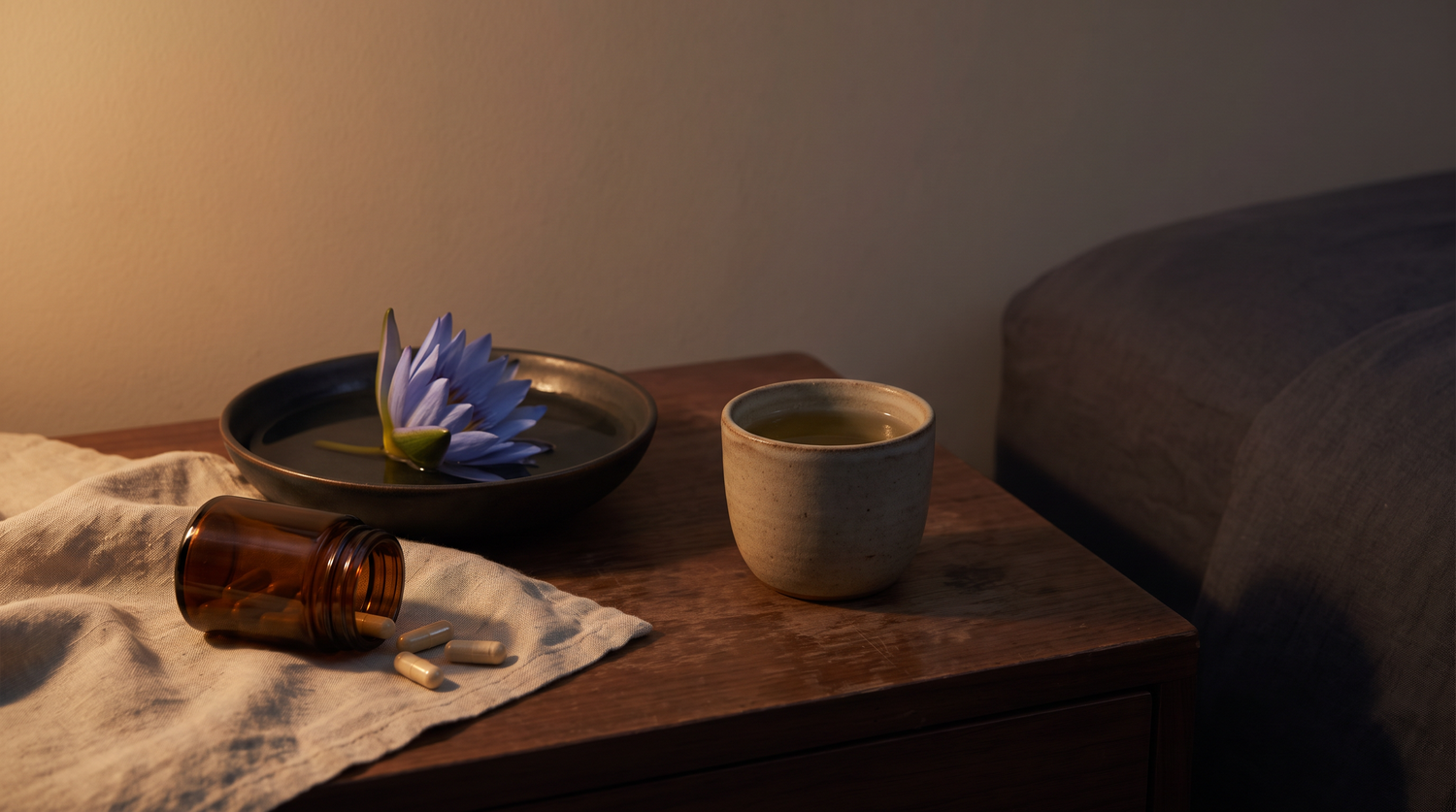
Blue lotus, known in Sri Lanka as Nil Manel, is the flower used here. It has a long traditional association with evening calm and it is the country's national flower. Tradition is not the same as evidence, and it should be said plainly: there are no controlled human trials showing that blue lotus improves sleep, so it is best treated as a calming part of the ritual rather than as something that acts on sleep itself. Ancient Nutra's Blue Lotus Capsules keep it to a measured dose rather than a homemade infusion of unknown strength.
Keep it occasional rather than nightly, and do not exceed the dose on the label. Blue lotus has mild sedative-like effects on the nervous system, so it should not be combined with alcohol or with sedative medication, and it should not be taken before driving or operating machinery. It is not for use during pregnancy or breastfeeding. Anyone who feels unusually drowsy, confused, dizzy or unwell after taking it should stop and speak to a doctor.
10:15 PM, make the room cool, dark and dull
Curtains closed, room on the cool side, nothing left glowing. Turn the clock away from the bed. Watching the minutes is its own form of stimulation.
10:30 PM, lights out at the same time
Same time tonight, same time tomorrow. Consistency is the part of the ritual that compounds, and it is the only step that cannot be replaced by any of the others.
Why the order works
Light comes first because it has the largest measured effect. In a laboratory study of 116 healthy adults, exposure to ordinary room light before bedtime suppressed melatonin by 71.4% compared with dim light, and shortened the window in which melatonin was produced by roughly 90 minutes (Gooley et al., Journal of Clinical Endocrinology and Metabolism, 2011). That was ordinary household lighting, not a stadium.
Temperature comes second because it needs a head start. A systematic review of 13 pooled studies found that water-based warming at 40 to 42.5 degrees Celsius, scheduled one to two hours before bed and lasting as little as ten minutes, significantly shortened the time taken to fall asleep and improved sleep quality (Haghayegh et al., Sleep Medicine Reviews, 2019). A shower at 10:25 PM is too late to help. One at 9:15 PM lands exactly in the window.
The list comes third because it is the cheapest step with a measurable result. In a laboratory experiment with overnight sleep monitoring, 57 adults who spent five minutes writing tomorrow's to-do list fell asleep in 15.82 minutes on average, against 25.09 minutes for those who wrote about tasks already completed (Scullin et al., Journal of Experimental Psychology: General, 2018). The more specific the list, the faster they fell asleep.
When to run it, and when not to
Run it every night, including weekends, because regularity is the point. In a study of nearly 61,000 adults wearing wrist monitors, how consistent sleep timing was predicted all-cause mortality more strongly than how long people slept, although this is an observed association rather than proof that one causes the other (Windred et al., SLEEP, 2024). A sequence run five nights out of seven still moves the average.
The exception is a genuinely late night. Do not compress all eight steps into fifteen minutes and treat that as a win. On those evenings, keep only the last two: dark room, lights out near the usual time. That is the version worth protecting.
Look for
If a blue lotus product is being considered, look for the botanical name on the label, Nymphaea nouchali var. caerulea, a stated dose per capsule rather than a vague blend weight, and a clear interaction caution on the pack. Blue Lotus Capsules from Ancient Nutra carry the dosing and the alcohol and sedative caution on the product page itself, which is the minimum a calming botanical should tell a buyer.
If there is no blue lotus in the house
Nothing in the sequence depends on it. The 10:00 PM slot can hold a plain cup of chamomile, a warm milk drink, or nothing at all, and the other seven steps do not change. That is worth stating clearly, because an evening routine that collapses without a specific product was never a routine. For a shorter version of the same idea, there is a five-minute evening sleep routine, and for the reasoning behind each layer rather than the timings, there is an evening calm routine explained plainly.
The bottom line
Dim the lights at 9:05, shower at 9:15, write the list at 9:35, phone away at 9:50, room dark at 10:15, lights out at 10:30. Print it, stick it somewhere visible, and run it for seven nights before judging it. The herbal step is the one part that is genuinely optional, and it belongs at the end of the list rather than at the start of the thinking.

Blue Lotus Capsules
A measured capsule dose of Nil Manel flower for the optional calm layer of an evening ritual. Not for use with alcohol or sedatives.
Shop Blue Lotus CapsulesSources and further reading
- Gooley JJ et al. (2011), Exposure to room light before bedtime suppresses melatonin onset and shortens melatonin duration in humans, Journal of Clinical Endocrinology and Metabolism.
- Haghayegh S et al. (2019), Before-bedtime passive body heating by warm shower or bath to improve sleep, Sleep Medicine Reviews.
- Scullin MK et al. (2018), The effects of bedtime writing on difficulty falling asleep, Journal of Experimental Psychology: General.
- Windred DP et al. (2024), Sleep regularity is a stronger predictor of mortality risk than sleep duration, SLEEP.
Written by the Ancient Nutra Wellness Team. The team researches, sources, and tests every ingredient before it earns a place in an Ancient Nutra blend. Questions? Email info@ancientnutra.com or message Ancient Nutra on Instagram.
Medical disclaimer: This article is for educational purposes only and is not medical advice. Statements have not been evaluated by the FDA. Ancient Nutra products are not intended to diagnose, treat, cure, or prevent any disease. Speak with a qualified healthcare provider before starting any new supplement, especially if you take prescription medication or have a medical condition.