By the Ancient Nutra Wellness Team · 24 June 2026 · Updated 6 August 2026 · 6 min read
- Spirulina is roughly 60 to 70% protein by dry weight, and it carries all nine essential amino acids, so it counts as a complete protein.
- Its cell wall is soft (peptidoglycan, not cellulose), which is why protein digestibility runs around 83 to 90% with no special processing.
- Chlorella, its freshwater cousin, has a tough cellulose wall that has to be cracked first. Spirulina does not, so it tends to sit easier for people new to greens.
- Start at 1 to 3g a day with food and build slowly. Please read the safety note below before starting.
Most green powders ask a lot of your gut. They are genuinely full of nutrients, but a good share of that goodness stays locked behind a fibrous cell wall your body never fully opens. Spirulina is the quiet exception. It is a cyanobacterium, often called blue-green algae, and it is wrapped in a soft cell wall rather than a tough fibrous one. That single detail is the reason it is one of the few plant-style proteins your body absorbs almost whole.
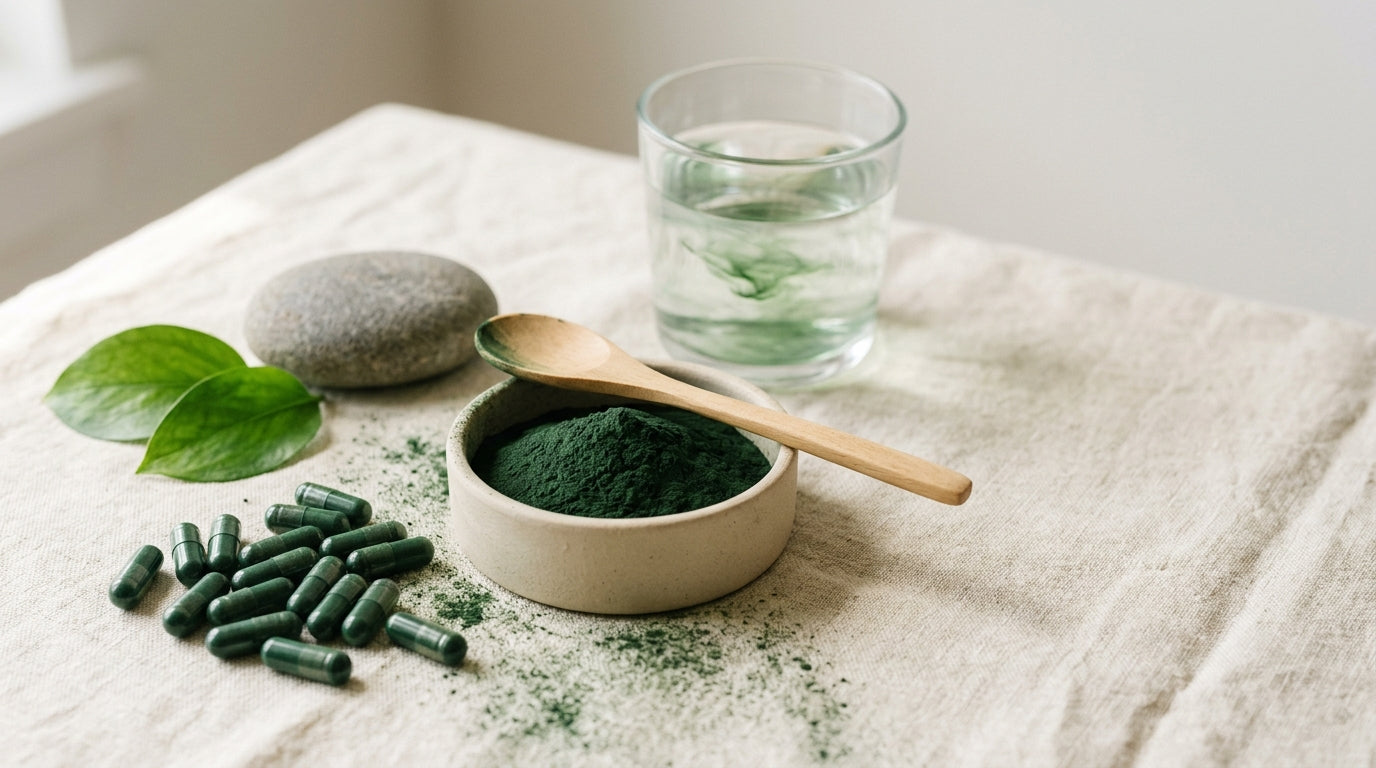
Spirulina is a spiral-shaped cyanobacterium that grows in warm, alkaline lakes. People have harvested it as food for centuries, from the shores of Lake Texcoco in Mexico to Lake Chad in Africa. Dried into a deep green powder or pressed into capsules, it is one of the most protein-dense foods on earth, and unusually easy to digest for something so nutrient-packed.
What spirulina actually does
By dry weight, spirulina runs about 60 to 70% protein. Gram for gram that is higher than beef, eggs, or soy. More importantly, it is a complete protein: all nine essential amino acids, the ones your body cannot make on its own, are present (National Library of Medicine).
Here is the part most greens cannot claim. Spirulina has no tough cellulose cell wall. Its envelope is made of soft peptidoglycan, the same fragile material found in simple bacteria, so digestive enzymes reach the protein inside without a fight. That is why its protein digestibility lands around 83 to 90%, and why the Food and Agriculture Organization has described it as a highly digestible protein product.
Chlorella is the opposite. Its wall is built from cellulose and has to be mechanically cracked before your body can use much of it. In a side-by-side lab test, spirulina broke down more readily than untreated chlorella (National Library of Medicine). That is the practical meaning of a green protein you can actually digest: less of it passes through unused, and more of what you paid for ends up doing something.
What spirulina has not been shown to do is treat any medical condition. The protein and micronutrient figures above are nutritional facts; they are not a health claim, and we are not making one.
Who should consider spirulina
Spirulina earns its place for a few specific people more than others:
- Anyone eating less meat. It is an easy way to add complete protein and iron without making tofu the centre of every dinner.
- People with sensitive digestion. If wheatgrass or raw chlorella leaves you bloated, spirulina's soft wall is usually gentler on the stomach.
- Busy, low-appetite mornings. A teaspoon in water or a smoothie quietly covers a nutrient gap on days you barely eat breakfast.
- Active people in a hard training block. The amino acid profile supports muscle repair, and the iron helps if long sessions are leaving you flat.
Now the honest part. If you already eat enough protein, plenty of vegetables, and your energy is steady through the day, spirulina is a nice-to-have, not a fix. It does not replace a meal, and it will not undo a diet that is mostly processed food. Supplements move the needle once the foundation is in place, not before.
How to actually take spirulina
Start low. 1 to 3g a day, roughly half a teaspoon of powder or a few capsules, is plenty to begin with. Take it with food, ideally alongside something containing vitamin C, since that helps your body use the iron. Build the dose up slowly over two weeks rather than starting at a heaped spoon on day one.
Powder is cheaper per gram but tastes strongly of the lake it came from. Capsules skip the flavour entirely, which is why most people who stay consistent end up there. One thing matters more than form: quality. Spirulina grown in unregulated open water can pick up heavy metals or microcystins, so buy a brand that tests for both. In the first four weeks, most people notice steadier energy and appetite before anything dramatic.
Rare cases of liver injury have been reported with spirulina supplements. The US National Institutes of Health LiverTox database lists it as a possible rare cause of clinically apparent liver injury, with recovery reported after stopping (NIH LiverTox). Stop taking it and seek medical advice if you notice yellowing of the eyes or skin, dark urine, or unusual tiredness.
Product purity matters here as much as dose: spirulina grown in unregulated open water can carry heavy metals or microcystins. People with autoimmune conditions or phenylketonuria (PKU) should be especially cautious, and anyone taking medication or managing a health condition should speak to a doctor first.
Clean, lab-tested spirulina (Arthrospira platensis), screened for heavy metals and microcystins, at 1 to 3g per day.
Ancient Nutra's Spirulina (60 capsules) is tested for purity, so you skip the taste and the guesswork.
Where spirulina comes from
Long before it landed in smoothie bowls, spirulina was simply food. The Aztecs scooped it from Lake Texcoco and dried it into cakes they called tecuitlatl. Around Lake Chad, the Kanembu people still harvest it into a sun-dried patty called dihe and cook it into a sauce poured over millet. Modern interest only began when researchers measured what those communities had relied on for generations and found a near-complete food in a single ingredient. Tradition opened the door here, and the lab work walked through it to the same conclusion.
What to stack spirulina with
Spirulina does most of its work on its own, but two pairings make sense. For an everyday greens habit, stack it with Ancient Nutra's Moringa Powder. Moringa brings fibre, calcium, and a milder grassy taste that softens spirulina's intensity.
For a greens routine with more variety, its freshwater cousin Ancient Nutra's Chlorella is the classic partner, bringing a different micronutrient profile while spirulina carries the protein load. This combined greens stack suits people building a deliberate daily nutrition routine, not everyone. One clean ingredient taken consistently still beats five taken now and then.
How long spirulina takes to work
Give it time. In the first two to four weeks, the common change is steadier energy and appetite, with less of the mid-afternoon crash. Around six to eight weeks, if your iron was running low, that is usually where the difference in stamina starts to show. Twelve weeks is a fair read on whether it belongs in your routine. We would not suggest treating any supplement as an open-ended daily habit without reviewing it: check in with yourself, and with your doctor, rather than simply continuing indefinitely.
When the team first added spirulina to the catalog, the feedback that came back was not about workouts or protein numbers. It was about digestion. The most common note was a version of the same line: this is the first green that does not leave me bloated. That is the soft cell wall doing its quiet work.
One green, taken consistently
You do not need a shelf of green powders. You need one your body actually absorbs, taken regularly enough to matter. Spirulina is one of the few that clears that bar on digestibility alone. Ancient Nutra's Spirulina (60 capsules) is lab-tested and in capsule form, which keeps the dose simple and the taste out of it. Powder or capsule, branded or not, the science does not care which bottle it comes in. It cares that it is clean, and that you have read the safety note above.

Lab-tested complete-protein greens in a soft-walled form your body absorbs almost whole.
ShopSources
- Trends and Technological Advancements in the Possible Food Applications of Spirulina and Their Health Benefits: A Review. National Library of Medicine (PMC9458102).
- Investigation of in vitro digestibility of dietary microalga Chlorella vulgaris and cyanobacterium Spirulina platensis as a nutritional supplement. National Library of Medicine (PMC5489447).
- Spirulina. NIH LiverTox, National Institute of Diabetes and Digestive and Kidney Diseases.
- Bioactive Compounds from Spirulina spp.: Nutritional Value, Extraction, and Application in the Food Industry. Separations, 2024 (further reading).
These statements have not been evaluated by the Food and Drug Administration. This product is not intended to diagnose, treat, cure, or prevent any disease. This article is general education, not medical advice. Talk to a qualified healthcare provider before starting any new supplement, especially if you are pregnant, nursing, taking medication, or managing a health condition. People with autoimmune conditions or phenylketonuria (PKU) should be especially cautious with spirulina.
Written by the Ancient Nutra Wellness Team. The team researches, sources, and tests every ingredient before it earns a place in an Ancient Nutra blend. Questions? Email info@ancientnutra.com or message Ancient Nutra on Instagram.