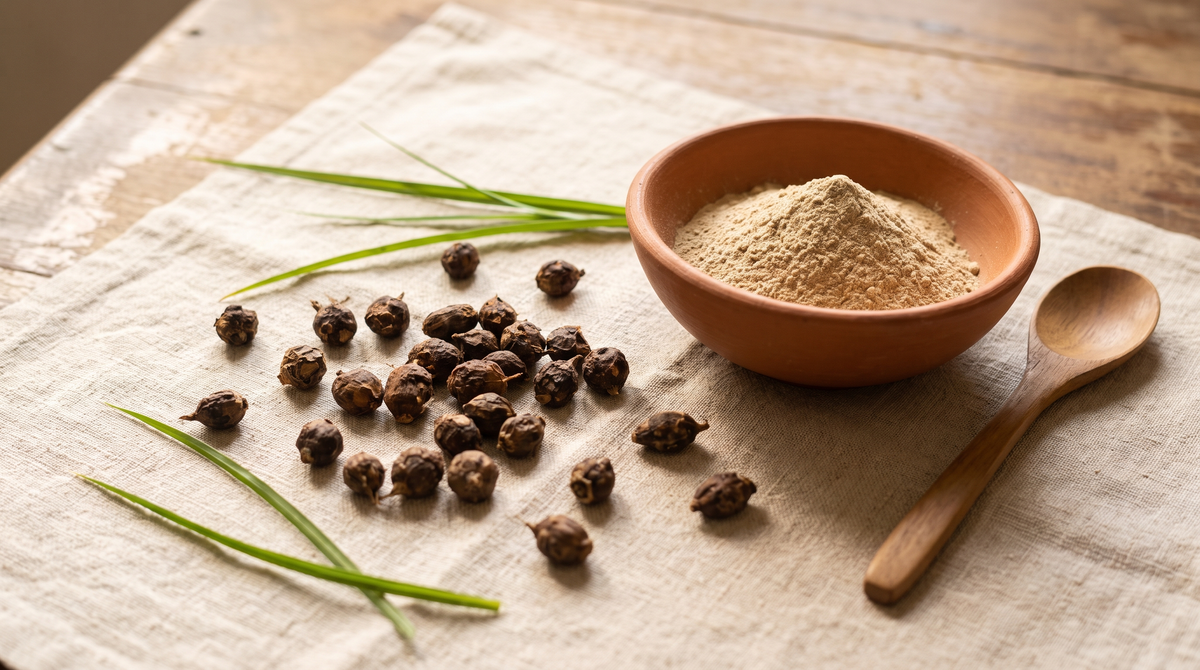
- Kalanduru is nut grass (Cyperus rotundus), a sedge whose dried underground tuber has long been used for digestion in Ayurveda, where it is called Musta.
- Most of the research is lab and animal work. Human trials exist, but none we found tests nut grass on its own for digestion.
- It has no entry in the NIH LiverTox database, so its long-term safety is simply unmeasured. Short, label-directed use and a conversation with your clinician are the sensible default.
By the Ancient Nutra Editorial Team
If you grew up in Sri Lanka, you may know nut grass as the stubborn weed that comes back after every weeding. Kalanduru is that same plant, and its small dark tubers have a second life in traditional medicine. That makes for a good story. It does not, on its own, make for good evidence, so this piece keeps the two apart.
What Kalanduru actually is
Kalanduru is the Sinhala name for Cyperus rotundus, called nut grass in English and Musta in Ayurvedic texts. It is a sedge rather than a true grass. The part used is the dried tuber, which botanists also call the rhizome. A 2022 systematic review in Frontiers in Pharmacology describes the dried rhizome as the traditional medicinal material, and notes that in Chinese medicine it is used for what that tradition calls stagnation of the spleen and stomach.
So the digestive reputation is not a one-country story. Separate traditions landed on the same root for the same general area of the body. That is interesting. It is also still tradition, and the next section is about what has been tested.
What the research shows, and where it stops
A PubMed search for Cyperus rotundus returns about 418 papers. Narrow that to clinical trials and only a handful remain. The honest summary of those is below.
- Digestion: one small 2013 trial in Iraq gave 40 people with irritable bowel syndrome either a standard medicine or a capsule of three powdered herbs (a mint, nut grass and ginger) for 8 weeks. Symptoms improved in the herb group. Because three herbs were combined, it cannot tell us what nut grass did by itself.
- Weight: a 2025 trial of 96 adults with obesity gave a standardized nut grass extract with piperine for 90 days alongside diet and exercise advice. It reported lower body weight and waist size versus placebo. The extract was a branded, concentrated preparation and the authors work for the company that makes it, so it says little about a plain root powder.
- Skin: several of the other trials test the essential oil applied to skin, which is unrelated to eating it.
Everything else is cell and animal work. That is a reasonable reason to be curious and not a reason to expect results. We found no human trial of nut grass alone for bloating or indigestion.
Who might reasonably try it
- Adults who like traditional botanicals and already look after the basics: regular meals, fibre, water, sleep.
- People curious about a Sinhala and Ayurvedic staple who accept that the evidence is early.
It is not a fit for anyone hoping for a proven fix for a digestive condition. Ongoing pain, blood in the stool, unexplained weight loss or symptoms that keep returning need a doctor, not a capsule. Pregnancy, breastfeeding and prescription medicines are also reasons to ask first, because we found no human safety data for those situations.
How to take it sensibly
Follow the directions on the label and take it with water or a meal. We do not give a dose or a timeline beyond that, because no trial has tested this capsule. The two trials above ran 8 weeks and 90 days, with different preparations, so neither is a promise about what a capsule will do for you. If you try it, note how you feel after a few weeks of ordinary use, and stop if you are not seeing a reason to continue.
A label that names the plant as Cyperus rotundus and the part used (tuber or rhizome), so you know exactly what you are taking. Ancient Nutra's Nut Grass Capsules follow that naming and are made in Sri Lanka in certified facilities.
A safety note worth reading
The US National Institutes of Health keeps LiverTox, a public database of how herbs and medicines affect the liver. Nut grass has no entry there, so we cannot place it on its scale. That is different from being proven safe. Lab studies on the liver point in both directions, and none of it replaces human data. If you have liver or kidney disease, take regular medication, or are pregnant, talk to your healthcare provider first. Stop and seek advice if you notice yellowing of the skin or eyes, dark urine, persistent nausea or unusual tiredness.
What to pair it with
For digestion, the dependable habits are unglamorous: eating slowly, a short walk after meals, and enough fibre. Among the plants with more human evidence, ginger is the best known for settling the stomach, and Ancient Nutra's Ginger capsules are one option if you prefer a capsule. This is a general pairing, not a protocol, and it is not for everyone.
The bottom line
Kalanduru is a traditional digestive root with real heritage and early research. It is a reasonable thing to be curious about and a poor thing to expect miracles from. Use it with open eyes, keep the basics in order, and ask a clinician when anything is unusual.

Nut Grass Capsules - 60 capsules
Kalanduru (Cyperus rotundus) in vegetarian capsules, a traditional digestive herb.
Shop Nut Grass CapsulesSources and further reading
- Systematic review of ethnomedicine, phytochemistry, and pharmacology of Cyperi Rhizoma, Frontiers in Pharmacology, 2022.
- Sahib AS, herbal combination for irritable bowel syndrome, Journal of Ethnopharmacology, 2013 (PMID 23707209).
- Majeed A et al., Cyperus rotundus extract and weight management, Medicine (Baltimore), 2025 (PMID 41305713).
- NIH, LiverTox: clinical and research information on drug-induced liver injury.
Written by the Ancient Nutra Wellness Team. The team researches, sources, and tests every ingredient before it earns a place in an Ancient Nutra blend. Questions? Email info@ancientnutra.com or message Ancient Nutra on Instagram.
Medical disclaimer: This article is for educational purposes only and is not medical advice. Statements have not been evaluated by the FDA. Ancient Nutra products are not intended to diagnose, treat, cure, or prevent any disease. Speak with a qualified healthcare provider before starting any new supplement, especially if you take prescription medication or have a medical condition.