Ancient Nutra Wellness Team · 17 August 2026 · 6 min read
5 Mistakes That Keep Digestion Stuck in Crisis Mode
- Maintenance and rescue are two different jobs. Most people only ever do the second one, then wonder why nothing changes.
- In one 2026 hospital study, 90.6% of people using stimulant laxatives regularly screened positive for dependence, against 5.1% of non-users.
- Judge a daily digestive herb over four to six weeks. That is the entire span of the published human research on Triphala, so anyone promising you a 90 day protocol is making it up.
Most people do not have a digestion routine. They have a digestion emergency plan. Nothing happens for weeks, then a bad Sunday arrives and out comes the strongest thing in the cupboard. It works, briefly, and the whole cycle resets. This is not a discipline problem. It is a category error: maintenance and rescue are two different jobs, and the tool for one is usually the wrong tool for the other. More than 40% of adults worldwide report a functional gut complaint, according to the Rome Foundation Global Study of 73,076 people across 33 countries. Here are the five mistakes that keep it that way.
Mistake 1. Waiting for a bad week before doing anything
The routine only starts once things have already gone wrong. Two uncomfortable days, then a scramble.
The problem is that a gut in a bad week is the worst possible place to start measuring anything. Everything you try lands on top of a system that is already inflamed, already sluggish, already stressed. So the fast, harsh options look effective and the slow, gentle ones look useless, when really you have just rigged the test. Digestion responds to what you do most days, not to what you do on your worst one.
The fix: pick your slowest, most boring week of the month and start then. Nothing to rescue, nothing to prove. One thing, same time daily, while your gut is behaving normally. That is the only condition under which you can actually tell whether it is doing something.
Mistake 2. Letting the rescue option become the routine
A stimulant laxative gets used once for a genuinely stuck week, then twice, then most weeks.
This is the mistake with real evidence behind it, and it is worse than most people assume. A 2026 study across three Japanese hospitals compared 280 people with chronic constipation. Among those using stimulant laxatives regularly, three times a week or more for over a year, 90.6% screened positive on a dependence questionnaire. Among occasional rescue users it was 58.8%. Among non-users, 5.1%. The regular users had also been constipated for longer, roughly 29 years against 18.
The fix: keep the strong stuff for actual crises. The US National Institute of Diabetes and Digestive and Kidney Diseases is direct about this: stimulants are for severe constipation or when other treatments have not worked, and if you cannot pass a stool without one, that is a conversation to have with a doctor rather than a habit to keep feeding. Their note is that the colon usually does start moving normally again once the laxative stops.
Mistake 3. Judging a maintenance herb at crisis speed
Three days in, nothing dramatic has happened, so it goes in the drawer.
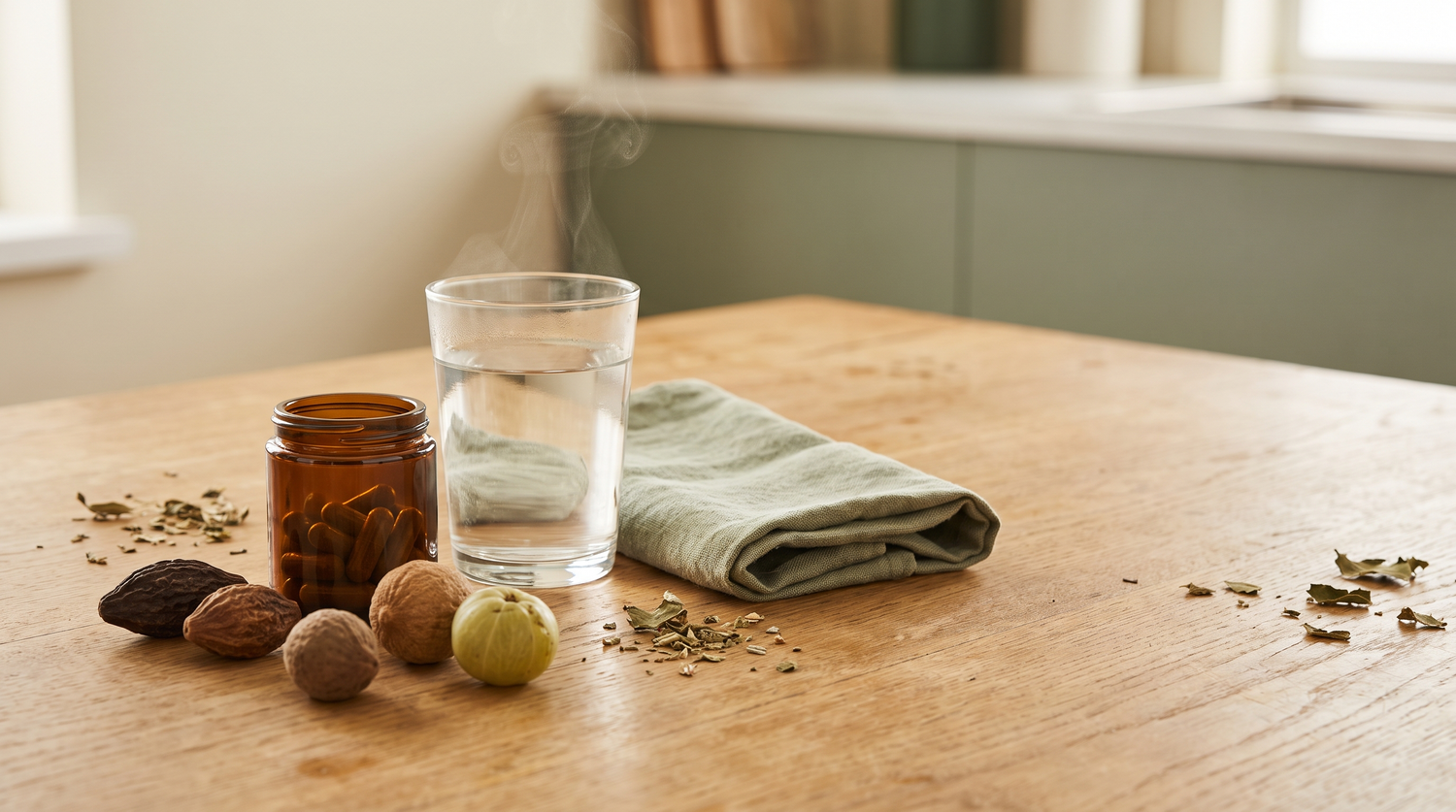
Daily digestive herbs are not built to produce an event. Triphala is the clearest example: three dried fruits ground together in equal parts, traditionally haritaki (Terminalia chebula), bibhitaki (Terminalia bellirica) and amla (Phyllanthus emblica, still often listed under its old name Emblica officinalis). Two of the three are close relatives and the third belongs to an entirely different plant family, which is part of why the combination behaves differently from any one of them alone. All three grow across South and Southeast Asia, including Sri Lanka. Ayurvedic practice has used the blend as a daily tonic, not a purge, for a very long time.
The fix: give it four to six weeks and judge it on frequency and comfort, not on drama. That window is not a marketing number. It is the honest edge of the published human research: the best-quality safety study gave 20 healthy adults 2,500 mg of Triphala daily for four weeks and reported no serious adverse effects, and the longest human study on record ran 45 days. Nobody has published a longer one.
Look for
Equal parts of all three fruits, 1:1:1, made from the dried fruit rather than a single isolated extract. Ancient Nutra's Triphala follows the classical three-fruit ratio. If a label will not tell you the ratio, that is the answer.
Mistake 4. Stopping the moment things feel normal
Two good weeks arrive, the problem feels solved, and the routine quietly ends.
Feeling normal is the result of the routine, not a sign that you have outgrown it. This is the same logic error as stopping a stretching habit because your back finally stopped hurting. Digestion is a maintained state for most adults, particularly if the underlying causes have not changed: the same job, the same sleep, the same rice and curry at the same late hour. Remove the input and the old pattern usually walks back in within a few weeks, at which point it looks like the herb "stopped working."
The fix: decide in advance what the end of your four to six week window looks like. Either you keep going because it is clearly helping, or you stop deliberately and watch what happens over the next fortnight. Both are useful. Drifting out of the habit without noticing tells you nothing.
Mistake 5. Changing five things at once during a bad week
The bad week hits and everything changes on the same day: new herb, no dairy, more water, earlier dinner, a probiotic.
If it works, you have no idea which part did it, so you carry all five forever. If it does not work, you have no idea which part failed, so you abandon all five including the one that was helping. Stacking is fine, and there are sensible ways to combine herbs without them cancelling each other out. Stacking blind during your worst week is not one of them.
The fix: one change at a time, held for the full window. Boring, and it is the only version of this that produces an answer you can reuse next year.
How to course-correct in a week
- Day 1. Pick one thing. If digestion is generally sluggish rather than acutely painful, a daily three-fruit blend is a reasonable place to start.
- Day 1 to 2. Fix the time, not the intention. Most people do best with Triphala in the evening, well after the last meal, with warm water.
- Day 3 to 7. Change nothing else. No new supplements, no new elimination diet running alongside it.
- Day 7. Write down two numbers: bowel movements this week, and how many days felt comfortable. That is your baseline.
- Then wait. Re-read those two numbers at week four, and again at week six if you get there.
The expected outcome at day seven is nothing dramatic. That is the point of the exercise. What you have at the end of week one is a clean baseline, which is the thing almost nobody has when they decide something did or did not work.
The bottom line
The two mistakes that cost the most are waiting for a bad week before starting anything, and letting the rescue option quietly become the routine. Fix those two and the other three get easier, because you are finally testing on a normal gut instead of a distressed one. Worth saying plainly: Triphala has never been assessed by the NIH LiverTox database, which means it has not been evaluated rather than that it has been cleared, and the published human record on it is small. Anyone on regular medication, pregnant, or breastfeeding should check with a doctor first. For a closer look at what each of the three fruits contributes, this breakdown of the blend goes deeper.

Triphala, 60 capsules
The classical 1:1:1 three-fruit blend, made for daily maintenance rather than rescue.
Shop TriphalaSources and further reading
- Sperber AD, et al. Worldwide Prevalence and Burden of Functional Gastrointestinal Disorders, Results of Rome Foundation Global Study, Gastroenterology, 2021.
- Ishihara Y, et al. Dependence-related screening positivity among regular stimulant-laxative users with chronic constipation, Journal of Gastroenterology, 2026.
- Treatment for Constipation, National Institute of Diabetes and Digestive and Kidney Diseases.
- Phetkate P, et al. Study of the safety of oral Triphala aqueous extract on healthy volunteers, Journal of Integrative Medicine, 2020.
- Tarasiuk A, et al. Triphala: current applications and new perspectives on the treatment of functional gastrointestinal disorders, Chinese Medicine, 2018.
Written by the Ancient Nutra Wellness Team. The team researches, sources, and tests every ingredient before it earns a place in an Ancient Nutra blend. Questions? Email info@ancientnutra.com or message Ancient Nutra on Instagram.
Medical disclaimer: This article is for educational purposes only and is not medical advice. Statements have not been evaluated by the FDA. Ancient Nutra products are not intended to diagnose, treat, cure, or prevent any disease. Speak with a qualified healthcare provider before starting any new supplement, especially if you take prescription medication or have a medical condition.